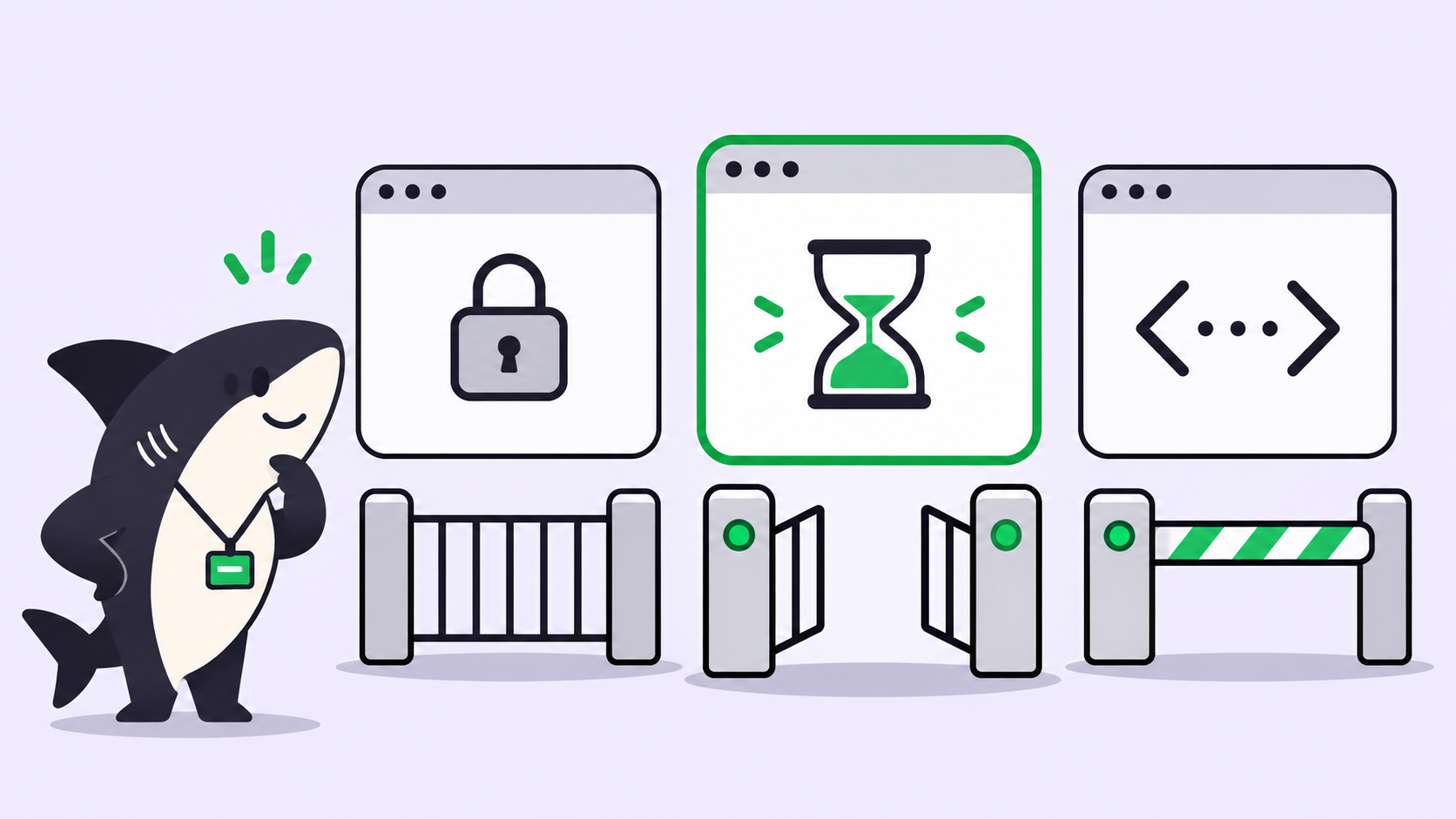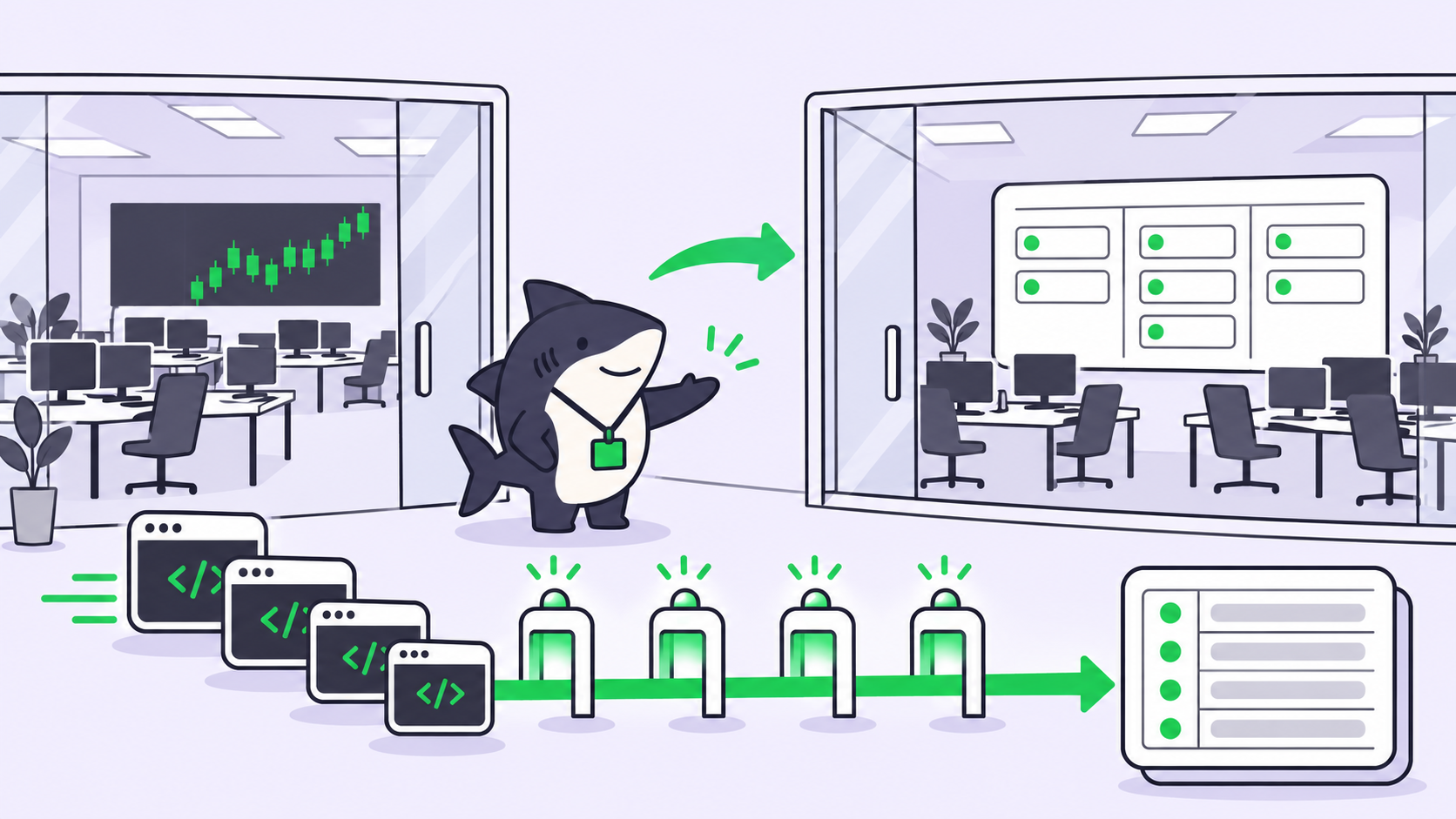
Conductor alternatives come up in two situations that look nothing alike. The first: your team liked Conductor, then someone joined on Windows or Linux, and the app’s own docs say it isn’t available there yet. The second: the setup works on every laptop, but the work outgrew laptops, and now you need agents on a server, a plan a manager can read, and a review trail that survives the week.
TL;DR
Conductor runs parallel Claude Code, Codex, and Cursor agents in isolated workspaces on macOS. If you need Windows or Linux coverage, team-level planning, or execution on machines that aren’t laptops, six credible alternatives exist:
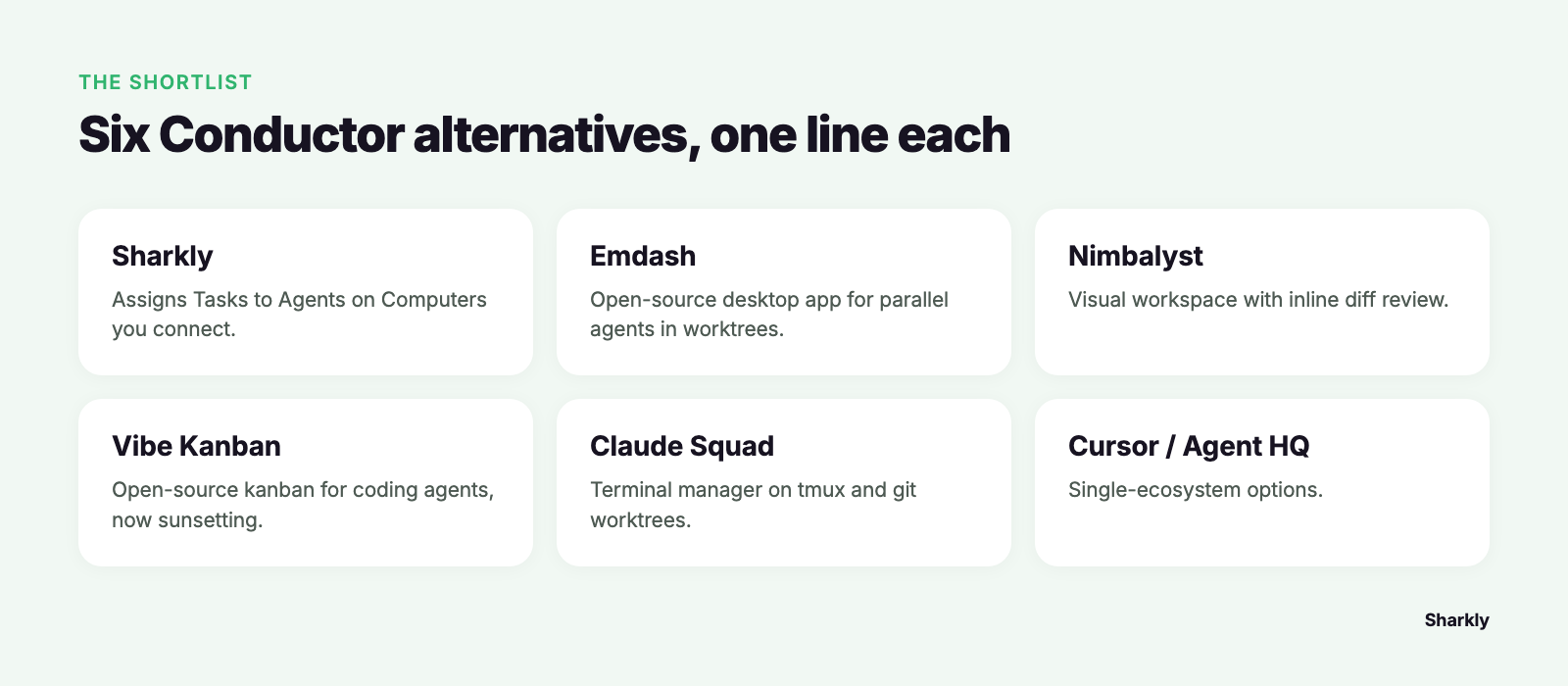
- Sharkly: assigns Tasks to Agents and runs them on Computers you connect, on macOS, Linux, and Windows.
- Emdash: open-source desktop app for parallel agents in git worktrees, all three platforms.
- Nimbalyst: visual workspace for Codex and Claude Code with inline diff review, desktop and iOS.
- Vibe Kanban: the open-source kanban for coding agents, now sunsetting.
- Claude Squad: terminal manager built on tmux and git worktrees, macOS and Linux.
- Cursor background agents or GitHub Agent HQ: single-ecosystem options.
Pick a desktop app when you want Conductor’s shape on more platforms, a terminal tool when you want no app at all, and Sharkly when planning, execution, and review belong in one shared record.
Why teams go looking for a Conductor alternative
Start with what Conductor gets right. Its pitch is one line: “Run parallel coding agents on your Mac.” Each agent works in an isolated workspace, you watch progress side by side, and you review diffs before anything merges. Paid tiers add cloud workspace hours, an API, live collaboration, and enterprise identity controls. We compared it in depth in Sharkly vs. Conductor; the honest summary is that it is a polished product that earned its reputation.
Three limits send people searching, and each points to a different replacement.
Platform coverage. Conductor’s installation docs state: “Conductor is not available for Windows or Linux yet.” For an all-Mac team that costs nothing. For a team with one Windows developer, it decides the question before any feature comparison begins.
The execution host. Workspaces run where the app runs, plus hosted hours on paid tiers. Work needing a VPN route, a seeded database, or a box that stays on overnight belongs on a different host.
The unit of work. A workspace is a session: this agent, this branch, this diff. It carries no priority, sprint membership, or record of what a reviewer decided three weeks ago. Teams that need those keep a second system, and the two drift.
Notice what is absent: parallelism itself. Every tool below isolates concurrent runs well, most with git worktrees. If your evaluation is “can it run five agents at once,” all seven answers look the same. Evaluate on platforms, hosts, and where the plan lives.
1. Sharkly: assign agent work like it’s teamwork
The boundary comes first: Sharkly is not a replacement for Claude Code, Codex, or other execution tools. It adds the shared task, Computer, context, control, and review layer around them. Conductor is an app you open; Sharkly is a work system your team signs into.
For Windows and Linux users: the Sharkly CLI and local service install on macOS, Linux, and Windows, and a Computer can be a laptop, a remote server, or a container. For teams: each repository-backed run still prepares a fresh worktree, so Conductor’s parallel-safety carries over, but the run now hangs off a Task carrying the goal, status, priority, assigned Agent, trace, and discussion. A Crew coordinates several Agents under one leader when work benefits from roles.
Model usage continues through the subscriptions or API keys configured in the tools you connect.
Pick Sharkly when execution has to leave the laptop, the team spans platforms, or planning and execution belong in one record. Skip it when you’re one developer on one Mac with a tracker you like.
2. Emdash: the open-source desktop closest to Conductor’s shape
If your requirement is “Conductor, but installable on my operating system,” Emdash is the most direct answer here. It is an open-source desktop app (Apache-2.0, around 5.6k stars) running multiple agents in parallel, each task in its own git worktree.
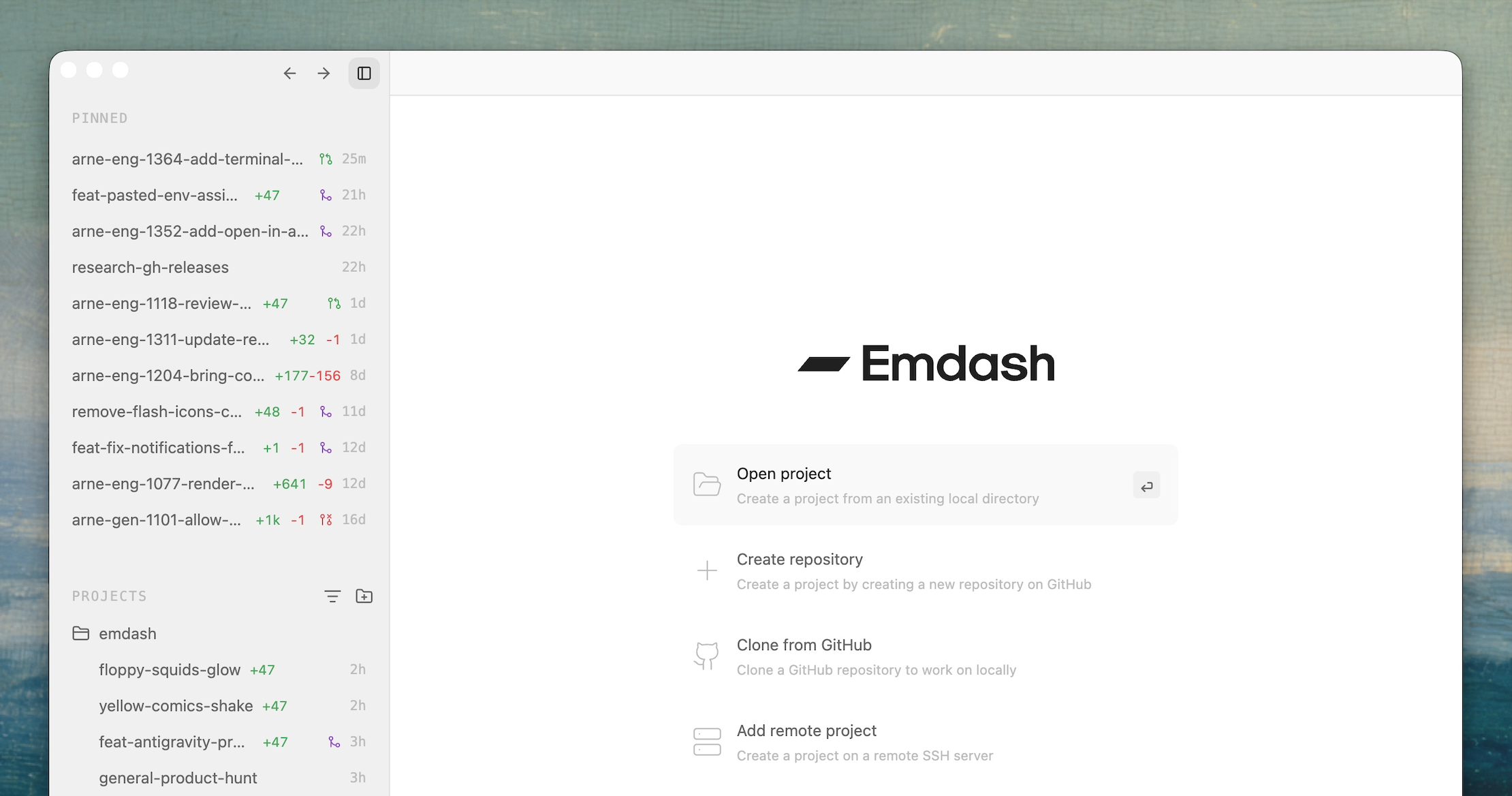
Two things distinguish it beyond the license: builds for all three platforms, and a wider agent roster than Conductor’s three. The trade is maturity and surface: a younger project, still working at the session level.
Pick Emdash when you want Conductor’s local, visual, parallel model on Windows or Linux. Skip it when you need admin controls, a hosted option, or a plan that outlives the session.
3. Nimbalyst: a visual workspace with diff review at its center
Nimbalyst puts its effort where it says: agent sessions run on a kanban board, and every AI edit lands as an inspectable inline diff you approve or reject before it applies. Around the code sit visual editors for markdown, mockups, and diagrams.
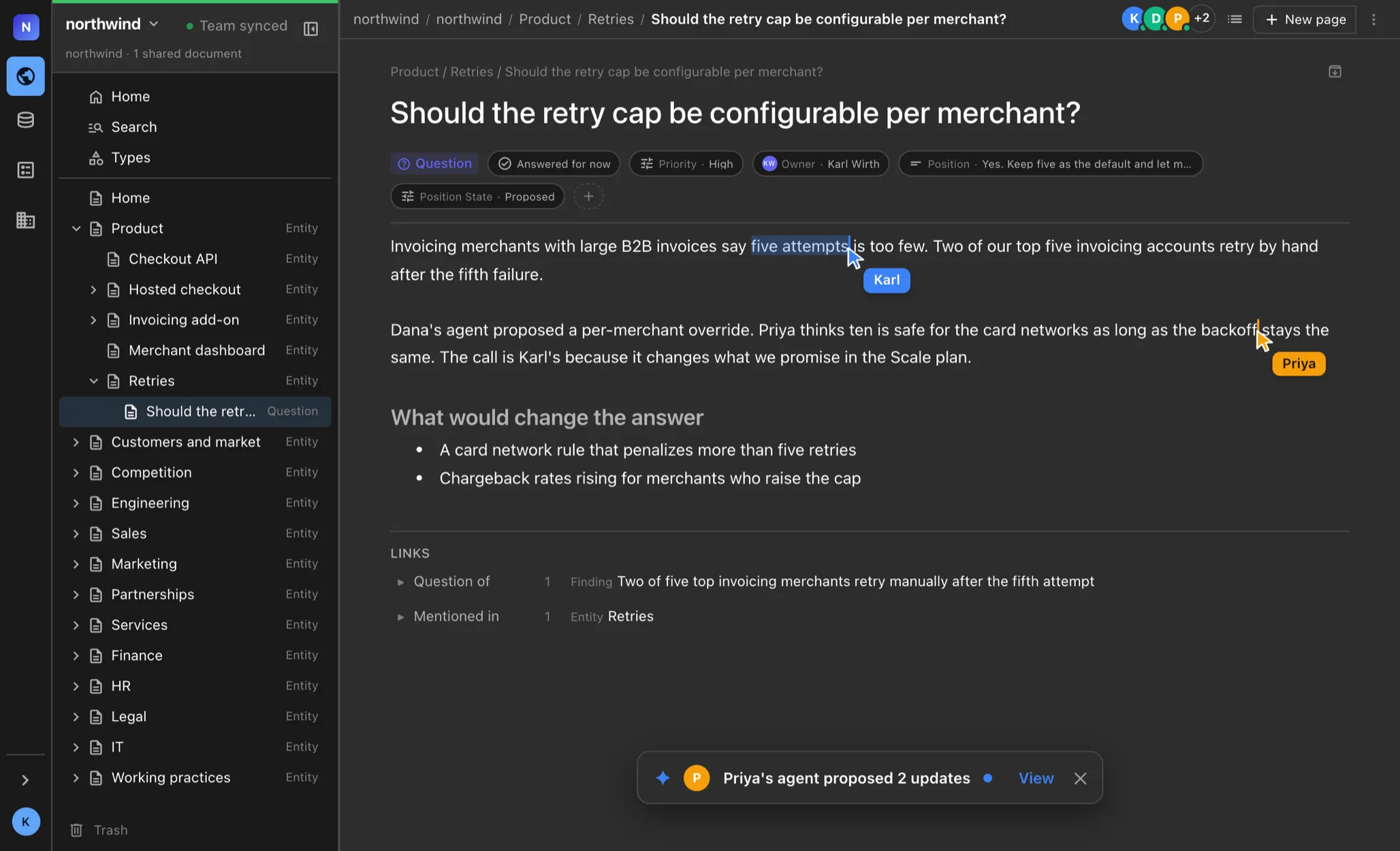
Coverage is broad: desktop builds for all three platforms plus an iOS companion, MIT licensed. Its site states it is free for individual users and free for teams during beta; verify current terms before committing, since beta pricing changes. Agent support centers on Claude Code and Codex, with others in alpha.
Pick Nimbalyst when review rigor is your bottleneck and you want every edit approved before it lands. Skip it when your agents fall outside its supported list, or your team needs work management rather than shared documents.
4. Vibe Kanban: the category pioneer, now sunsetting
Vibe Kanban built the pattern most of this list follows: plan work as kanban issues, run agents in isolated workspaces, review diffs inline. Apache-2.0, around 28k stars, ten-plus agents, a single npx vibe-kanban install, and Docker self-hosting that made it a Linux favorite.
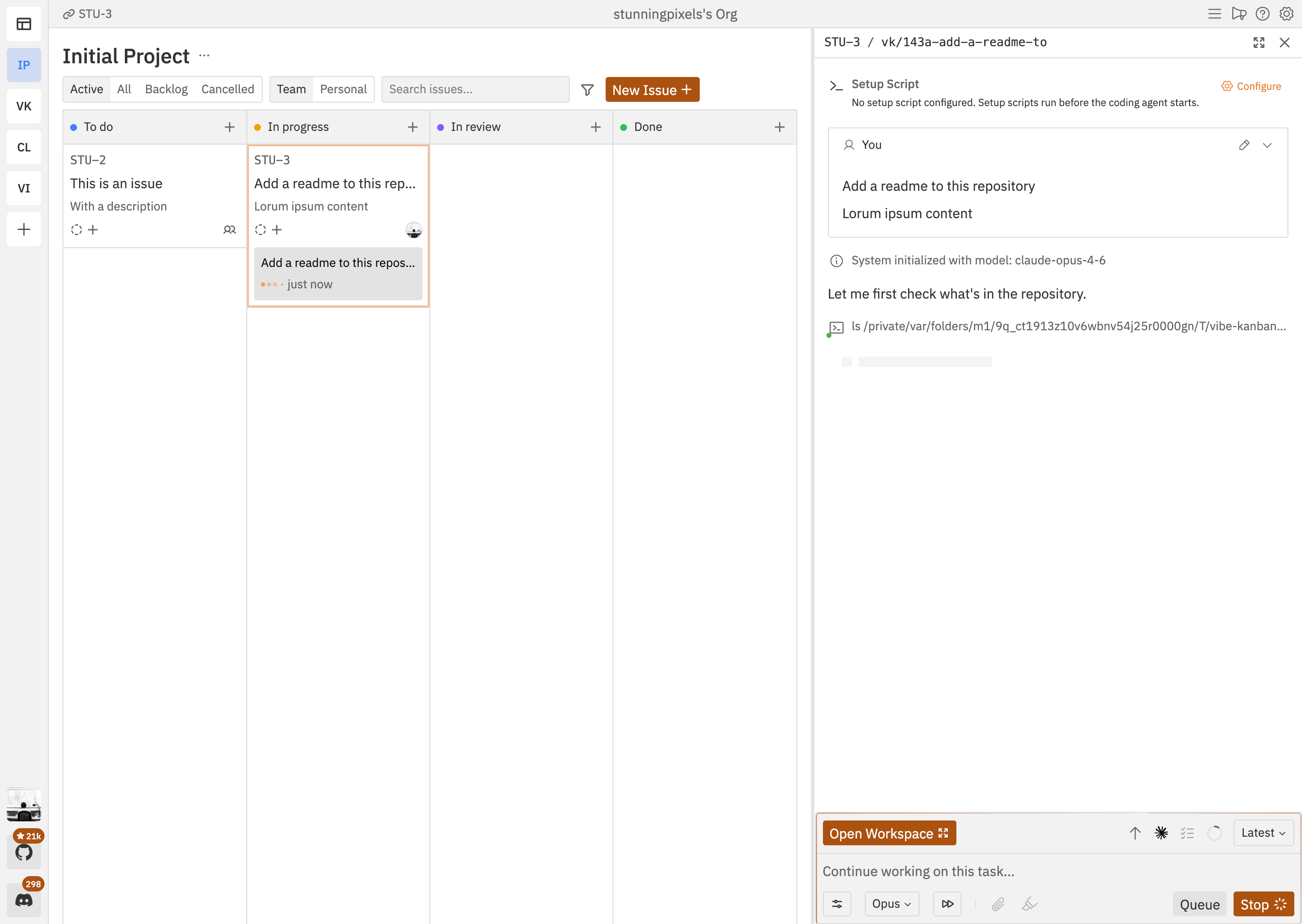
The caveat now outweighs the feature list: the repository announces the project is sunsetting. The code still works, so it serves as a low-commitment trial of the pattern, but building a team’s daily workflow on it is a different bet. See Vibe Kanban alternative.
Pick it when you want a free, self-hostable trial and accept the sunset risk. Skip it when you are choosing infrastructure you expect to be maintained next year.
5. Claude Squad: the terminal answer
Claude Squad manages multiple agents from a terminal UI. It composes three familiar parts: tmux for isolated sessions, git worktrees for isolated checkouts, and a TUI to move between them. Open source (AGPL-3.0, around 8.4k stars), installs via Homebrew on macOS and Linux, and manages Claude Code, Codex, Gemini, and Aider.
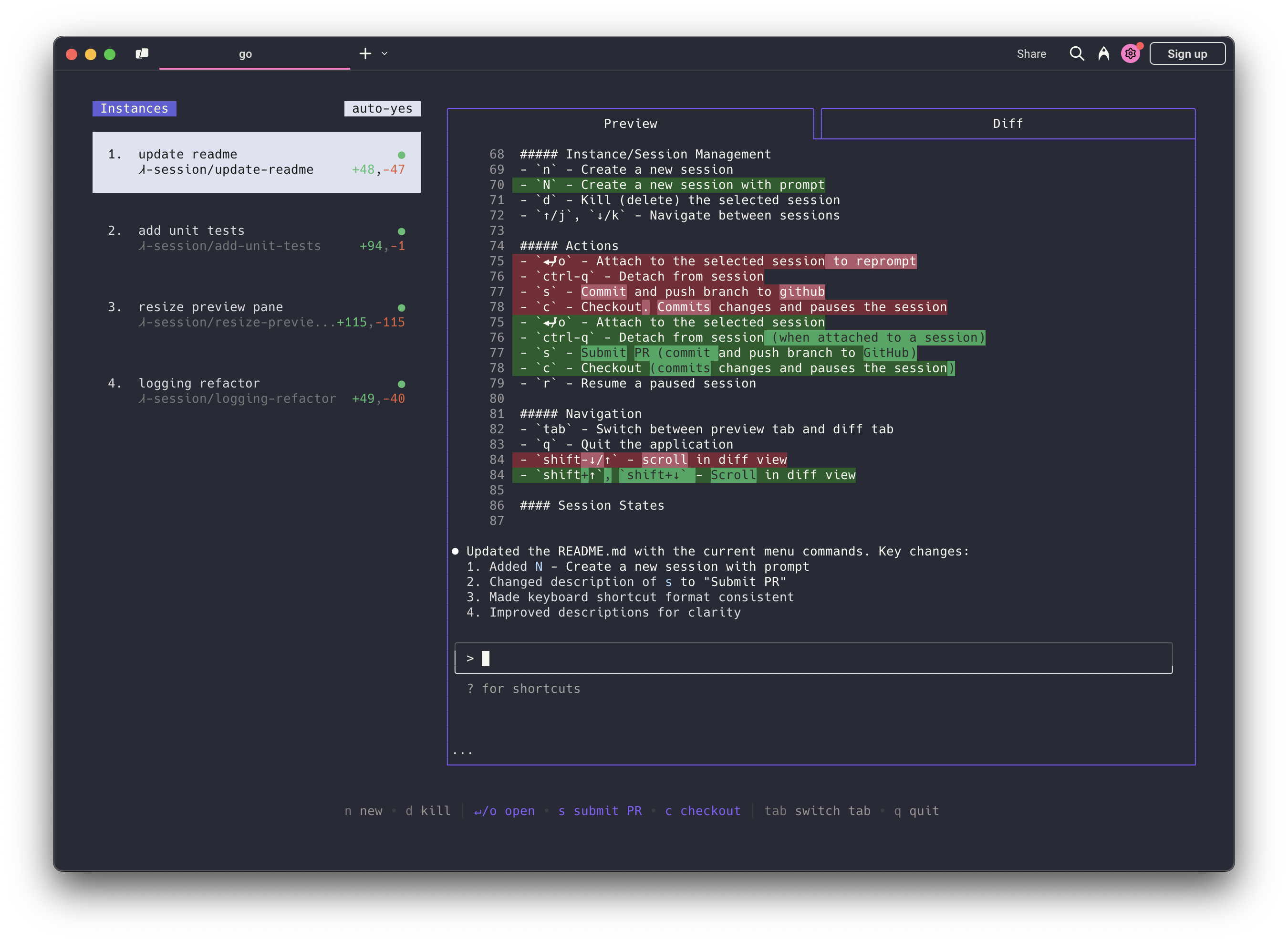
The appeal is the absence of ceremony: it runs where you already are, including the remote Linux box a desktop app will never reach. The flip side is that it is a session manager for one person’s terminal, and Windows is not in the picture. Our deeper comparison covers when DIY beats an app.
Pick it when you’re terminal-native and want isolation without an app. Skip it when “check the tmux session” isn’t an acceptable status update.
6. The ecosystem options: Cursor background agents and GitHub Agent HQ
Neither is a neutral orchestrator, but both deserve honest placement. If your team pays for Cursor, its background agents move parallel execution into Cursor’s cloud. If your team lives in GitHub, Agent HQ is mission control for agents in its ecosystem.
The rule for both is the same: a single-vendor layer is a fine alternative when that vendor’s agent is the only one you run. It stops fitting the moment you want to mix runtimes or keep execution on your own machines. The wider roundup places them alongside the independents.
Conductor alternatives at a glance
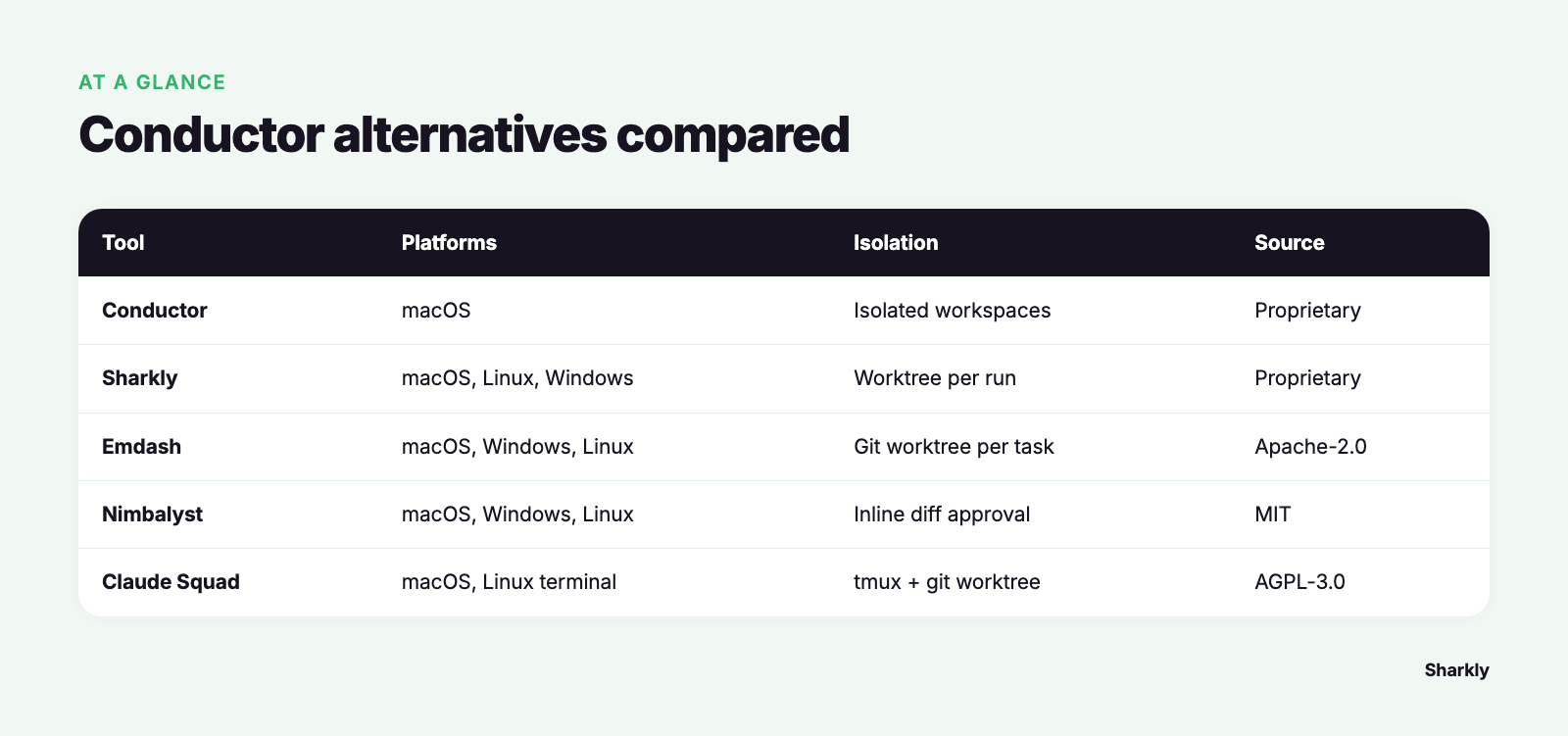
| Tool | Platforms | Agents supported | Isolation | Unit of work | Source model |
|---|---|---|---|---|---|
| Conductor (baseline) | macOS (docs: not on Windows/Linux yet) | Claude Code, Codex, Cursor | Isolated workspaces | Workspace | Proprietary, free tier plus paid |
| Sharkly | macOS, Linux, Windows (CLI and local service) | Runtimes detected on the Computer, plus custom ACP Runtimes | Worktree per repository-backed run | Task, in Projects and Sprints | Proprietary, bring your own subscription |
| Emdash | macOS, Windows, Linux | Claude Code, Codex, Cursor, OpenCode, Amp, Devin, Qwen Code, Droid, Copilot | Git worktree per task | Workspace/task | Open source, Apache-2.0 |
| Nimbalyst | macOS, Windows, Linux, iOS companion | Claude Code, Codex; others in alpha | Inline diff approval per edit | Session on a board | MIT-licensed apps |
| Vibe Kanban | Cross-platform via npx and Docker | 10+ including Claude Code, Codex, Gemini CLI | Isolated workspaces | Kanban issue | Open source, Apache-2.0, sunsetting |
| Claude Squad | macOS, Linux terminal | Claude Code, Codex, Gemini, Aider | tmux session plus git worktree | Terminal session | Open source, AGPL-3.0 |
Verify platform and pricing rows against each project’s site before deciding; several of these ship weekly.
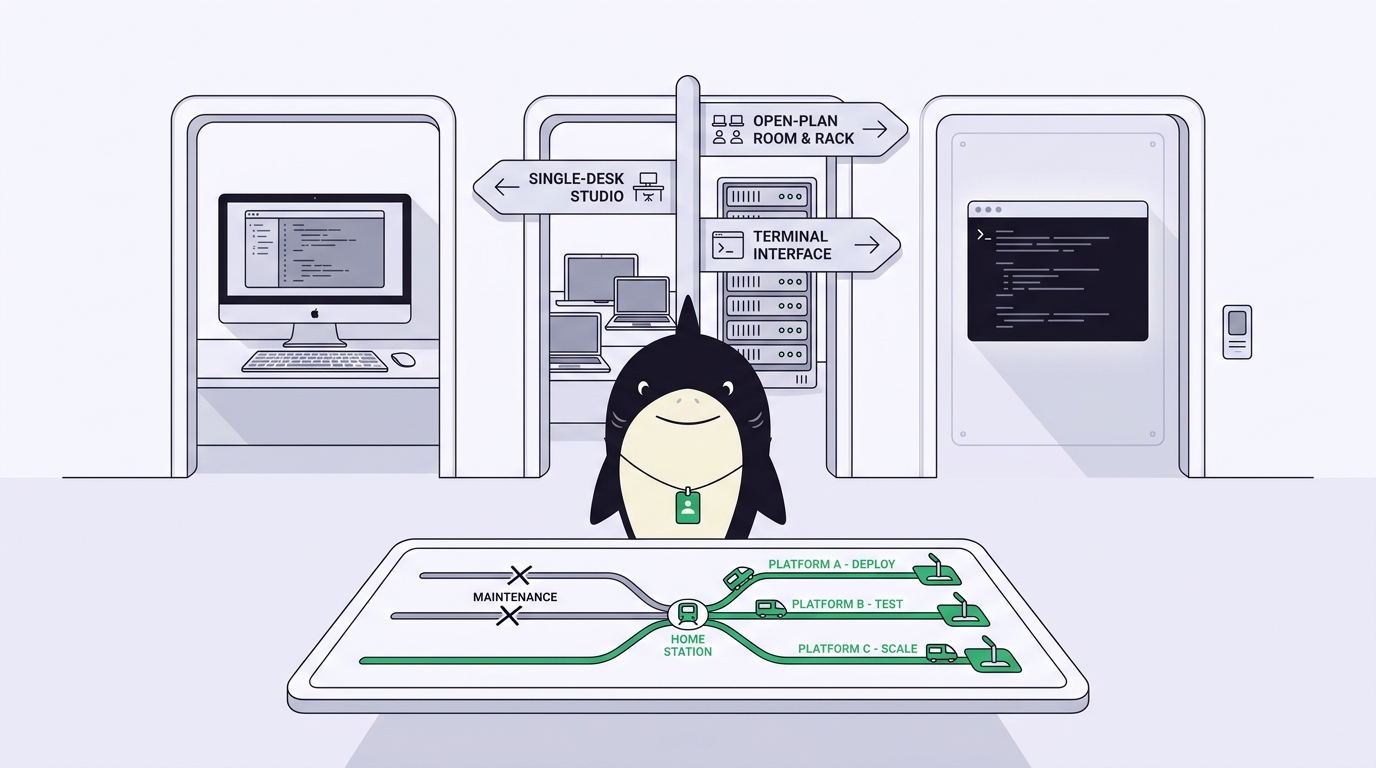
How to choose: three questions that settle it
Where must the agents run? If every run fits on developer laptops, pick by interface preference. If runs belong on a server, you need Claude Squad over SSH for one person, or Sharkly’s Computers for a team.
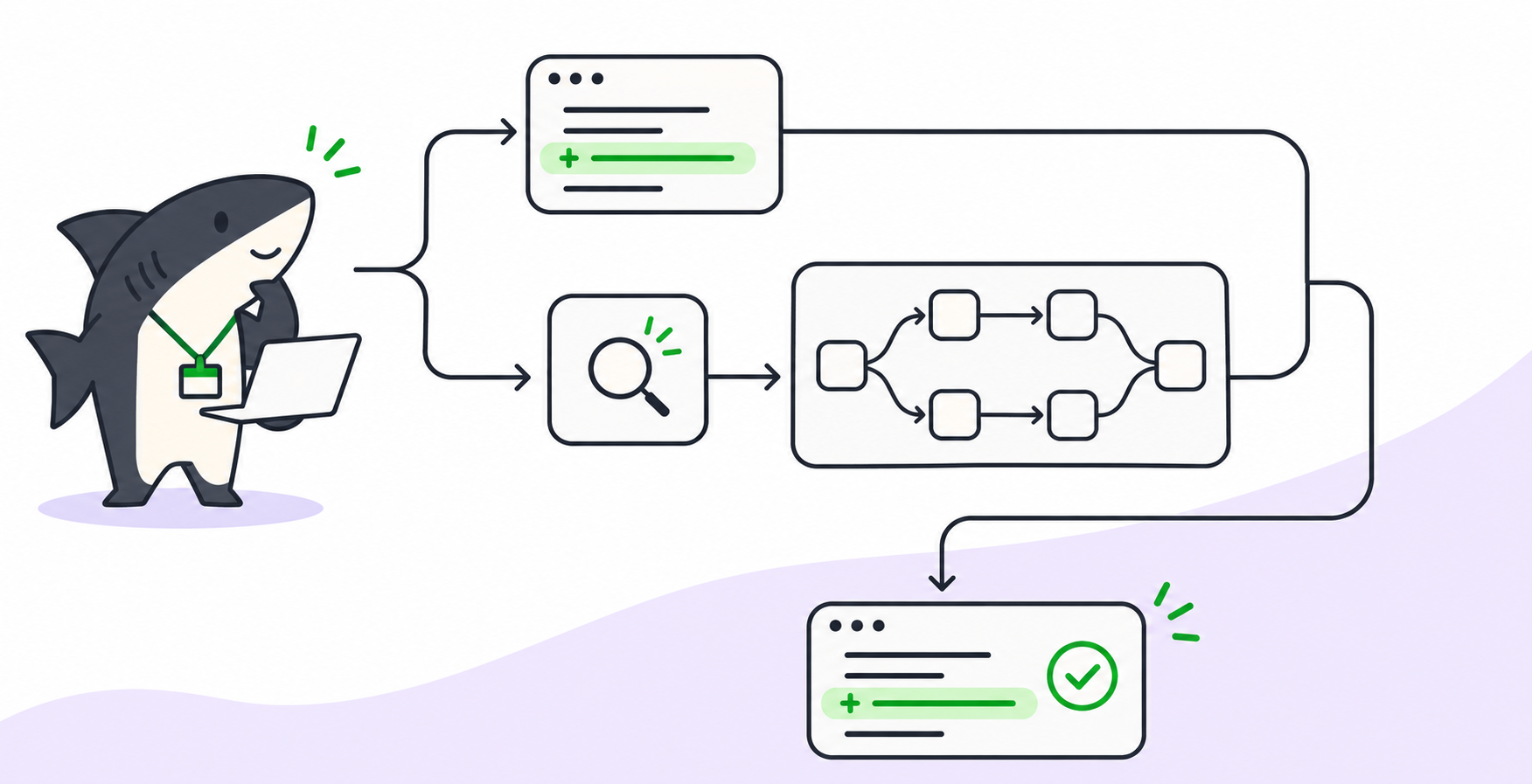
Who needs to see the work? One person reviewing their own diffs points to Emdash, Nimbalyst, or Claude Squad. A team asking “what’s the agent doing and who approved it” needs the run attached to a shared record. Agents research, execute, and report; people set direction and accept the result. A tool supports that split only if the report and the acceptance live where everyone can read them.
Where does the plan live? If your backlog stays in Jira and you’re happy, a session tool beside it is fine, and Sharkly can sync rather than replace it (how that works). If the plan currently lives in screenshots of workspace lists, that is the drift a work system exists to end.
Conclusion
Conductor set the bar for local parallel-agent work on the Mac, and if that is your whole requirement, staying put is defensible. The alternatives exist because requirements grow in three directions: onto other operating systems, onto other machines, and into team process. If the team-and-platforms problem is the one on your desk, install the Sharkly CLI on the machine that should do the work, connect one Computer, and assign one Agent something boring. The getting-started guide takes about ten minutes.
FAQ
Is there a version of Conductor for Windows or Linux? Not at the time of writing; its installation documentation says so directly. The cross-platform routes today are Emdash, Nimbalyst, Vibe Kanban, Claude Squad (Linux and macOS), or Sharkly.
What’s the closest free and open-source Conductor alternative? Emdash, an Apache-2.0 desktop app with builds for all three platforms. Claude Squad is the equivalent for terminal users on macOS and Linux.
Can these tools run agents on a remote server? Claude Squad can, for one person, because it runs wherever you SSH. Sharkly is built for it: Computers can be remote servers or containers. The desktop apps center on the machine where they are installed.
Do Conductor alternatives handle parallel runs as safely? The isolation mechanism is broadly shared, so the differences worth evaluating are platforms, hosts, and review flow. Our worktrees explainer covers the mechanics.
Does Sharkly replace Claude Code or Codex? No. Those Runtimes perform the execution. Sharkly manages team-level assignment, connected Computers, task context, progress, blockers, results, and human review across them.