You built a habit around a board. One column per task, one coding agent per card, each working in its own git worktree so nothing collided. It was a clean way to run three or four agents at once and still review their diffs one at a time. Then the company that maintained the tool wound down its cloud, and the honest question landed: where do you run your coding agents now, and does the answer scale past one laptop and one person?
If you are searching for a Vibe Kanban alternative, you are not looking for a replacement for Claude Code or Codex. You are looking for the layer that sits around those runtimes: the place that hands each agent a task, keeps its work isolated, and shows you what changed before anything merges. This guide walks through that layer. It gives Vibe Kanban full credit for the pattern it proved, marks the exact line where a local board stops, and shows how Sharkly continues past that line into shared tasks, Crews, and Sprints for a whole team.
TL;DR
Vibe Kanban pioneered the board-per-agent model: run multiple coding agents in parallel, each in its own worktree, and review their output on a kanban board on your machine. Sharkly keeps that model and adds the team layer around it: a shared Task record, connected Computers, Crews, Sprints, and human review from request to release. If you work solo on one machine, a local board is enough. If a team needs shared context and a review gate, that is where Sharkly picks up.
The problem a Vibe Kanban alternative actually solves
Vibe Kanban got something right that most tooling missed. When you run several AI coding agents at once, the hard part is not the models. It is the collisions. Two agents editing the same files, output scattered across terminal tabs, and no single view of which task is done, which is blocked, and which quietly went sideways.
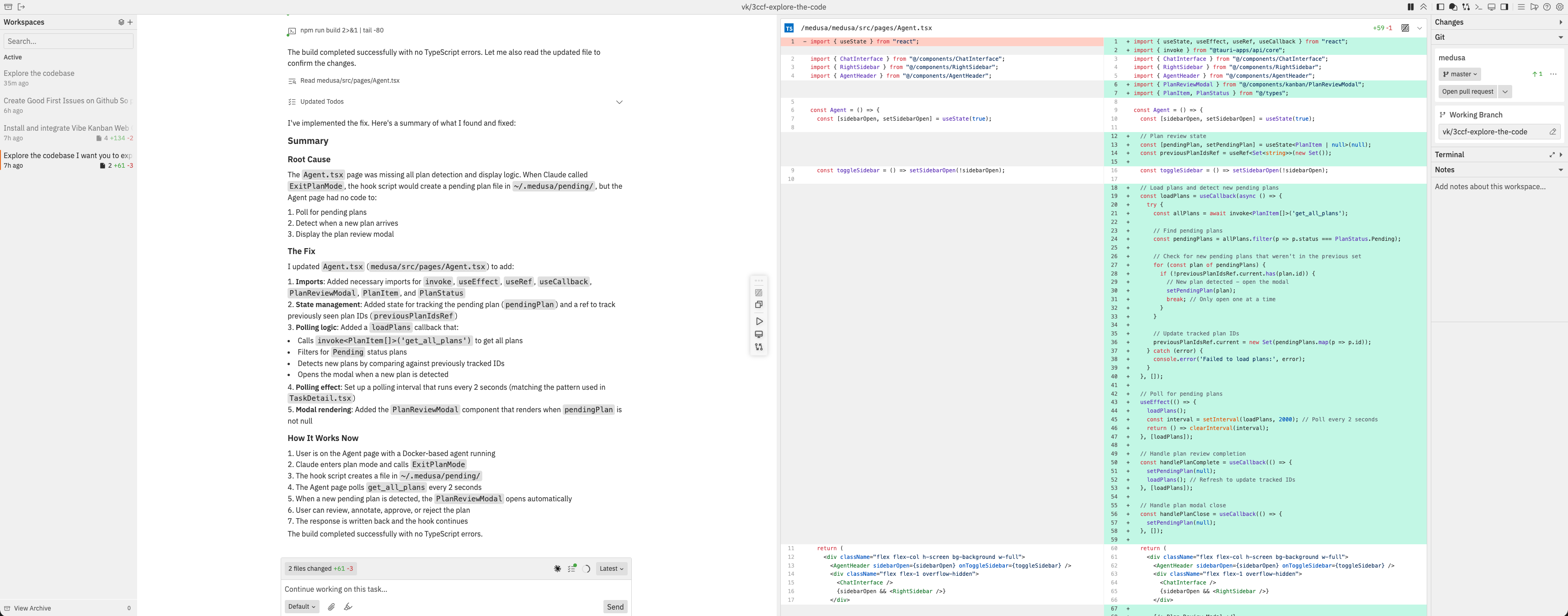
The board-per-agent answer was elegant. Give each task its own card. Give each card its own git worktree so the agent works on an isolated branch in an isolated directory. Let Claude Code, Gemini CLI, Codex, or another runtime do the work inside that sandbox, then bring the diff back for review. It turned “I have five agents and no idea what any of them did” into a board you could actually read. If you want the mechanics of that parallel pattern on its own, our guide on how to run multiple Claude Code agents in parallel covers the worktree setup in detail.
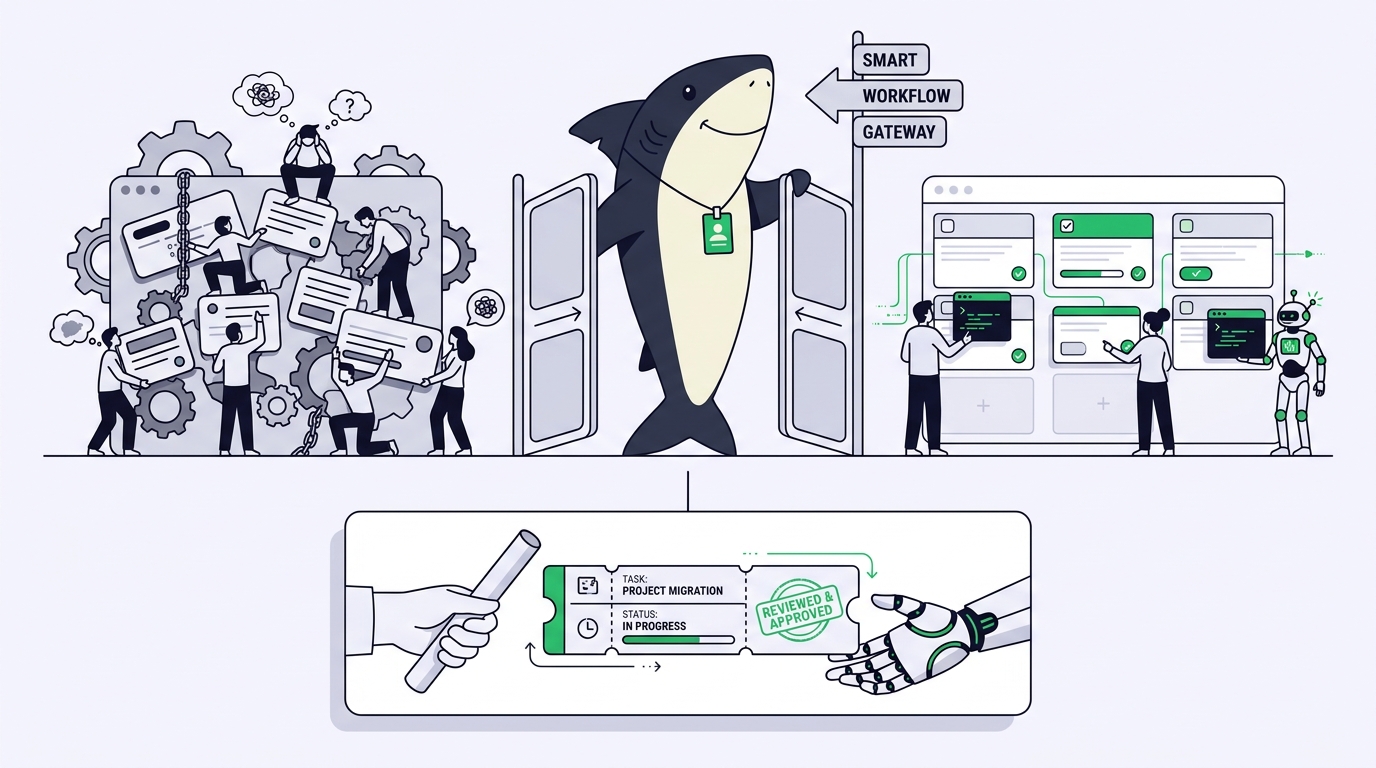
The gap was never the pattern. The gap is what a local board cannot reach. A board on your machine is a board for you. Your teammate cannot see the task, cannot pick up a blocked card, cannot review the diff before it merges, and cannot tell from across the room whether the sprint is on track. When the work is solo, that is fine. When the work belongs to a team, the missing piece is a shared record, and that is a different kind of tool.
What Vibe Kanban proved, stated plainly
Give the tool its best version, because it earned it. Vibe Kanban treated agent runs as first-class units of work instead of throwaway terminal sessions. It made worktree isolation the default, so parallel agents stopped stepping on each other. It made switching runtimes cheap, so you were not married to one model. And it made review a step, not an afterthought, by putting the diff in front of you before you moved a card to done.
Those four ideas are correct, and any serious alternative has to keep all of them. A Vibe Kanban alternative that drops worktree isolation, or hides the diff, or locks you to a single runtime, is a downgrade no matter what else it adds. The bar the board set is the floor, not the ceiling.
What changed is the maintenance story. The project is open source and can still run locally, but company-operated cloud features were removed and ongoing fixes now depend on community contributors. For a solo developer that may be perfectly acceptable. For a team betting a quarter of delivery on the tool, “depends on whoever shows up” is a real risk to weigh, and it is the honest reason migration intent is live right now.
Where the local board ends and Sharkly continues
Here is the decision pair, stated the way the choice actually breaks down.
Use a local board when you are one person on one machine, the tasks are yours alone, and nobody else needs to see the work until you open a pull request. The board-per-agent setup is lightweight, it runs where you run, and it adds zero coordination overhead because there is no one else to coordinate with. Reaching for a team platform in that case is overkill.
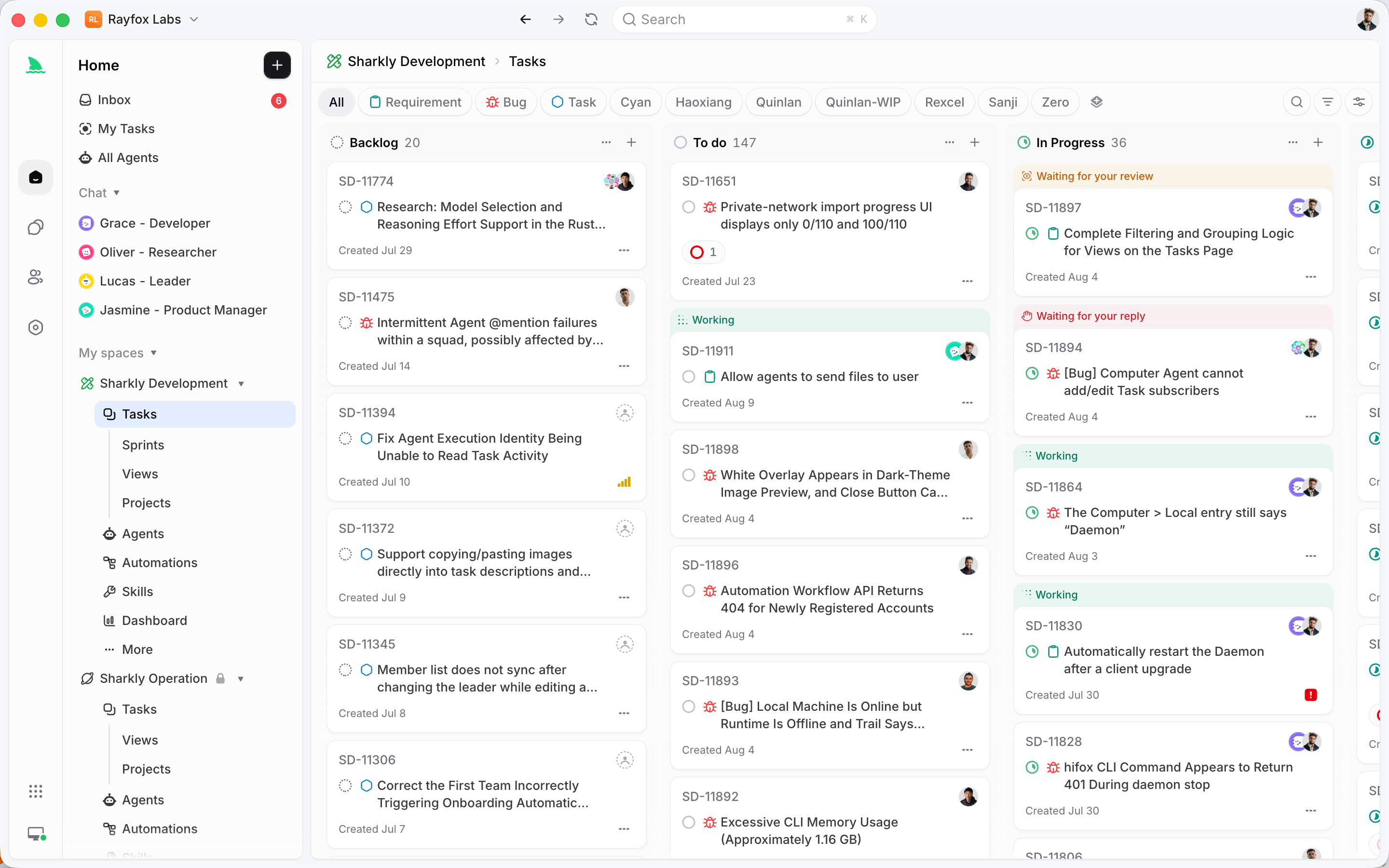
Use Sharkly when the agent runs stop being private. The moment a second person needs to assign a task, pick up a blocker, or review a diff before it merges, a board that lives on your laptop becomes the bottleneck. That is the line. Sharkly is the layer that sits around the same runtimes you already use and makes every run assignable, visible, and reviewable by the team, not just by you.
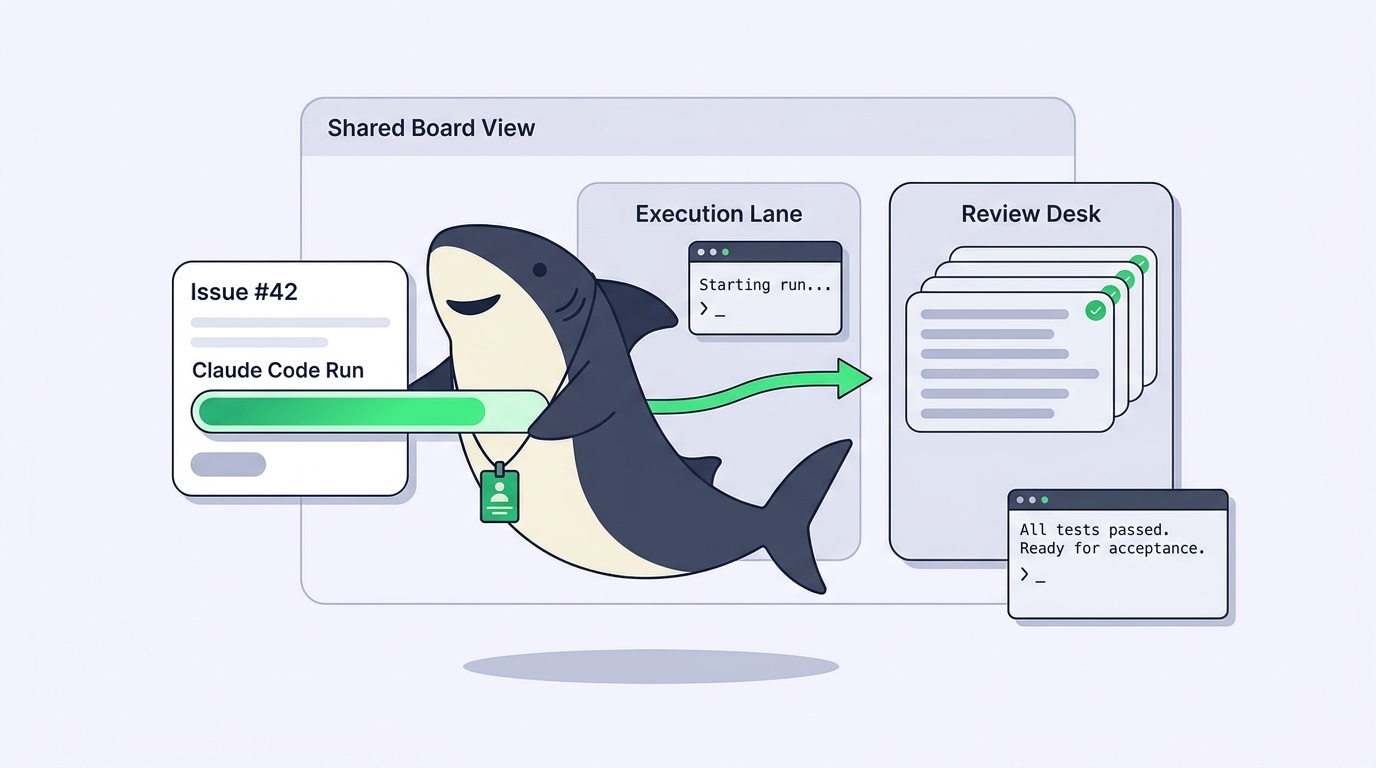
A quick definition, glossary-grade, because the rest of this depends on it. A Task is the main unit of work in Sharkly. It holds the goal, the assigned Agent, the runtime, the progress, the blockers, the resulting diff, and the human review, all in one shared record. Where a card on a local board is yours, a Task is the team’s.
And a boundary, because a reader migrating from a board will otherwise assume wrongly. Sharkly is not a replacement for Claude Code, Codex, or Gemini. It does not run the model or write the code. It adds the shared task, connected Computer, context, control, and review layer around the execution tools your team already uses. If you loved that Vibe Kanban let you swap runtimes freely, Sharkly keeps that freedom and puts a team around it.
The migration path: keep your runtimes, keep your repos, add the review layer
The best part of moving off a sunsetting board is how little you have to give up. You are not rebuilding your stack. You are keeping the parts that worked and adding the part that was missing.
Keep your runtimes. Claude Code, Codex, Gemini CLI, OpenCode, Cline, and the rest keep doing execution exactly as before. Model usage continues through the subscriptions or API keys already configured in those tools. You bring your own subscription; Sharkly does not sit between the agent and the model. If you want the conceptual grounding for what these runtimes are doing, our explainer on what agentic coding means for dev teams sets the terms.
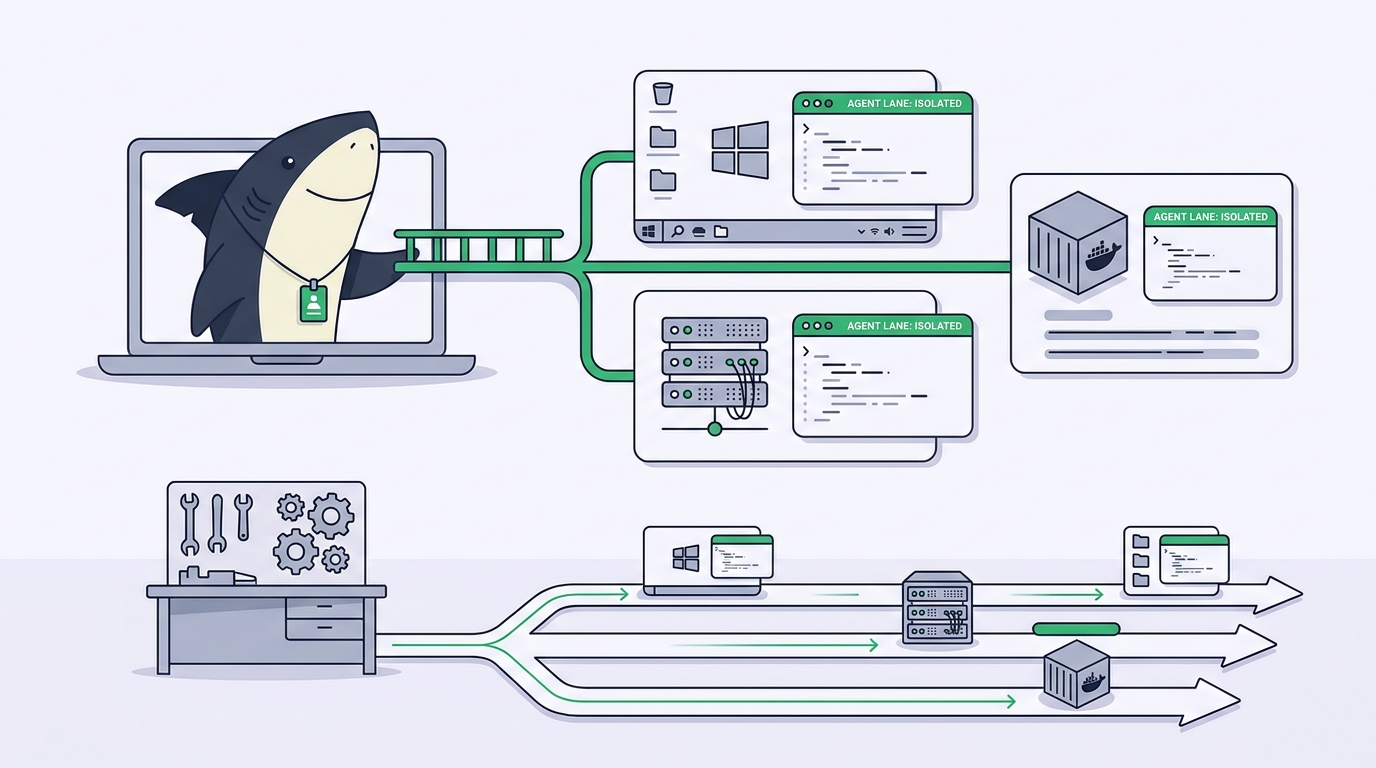
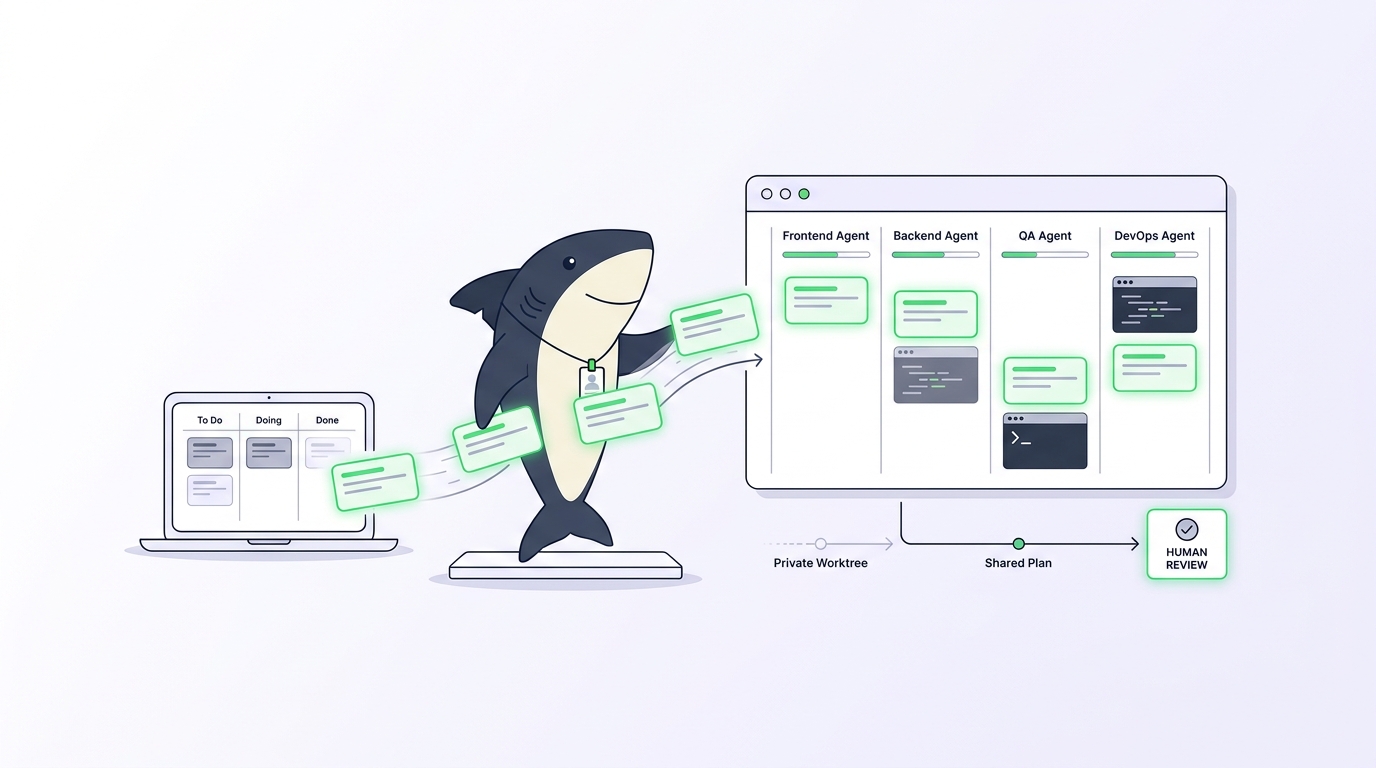
Keep your repos and your worktree habit. Sharkly runs agents in isolated worktrees on connected Computers, the same isolation you relied on, now tied to a shared Task instead of a local card. Frontend, backend, bug fixing, and test coverage can move at the same time without colliding, which is the whole reason the board-per-agent model existed.
Add the review layer you were missing. This is the new part. Execution, blockers, results, and follow-up discussion return to the Task timeline where the team can see them. An Agent researches, executes, tests, and reports. People set direction, grant authority, and accept the result. Automation stops where team judgment is required and returns a delivery with complete context and inspectable evidence. That last sentence is the contract a local board could not enforce, because there was no team on the other side of it.
So the migration is additive. Connect a Computer, point Sharkly at the runtimes you already have, and start routing work without rebuilding the process your team already understands. The board taught you to run agents in parallel. Sharkly lets the rest of the team in on it.
From solo board to team system: Crews, Sprints, and Projects
Once the runs are shared, three capabilities open up that a single-user board could not offer.
Crews, for work that needs more than one agent. A Crew is a reusable group of People and Agents coordinated by one leader Agent. For small, well-defined work you do not need one: assign the Task to a single Agent and keep the moving parts at zero. Use a Crew when the leader Agent needs to interpret a broader goal, pull in other Agent members, and bring their results back into one Task. That is the honest rule. A Crew is leverage when the work is genuinely multi-part, and dead weight when it is not.
Sprints and Projects, for tracking that survives past one card. A local board shows the tasks in front of you today. A Sprint tracks completion, ownership, dependencies, scope changes, and blockers across a cohort of work over time. For a hybrid team of People and Agents, that is the difference between “the agents did some things this week” and a plan you can actually report against. Our primer on AI agent orchestration for dev teams walks through why the coordination layer, not the models, is where team throughput is won or lost.
Team transparency, as a default rather than a screen-share. Keep context, progress, blockers, results, and human review visible from request to release. On a local board, visibility stopped at your monitor. In a shared system, the leverage does not come from opening more AI chats. It comes from sharing roles, rules, context, and workflows so one good setup becomes a capability the whole team reuses.
Vibe Kanban vs Sharkly: a fair comparison
| Dimension | Vibe Kanban (local board) | Sharkly (team layer) |
|---|---|---|
| Core unit | Card on your machine | Shared Task for the team |
| Parallel agents | Yes, worktree-isolated | Yes, worktree-isolated on connected Computers |
| Runtimes | Claude Code, Gemini, Codex, and more | Same runtimes, brought in as-is |
| Review | Diff review, solo | Human review from request to release, team-wide |
| Multi-agent grouping | Not the model | Crews with a leader Agent |
| Planning over time | Board view | Projects and Sprints |
| Model billing | Your own keys, runs locally | Bring your own subscription; keys stay in the tools |
| Maintenance | Open source, community-maintained after shutdown | Actively developed platform |
| Best fit | Solo dev on one machine | Teams routing and reviewing agent work together |
Read the table as a division of labor, not a scoreboard. For a solo developer who wants a free local board and nothing more, the community-maintained project may still be the right call, and there is no shame in staying there. For a team that needs the runs to be shared, assignable, and reviewable, the board was always going to run out of room, and Sharkly is where the same runtimes keep working with the team added in. You can download Sharkly and connect one Computer to see the difference on real work.
Common mistakes when moving off a local board
- Treating it as a like-for-like swap. You are not looking for another board. You are looking for the team layer the board never had. If the alternative only reproduces columns and cards, it solved nothing.
- Dropping worktree isolation to move faster. The isolation is why parallel agents do not collide. Keep it. Any tool that makes agents share a working directory is trading a real problem back in.
- Adding a Crew for single-agent work. Reach for a Crew only when the goal genuinely needs a leader Agent to coordinate members. For a well-scoped task, one Agent and zero moving parts is the correct answer.
- Skipping the review gate to feel productive. The point of the layer is that people accept the result. Merging agent diffs unreviewed because it is faster gives back the exact safety the whole system exists to provide.
- Migrating everything on day one. Start with one real requirement and one low-risk Task. Prove the loop, then widen it.
Conclusion
Vibe Kanban proved a pattern worth keeping: agents run best in parallel, isolated in their own worktrees, with review as a real step. That pattern is the floor now, and any Vibe Kanban alternative that abandons it is going backward.
- The board-per-agent model was correct; parallel, worktree-isolated agents with diff review is the right shape.
- A local board ends at one person on one machine. Shared work needs a shared record.
- Sharkly keeps your runtimes, your repos, and your worktree habit, and adds the team layer around them.
- A Task carries the goal, the runtime, the progress, the blockers, the diff, and the review in one place.
- Crews, Sprints, and Projects turn parallel runs into a plan a team can report against.
- Agents research, execute, test, and report; people set direction, grant authority, and accept the result.
If you are choosing where to run your coding agents next, keep the tools your team already uses and add the layer that makes runs assignable and traceable. Connect one Computer, create one Agent, and assign it something boring. Then let the rest of the team watch the work return to the Task. Start at Sharkly, and the docs cover each concept in more depth at docs.sharkly.ai.
FAQ
Is Vibe Kanban still usable after Bloop shut down? Yes. The project is open source and can still run locally. Company-operated cloud features were removed, and fixes and updates now depend on community contributors. For solo use that may be fine; for a team relying on it for delivery, the maintenance risk is worth weighing.
Is Sharkly a replacement for Claude Code or Codex? No. Sharkly is not a replacement for Claude Code, Codex, or other execution tools. Those runtimes perform execution. Sharkly adds the shared task, Computer, context, control, and review layer around them. You keep using the same agents.
Do I have to give up running agents in parallel worktrees? No. Sharkly runs agents in isolated worktrees on connected Computers, the same isolation the board-per-agent model relied on. Frontend, backend, and tests can move at once without colliding. See how to run multiple Claude Code agents in parallel for the underlying pattern.
What does migrating from a local board actually involve? Keep your runtimes and your repos. Connect a Computer, point Sharkly at the execution tools you already use, and start routing work as shared Tasks. Model usage continues through the subscriptions or API keys already configured in those tools, so billing does not change.
When should I not use Sharkly? When you are one person on one machine and nobody else needs to see or review the work, a local board is enough. Sharkly earns its place the moment a second person needs to assign, pick up, or review an agent run.
What is the difference between a card and a Task? A card on a local board is yours and lives on your machine. A Task is the team’s shared record: it holds the goal, the assigned Agent, the runtime, the progress, the blockers, the diff, and the human review, and execution results return to it.