Tembo and Sharkly start from the same premise, which is why they get compared. Neither one is trying to build a better coding agent. Both assume you already pay for Claude Code or Codex or Cursor, and both are aimed at the layer above: routing work to those agents, keeping the results reviewable, and making the whole thing legible to a team.
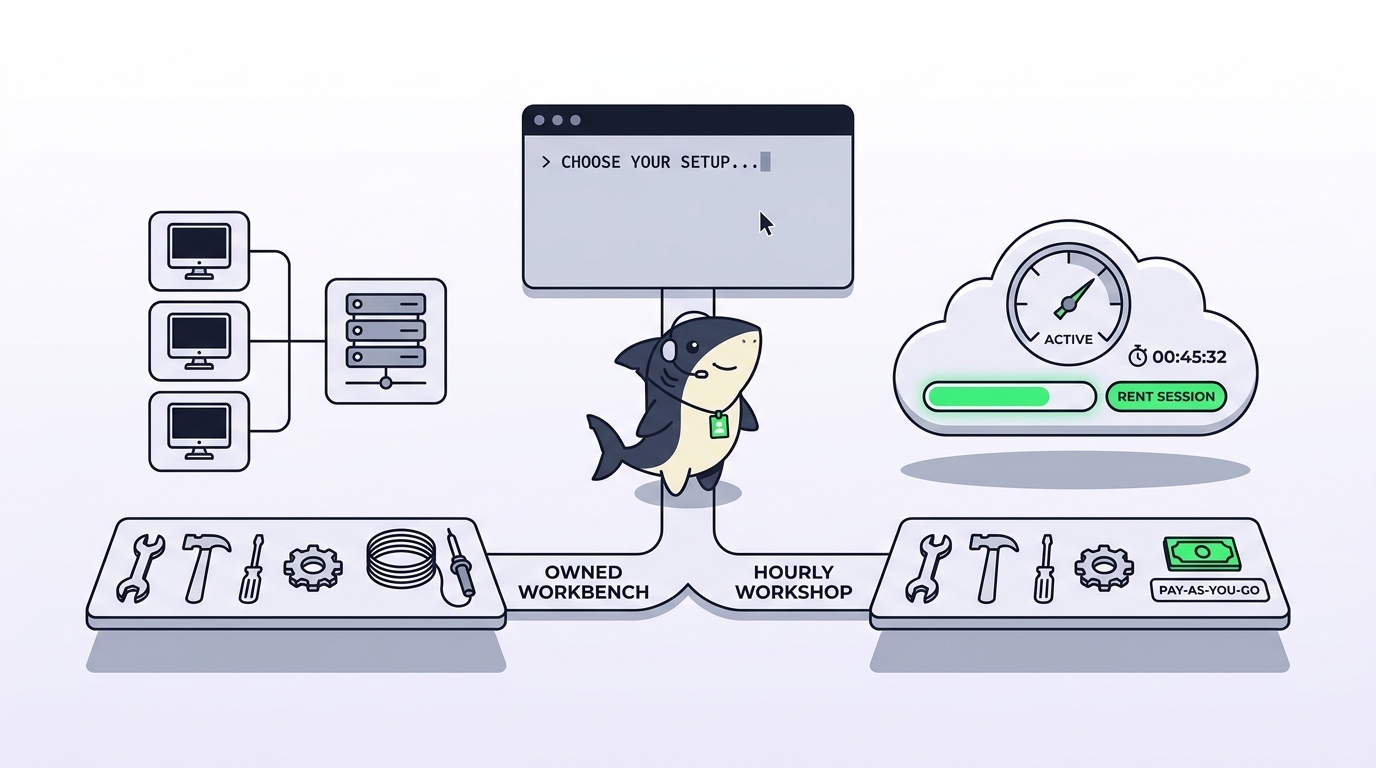
They part ways on one question, and it is the question worth deciding first. Where does the agent session actually run, and who pays for that compute? Tembo answers “cloud VMs, on a dollar allowance that covers them.” Sharkly answers “Computers you connect, on the subscriptions you already have.” Everything else in this comparison follows from that.
TL;DR
Tembo is an orchestration layer that runs coding agents in cloud sessions, entered through the tools you already use. Its pricing page describes a dollar-denominated allowance that covers both Tembo Gateway usage and the cloud VM compute used by sessions, across Free, Pro, Max, and Enterprise tiers with seat caps. Sharkly runs agents on Computers you connect, local machines, remote servers, containers, or supported cloud hosts, with model usage continuing through the subscriptions and API keys already configured in those tools, and adds a full work-management layer of Tasks, Projects, Sprints, and Crews. Choose Tembo if you want zero machine management and are happy paying for hosted compute. Choose Sharkly if execution needs your environment, your credentials, and your existing subscriptions, and if the team needs planning and review in the same place as execution.
What Tembo does well
Tembo made a real bet on chat-first and issue-first entry points, and it paid off in usability.
You do not have to open Tembo to use Tembo. Work reaches it through the tools your team already lives in, and its own materials list GitHub, Linear, Slack, and Sentry among the integrations, with custom integrations and webhooks on the Enterprise tier. Tembo also appears on Linear’s own agents roster, which means you can delegate a Linear issue to it the same way you would to any other agent there.
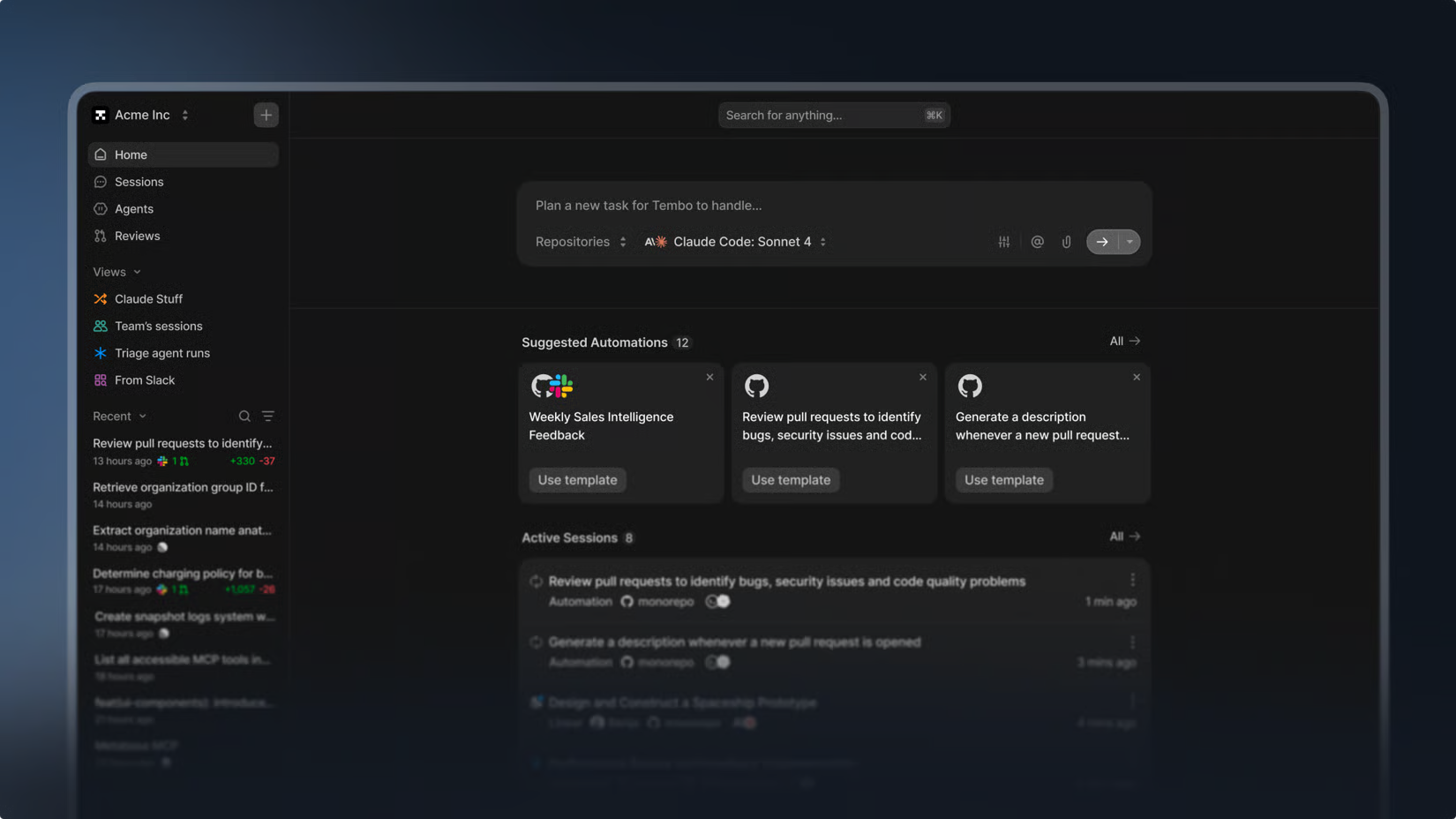
Agent choice is a first-class feature rather than an afterthought. Tembo’s pricing page states that you can run Claude Code, Codex, Cursor, or Amp, and switch agents or models at the task level with one click. That is a genuinely good design: the model that is best for a refactor is not always the one that is best for a bug reproduction, and forcing one choice per workspace is the wrong granularity.
The cloud session model removes a category of work entirely. Nobody sets up a machine, nobody keeps a local service running, nobody is the person whose laptop was closed when the agent needed to run. For teams that do not want to think about hosts, that is worth real money.
Tembo has also pushed on autonomy in ways worth watching. Its published material describes monitoring production errors and turning them into pull requests, and in May 2026 it released Agent Studio, an MIT-licensed self-hosted control plane with agent definitions living in Git repositories. Whatever you conclude about the hosting question, that direction is serious engineering.
Where the hosted model runs into limits
The strengths above have a shared cost, and it is not a criticism so much as a boundary.
Compute is billed, and it is billed by session. Tembo’s own framing is that the allowance covers Tembo Gateway usage and the cloud VM compute used by sessions. That is an honest and readable pricing model. It also means agent work has a per-run cost on top of whatever you already pay Anthropic or OpenAI, and long-running or retry-heavy work spends more of it. Predicting that spend is a planning exercise teams have to actually do.
The environment is a rebuild. A cloud VM starts clean. Your repo may need a private registry token, a seeded database, an internal certificate, a VPN route to staging, or the specific toolchain version your build assumes. Reproducing all of that in a hosted session is possible and often worth it. It is also work that never ends, because the environment keeps drifting.
Seat caps arrive before you expect them. The published tiers cap users: up to 3 on Free, up to 5 on Pro, up to 10 on Max, with Enterprise custom. A twelve-person engineering group crosses that line quickly.
Orchestration is not the same as project management. Tembo routes work well through the tools you already use, which is deliberate. But that means the plan still lives somewhere else. If you want sprints, a shared backlog, blockers, and human review in the same record as the execution trace, you are assembling that from parts.
The decision pair
Use Tembo when you want agent work to happen without managing hosts, your repositories build cleanly in a fresh cloud environment, hosted compute billed against a dollar allowance fits your budgeting, and your entry points are Slack, Linear, GitHub, and similar tools that already hold your work.
Use Sharkly when execution needs the machine your environment already lives on, when you want model usage to stay on the subscriptions your developers already have, or when the team needs the planning and review layer in the same system as the execution.
A definition, since the whole comparison turns on it. A Computer in Sharkly provides the execution host for Agent work, and it can be a local computer, a remote server, a container, or a supported cloud host. A small local service connects the Computer to Sharkly, detects available Runtimes, receives work, prepares the task directory, starts the selected Runtime, and streams progress back.
Note what that does and does not say. It does not say “local only.” A remote server or a supported cloud host is still a Computer. The difference is that the host is yours, so it can carry your credentials, your network position, and your toolchain, and you are not renting session compute on top of your model subscriptions.
The layer Tembo deliberately leaves to other tools
Tembo’s design choice is to meet you inside Slack, Linear, GitHub, and Sentry. That is a legitimate architecture, and for many teams it is the right one.
Sharkly makes the opposite choice: the work system and the execution system are the same system. A Task is the main unit of work. It belongs to an Organization and a Space, and it can also belong to a Project or Sprint. It records the goal and description, status, priority, dates, labels, and task type, the person responsible, the Agent or Crew assigned to execute it, comments and attachments, and the Agent execution state, trace, and result.
Three consequences follow.
Configuration becomes reusable. An Agent is a saved working configuration rather than a one-off prompt: instructions, Runtime, Skills, repositories, environment, and run settings. A team can maintain separate Agents for code changes, review, testing, documentation, or operational triage without rewriting the same instructions every time.
Coordination has a shape. A Crew is a reusable group of People and Agents coordinated by one leader Agent. Use a Crew when work benefits from role-based collaboration, sequencing, or a leader deciding which Agent should act next. Our guide to Sharkly Crews covers when a Crew beats a single Agent, including the cases where it does not.
Planning and execution share a record. Sprints, Projects, and the Task backlog are in the same place as the execution trace, so a status meeting reads from the same source as a code review.
If your existing stack already gives you planning and you only want routing, this is weight you do not need. That is the honest version of the trade.
A worked example
An eight-person team maintains a payments service and an internal admin app.
Their production error triage fits Tembo’s model well. An alert fires, a session spins up in the cloud, an agent reproduces the failure against the repository, and a pull request lands for review. Nobody maintained a machine to make that happen, and the compute cost is visible on the allowance.
Their migration work does not fit as neatly. It touches three repositories, needs a seeded local database, and depends on a Skill the team wrote encoding their migration conventions. In Sharkly, that becomes a Task assigned to a migration Agent with those three repositories and Claude Code as the Runtime, running on a connected Computer that already holds the database and the network route. A second Agent updates the test suite in an isolated worktree so neither one touches the other’s files. Our guide on running parallel agents in isolated worktrees covers why that isolation matters once two agents are live.
The reviewer sees the diff, the trace, and the blockers on one Task, asks a follow-up in a comment that starts another run, and accepts. The sprint board updates because the Task is the sprint item, not a mirror of one.
Running both is a reasonable outcome. The mistake would be pretending one model is strictly better.
Sharkly vs Tembo: a fair comparison
| Tembo | Sharkly | |
|---|---|---|
| Category | Agent orchestration through your existing tools | Work management and execution layer for People and Agents |
| Where sessions run | Cloud VMs managed by Tembo | Computers you connect: local, remote server, container, or supported cloud host |
| Compute billing | Dollar-denominated allowance covering Gateway usage and session VM compute | No session compute charge from Sharkly; hosts are yours |
| Model billing | Your agent accounts | The subscriptions or API keys already configured in those tools |
| Agent choice | Claude Code, Codex, Cursor, or Amp, switchable per task | Runtimes detected on the Computer, plus custom ACP Runtimes you configure |
| Entry points | Slack, Linear, GitHub, Sentry and more | Tasks in Sharkly, plus bidirectional Jira sync and Slack integration |
| Seats | Tiered caps: 3, 5, 10, then custom | Organization and Space membership |
| Planning layer | Lives in the tools you integrate | Projects, Sprints, backlog, and review in the same record |
| Multi-agent coordination | Per-task agent selection | Crews with a leader Agent coordinating Agents and People |
| Environment setup | Reproduced in the cloud session | Whatever the connected Computer already has |
Common mistakes
Comparing sticker prices instead of total cost. Tembo’s allowance covers session compute you would otherwise not pay for; Sharkly leans on subscriptions you are already paying. The comparison only makes sense once you count both model spend and compute spend for your actual volume of runs.
Underestimating environment reproduction. The first repository always looks easy to containerize. The one with the internal certificate and the seeded database is the one that decides this.
Ignoring seat caps during a pilot. A three-person pilot fits every tier. Check the cap for the team size you intend to reach, not the one you are starting with.
Assuming you must pick one. Hosted sessions for triage and connected Computers for environment-heavy work is a coherent setup, not a hedge.
Conclusion
Tembo and Sharkly agree on the important thing: the agents are not the product, the layer around them is. Tembo builds that layer as hosted sessions reached through the tools you already use, with compute billed on a clear allowance. It is a good answer for teams who want agent work without machine management.
Sharkly builds it as a work system with real hosts underneath: Agents as saved configurations, Computers carrying your environment and credentials, Crews for coordinated work, and Tasks holding the trace next to the review. Sharkly is not a replacement for Claude Code, Codex, or other execution tools. It adds the shared task, Computer, context, control, and review layer around the tools your team already uses.
If your blocker is “nobody wants to manage machines,” Tembo is a straight answer. If your blocker is “the agent cannot reach what it needs, and the plan lives somewhere the execution does not,” start with Sharkly and connect one Computer.
FAQ
Does Sharkly charge for agent compute? Sharkly runs work on Computers you connect. Model usage continues through the subscriptions or API keys configured in those tools, and model quota depends on the AI coding tools, plans, and API accounts your team connects.
Which agents can each one run? Tembo’s pricing page lists Claude Code, Codex, Cursor, or Amp, switchable at the task level. Sharkly runs the Runtimes its local service detects on a connected Computer, and you can add a custom ACP Runtime with your own startup command.
Can a Computer be a cloud machine? Yes. A Computer can be a local computer, a remote server, a container, or a supported cloud host, so a team can standardize on shared servers rather than laptops.
Do either of these replace Jira or Linear? Tembo integrates with them as entry points. Sharkly syncs bidirectionally with Jira Cloud, Server, and Data Center, and can also be the primary work system.
What about Windows and Linux developers? Sharkly’s CLI and local service have macOS, Linux, and Windows installers, with the current Windows installer being AMD64 only.
Is Tembo open source? Tembo announced Agent Studio in May 2026 as an MIT-licensed self-hosted control plane with agent definitions in Git repositories. Check Tembo’s current documentation for what that covers today.