
Short answer: it is a real service with a real API, a hundred-odd working models and a billing model that is fairer than most. It is also a small startup reselling other companies’ models, which carries a specific and permanent category of risk that no amount of due diligence removes.
The interesting part is that Kie says both of those things about itself. Most of the review content on this topic is written by competitors or affiliates. What follows is what the primary sources say, including the places where Kie contradicts its own marketing.
The most reassuring thing about it
Buried in the getting-started documentation, Kie writes this:
We are not perfect. Our overall stability may be slightly lower than official providers. This is a conscious trade-off.
And, a section later, that it is built by a small startup team.
A vendor that volunteers its weakest point in its own onboarding docs is behaving more honestly than one that does not. It reframes the question usefully too. You are not deciding whether Kie is a scam. You are deciding whether a slightly less reliable path to the same models, at a large discount, fits what you are building.
Where the marketing does not hold up
Against that, the promotional surfaces are careless in ways worth noticing.
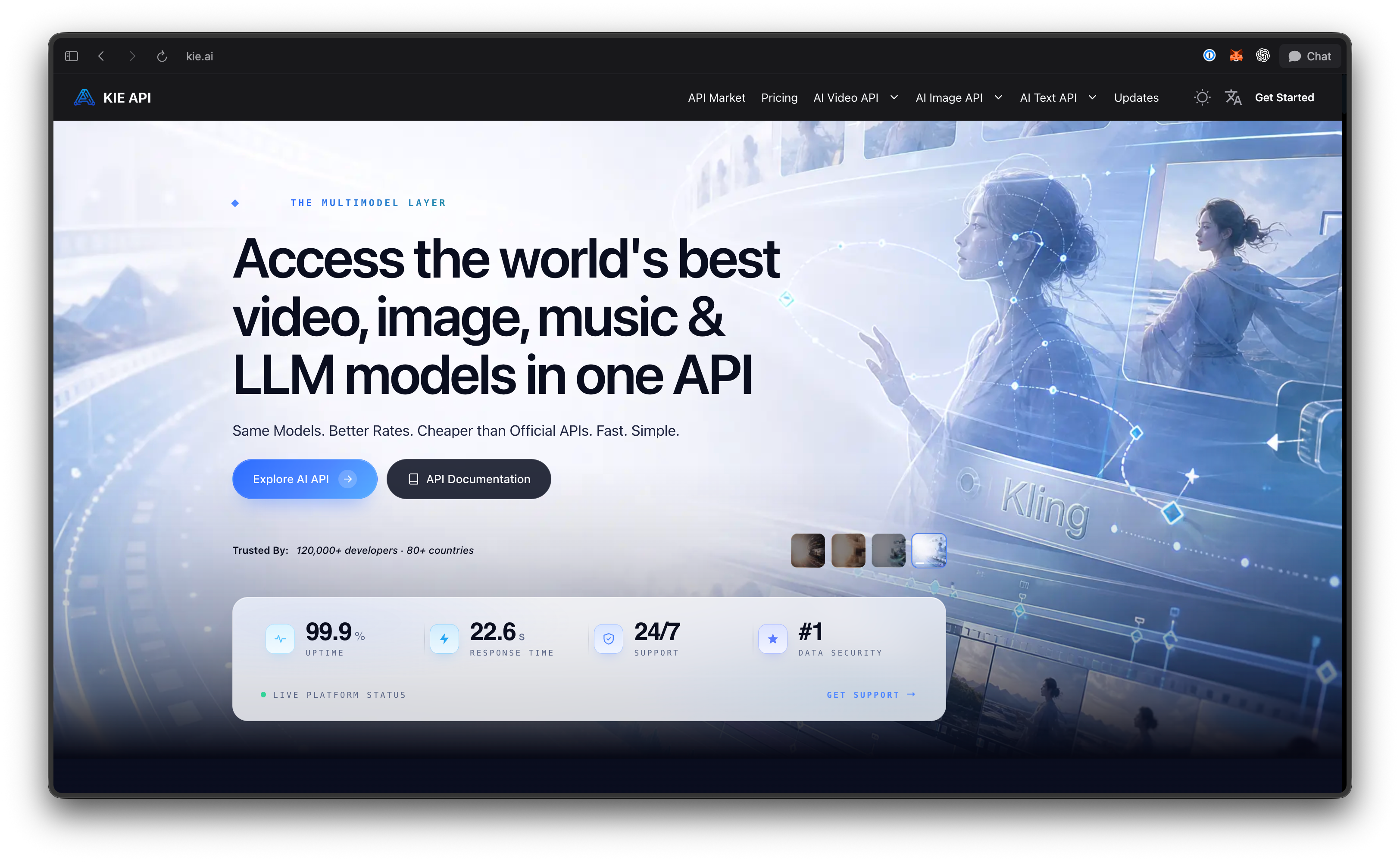
The homepage claims more than 120,000 developers across 80 countries. The changelog page header says more than 1,000 developers. Both are live.
The homepage claims 99.9 percent uptime in the hero, and 99 percent availability in a feature block further down the same page. It also asserts a 24.9 second response time and a number one ranking for data security, neither of which is substantiated anywhere.
The catalogue count drifts as well. The homepage says one hundred plus models, the public model sitemap lists 105, and the documentation carries 182 model endpoint pages. Those are all defensible readings of a catalogue that counts endpoints differently in different places, but they are not the same number.
None of this is fraud. It is a small team shipping fast and not reconciling its own copy. Treat the specific numbers as decoration and the documentation as the source of truth, because the documentation is markedly more careful than the marketing.
Who actually operates it
The terms name two companies: “jointly operated by NEXUSAI SERVICES LLC and INNOLEAP AI LLC”. Governing law is Colorado.
Only the first checks out. Colorado’s business registry lists NEXUSAI SERVICES LLC, formed 29 May 2024, in good standing, with a principal address at a commercial registered-agent building. INNOLEAP AI LLC does not appear in that registry at all, despite the Colorado choice-of-law clause. It may be registered elsewhere. It is also named in exactly one sentence of the terms and in no operative clause: the intellectual property, liability and privacy provisions all name NEXUSAI alone.
Two smaller mismatches. The address in the terms is not the address on the state filing. And the domain was registered in August 2022, about 21 months before the company that operates it was formed.
The same entities run a network of consumer AI sites. I confirmed NEXUSAI named in the terms of brev.ai, bylo.ai, songgenerator.io and aimusic.so, and INNOLEAP named on sdxlturbo.ai. Kie.ai is the developer-facing property in a portfolio otherwise aimed at music and voice.
No founder, officer or team size is named anywhere: not on the site, not in either legal document, not in the registry extract, and not in the domain record, which is privacy-shielded. The only self-description is a line in the documentation calling it a small startup team. Third-party startup-data sites do list names against this entity, but none is corroborated by any primary source, so I would not rely on them.
What the terms do and do not say
They exist, at /terms-of-use, and they are short. What matters is mostly what is missing.
Output ownership is never addressed. The terms cover “User Content”, defined as what you upload or submit, and confirm you retain ownership of it. Model outputs are not mentioned in the document. The claim that Kie supports commercial workflows appears in homepage marketing, which is not a licence grant. If you need to assert rights in something you generated, the terms do not help you.
Refunds are one sentence. Credits never expire, “and refunds are also supported if needed”. No procedure, no window, no eligibility test, no definition of “if needed”.
Termination is at sole discretion, without notice or liability. And there is no clause anywhere describing what happens to an unspent credit balance when an account is terminated, which sits awkwardly beside the promise that credits never expire.
Nothing covers upstream model changes. No clause on availability, deprecation or third-party provider changes, which is a conspicuous silence given the removals below.
Training is not addressed either way. The content licence includes “modify” and “improving our services”, which is broad, but training is never named. The privacy policy does not fill the gap: it is scoped to the website, states that the only personal information collected is an email address, and never uses the words prompt, output or generated content.
That last point has a practical edge. The 14-day media and two-month log retention figures that everyone quotes, including this article’s companion piece, appear only in the homepage FAQ. They are in neither legal document, so they are a description of current practice rather than a commitment.
There is no status page. The homepage shows “Live platform status” beside a 99.9 percent uptime figure. It is a styled span, not a link, the subdomain serves nothing, and the site’s own JavaScript contains no reference to any status provider. The uptime number is hardcoded markup.
The evidence base is thinner than the claims
Kie’s homepage says 120,000 developers across 80 countries. Its own changelog page says more than a thousand. Whichever is closer, the public trace is almost nonexistent.
Hacker News has four results for kie.ai in total and zero comments, and none of the four is about Kie itself. No substantial Reddit discussion surfaced either. What ranks for “Kie AI review” is a wall of affiliate content following the same review-plus-alternatives template, including at least one piece written by a directly competing aggregator that concludes you should use its own product.
I attempted to retrieve an aggregate review score and could not: the review site returns 403 to automated requests, and I am not going to publish a rating I have not read myself. Secondary sources report recurring complaints about credits consumed by failed or incorrect generations and about unanswered refund requests, but I could not trace any of them to a named primary account, so treat them as unconfirmed.
The absence is the point. A service with a genuine six-figure developer base leaves a trace in developer forums. This one has not.
What happened with Midjourney, and with Sora
Both were offered. Both are gone. Neither removal was announced.
Midjourney is provable: an archived copy of Kie’s own Midjourney API specification still exists, documenting generate, upscale, vary and extend endpoints. The marketing page disappeared around late 2025 and the documentation followed around March 2026. Sora 2 went later, with archive snapshots showing its pages live in the afternoon of 15 May 2026 and returning 404 by that evening.
What survives are leftovers, and they mislead people into thinking Midjourney is still on offer. A vendor-category URL still loads, but that route is a catch-all that returns the same page for any invented vendor name, so it proves nothing. Beyond that: a dead filter option in the changelog, orphaned interface strings, a Sora card in the quickstart whose link 404s, and legacy Midjourney API routes that answer with an authentication error rather than a 404.
Why either was removed is unknown. The widely repeated explanation that Midjourney forced resellers to stop appears only in competitor marketing and in commentary citing no primary source. Kie has never published a statement. The removals were silent.
That silence is the actual lesson. Your integration’s lifespan depends on agreements you cannot see, and you will find out the same way everyone else did, when the endpoint starts returning 404.
The risks worth actually pricing in
Set aside the question of legitimacy and the practical exposures are these.
Catalogue continuity. Any model can leave, as Midjourney did. Keep the integration thin enough that swapping one model for a direct provider connection is an afternoon of work.
Retention windows. Generated media is kept 14 days, logs two months, and signed download links expire after 20 minutes. Move anything you care about into your own storage in the same job that created it. This is the failure that actually bites people, and it bites silently a fortnight later.
Single point of failure. One key across a hundred models is the selling point and the concentration risk in one sentence. If you route both your agent’s reasoning and its media generation through Kie, one incident stops both.
Prepaid balance. Credits do not expire, which is good, but money sits with a company whose legal identity I could not establish. Top up in amounts you would not mind losing rather than buying a year ahead for the bonus.
So, is it legit
Yes, in the sense the question usually means. The API works, the documentation is accurate and detailed, the billing rules are clearly stated and favour the customer, failures are not charged, and the company is candid about its own reliability.
Where I would hesitate is anywhere the paperwork matters. No terms of service means no stated position on ownership or refunds, and a privacy policy that never mentions prompts means no stated position on training. If you are generating client work, or anything whose rights you may need to assert later, that silence is a real cost and the discount does not offset it. The same applies to production traffic on a model you have already settled on, where you could hold the provider relationship directly.
Where it is genuinely good is the case it was built for: evaluating many models quickly without opening eight vendor accounts, on a balance that does not expire, paying nothing for the generations that fail. Use it for the long tail and the comparison work, and move your one production model direct once you know which one that is.