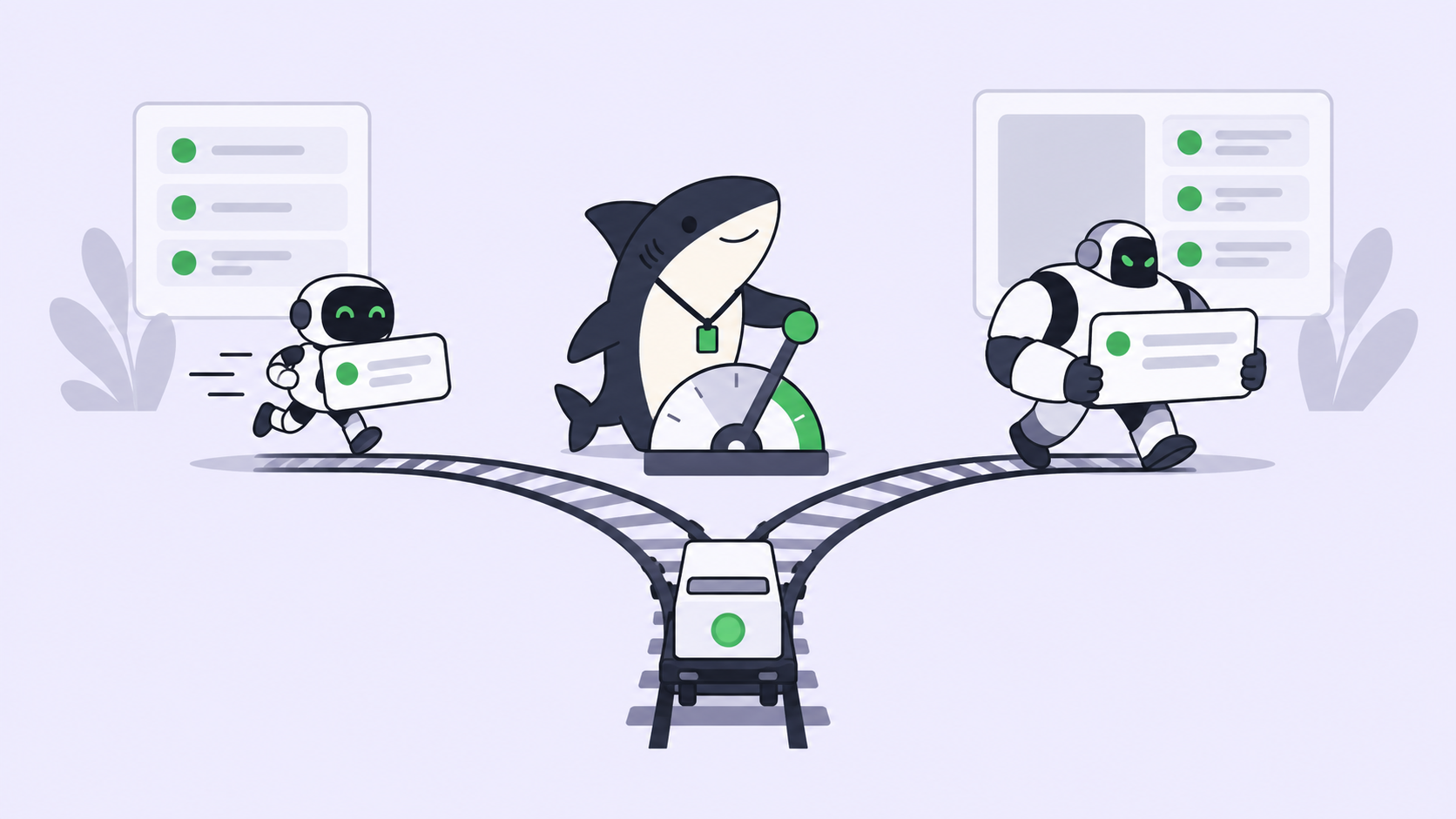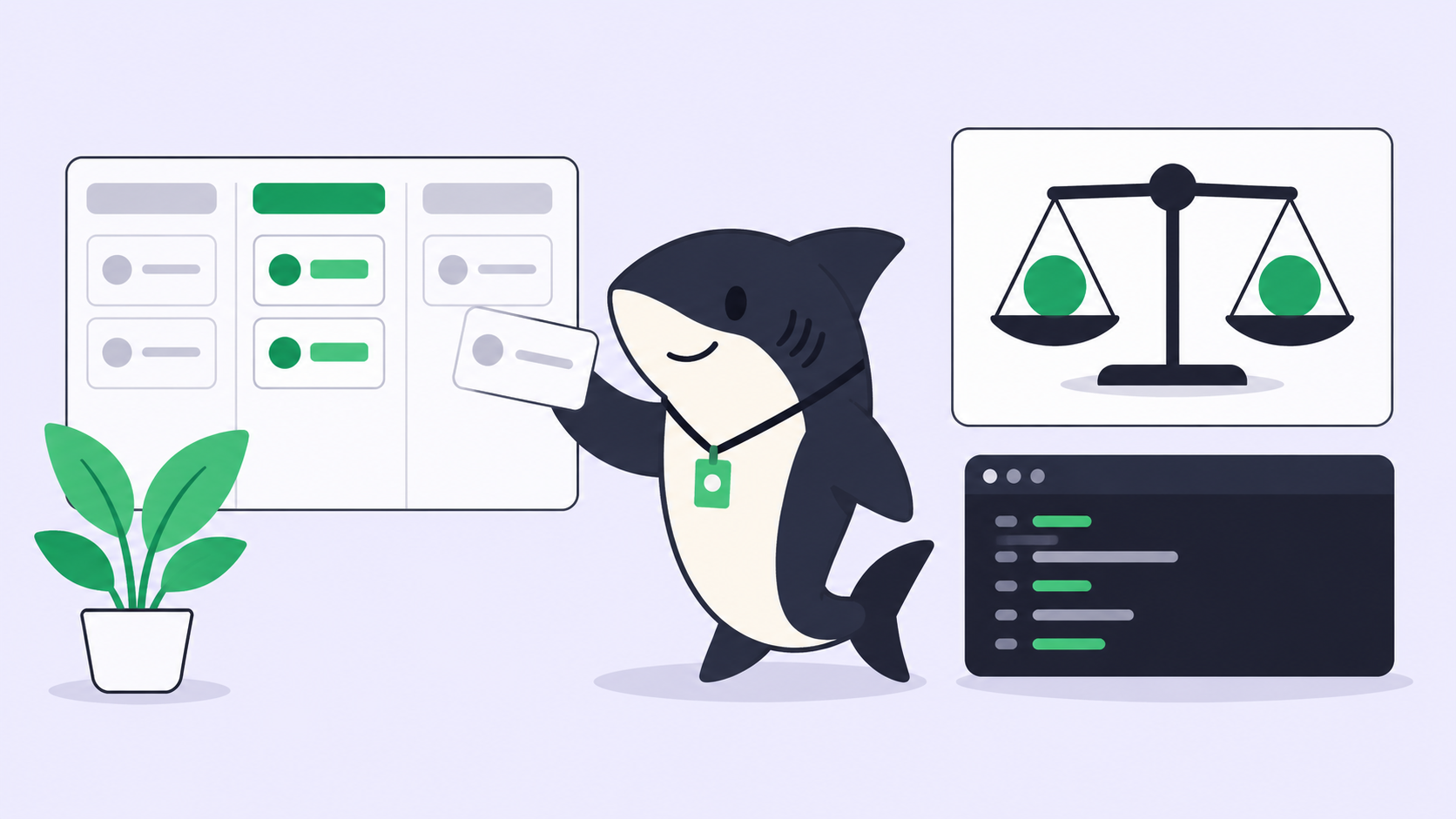
Most tools in this category charge you twice for the same decision. You pay per seat to add a coding agent to the roster, and then you pay again, often to the same vendor, for the tokens that agent burns while it works. Bring five agents onto a ten-person team under that model and the invoice grows along two axes at once. Sharkly’s pricing is built to avoid that, and the mechanism is worth spelling out before you decide whether to bring more agents onto your board.
TL;DR
Sharkly is currently free for organizations up to 10 people, full product, no feature gate. Past 10 people, it’s $7 per user per month billed yearly on the Team plan, same product. Self-hosted is priced directly with the team. None of that changes when you add Agents, Crews, Computers, or Runtimes: a seat is a person in the organization, and those four things are not people. Model usage is bring-your-own-key. Sharkly does not sell tokens; a run bills against the Claude Code, Codex, or API plan already attached to the Runtime that executes it.
The three plans, and the one number that changes between them
There are three plans, and the difference between the first two is a single number.
Free costs $0 and covers organizations of up to 10 people, with the full product and no seat charge. Team costs $7 per user per month, billed yearly, and applies once an organization grows past 10. A monthly billing toggle exists on the pricing page, but no monthly figure is published, so don’t assume one. Self-hosted is custom, “priced with us,” for teams that need to run Sharkly on their own infrastructure; that conversation happens on a demo call, not a price list.
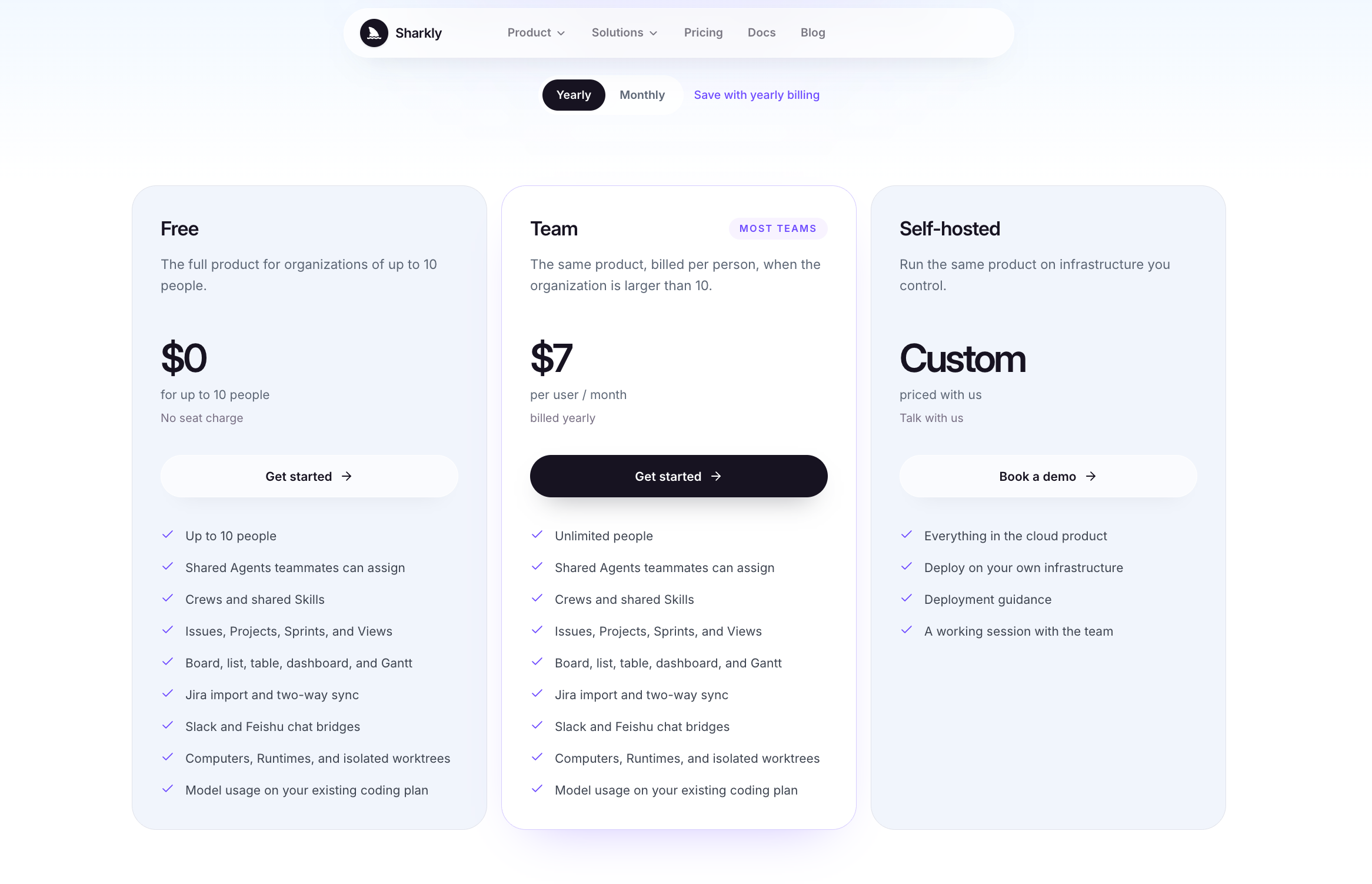
Free and Team ship the same feature list: shared Agents and Crews, shared Skills, Issues, Projects, Sprints, board and list and table and dashboard and Gantt views, Space workflows, isolated worktrees, Computers and Runtimes, a usage dashboard, guests, Jira import with two-way sync, and the Slack and Feishu chat bridges. Nothing on Team unlocks a capability Free doesn’t already have. The only variable across the two paid-eligible tiers is the size of the organization, which is a very different pricing lever than most tools in this space use, and it’s why the seat math below is worth doing carefully.
What actually counts as a seat
A seat, on Sharkly’s own definition, is a person in the organization. That’s the whole rule, and it’s stricter than it sounds, because it excludes almost everything that isn’t a human.
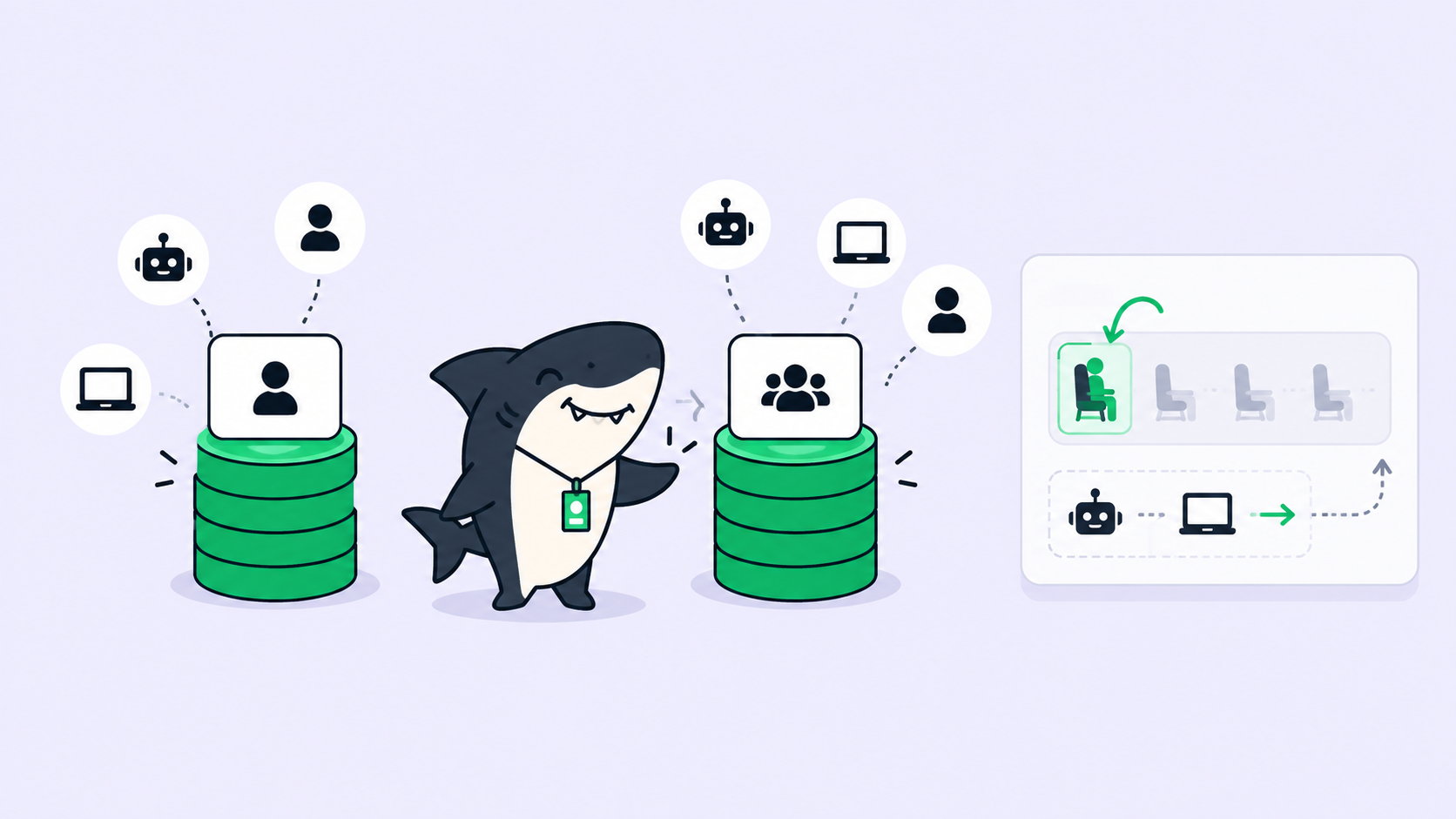
Agents don’t occupy seats. An Agent is a saved working configuration (instructions, Skills, a Runtime, repositories, run settings, visibility), not a person and not a one-off prompt, so creating a tenth or fiftieth Agent has no effect on your headcount for billing purposes. Crews, which group a leader Agent with other Agent and People members under one owner, don’t add seats either, beyond whatever people are already in the organization. Computers, the hosts a run actually executes on, aren’t people, so connecting a laptop and three cloud hosts doesn’t move the seat count. And Runtimes, the concrete coding tools Sharkly detects on a Computer, are configuration, not headcount.
Guests are the other case worth naming: they don’t occupy seats either, which matters if a client or contractor needs visibility into a Task without joining the organization proper.
Put together, the only thing that grows your bill is adding a person. Everything an Agent needs to run, and every Agent itself, sits outside that count.
The arithmetic that makes this worth doing
Say a nine-person engineering team is deciding whether to put five coding agents to work alongside their Claude Code and Codex habits. Under a seat model that counts agents as users, five agents on a nine-person team would functionally be a 40% headcount increase on the invoice before anyone typed a Task. Under Sharkly’s model, the team is still at nine seats, comfortably inside the Free organization cap of 10, whether they run five Agents or fifteen. Crossing into Team pricing has nothing to do with how many Agents, Crews, or Computers they add; it’s purely a function of the eleventh person joining the organization.
That’s the inversion worth noticing. Most of this category prices agent adoption as a cost center: the more you delegate to agents, the bigger the bill, twice over, because you’re paying for the seat and the inference behind it. Sharkly ties the price to organization size instead, so a team can scale how many agents they run without that decision touching what they pay for the platform itself. The decision to add a sixth Agent and the decision to hire an eleventh person stay financially unrelated.
This matters more once a team has actually felt the coordination problem that comes with running several agents at once: which Agent is on which Task, what finished overnight, what’s waiting on a human reply, which Computer has capacity. That problem, not the invoice, is the real reason teams hesitate to add a third or fourth Agent. A pricing model that punishes you twice for trying makes the hesitation worse. One that only counts people removes at least that objection, so the remaining question becomes whether the coordination is manageable, which is a workflow question rather than a budget one.
Sharkly does not sell tokens
The other half of the “charged twice” problem is inference. Sharkly’s own line on this is direct: it does not sell tokens. Model usage is bring-your-own-key, and a run bills against whatever Claude Code, Codex, or API plan is already attached to the Runtime that executes it. If your team already pays for Claude Code seats or a Codex subscription, an Agent’s run consumes against that existing plan, the same way it would if a person had typed the same commands into the same terminal.
This is why the pricing page treats seats and Runtimes as separate lines entirely. The organization pays Sharkly, if it pays at all, for the coordination layer: assignable Agents, the Task record, Computers, Crews, review, visibility. It pays the model providers, directly, for the tokens those Agents actually spend. There’s no markup sitting between the two, because there’s no token resale to mark up.
What “currently free” actually means
Say this plainly, because it matters more than the discount framing usually gets: Sharkly is currently free, not free forever. The Team price above is the published number a growing organization moves to, and nobody is billed under it until the organization crosses 10 people or Sharkly changes what’s free with posted terms. Free today does not mean the Free plan is permanent regardless of how big your organization gets, and it doesn’t mean today’s terms are locked in indefinitely either. It means exactly what the page says: right now, at this organization size, the price is zero.
That distinction is worth sitting with before you build a workflow that assumes free is a permanent floor. If you’re at 8 people running a handful of Agents today, the arithmetic in this article holds until you either grow past 10 or the terms themselves change, whichever comes first. Neither outcome should surprise you if you’ve read the actual pricing page rather than the one-line summary of it.
Deciding whether the agents are worth adding
None of this pricing model answers whether Claude Code or Codex is the right agent for a given Task, and it isn’t supposed to. That decision still belongs to your team, and Sharkly deliberately stays out of it: it manages the Agents you already want to run, it doesn’t tell you which one to want. What the pricing does answer is the much narrower, much more practical question that usually blocks the experiment before it starts: does bringing a third or fifth Agent onto the team change what we pay for the platform. On Sharkly, it doesn’t. It changes what you pay in tokens, and that bill goes to the provider you already have a relationship with, not to a second invoice from Sharkly on top of it.
If you’re already running multiple coding agents and the coordination between them, not the invoice, is the actual friction, that’s the broader problem Sharkly is built around.