Gemini 4 Hydrogen is Google’s fast Gemini 4 model, released November 12, 2026, as gemini-4-hydrogen. It costs $1.50 per 1M input tokens and $7.50 per 1M output tokens, flat across a 1M-token context, and it sits on the Gemini API’s free tier too. For a team running coding agents, it’s the model you put on the high-volume work: triage, small fixes, test runs and verification. Carbon stays for the hard calls.
TL;DR
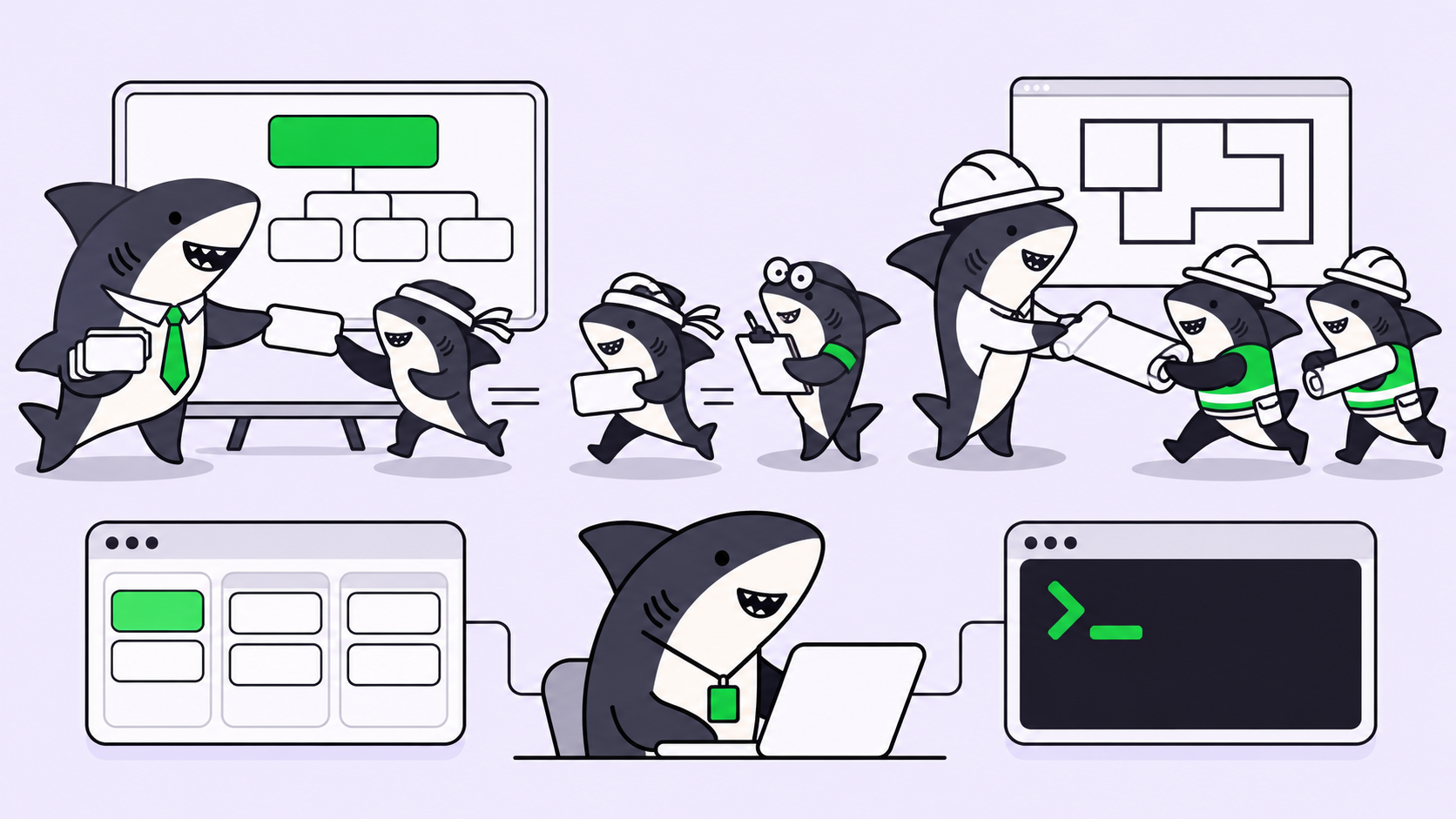
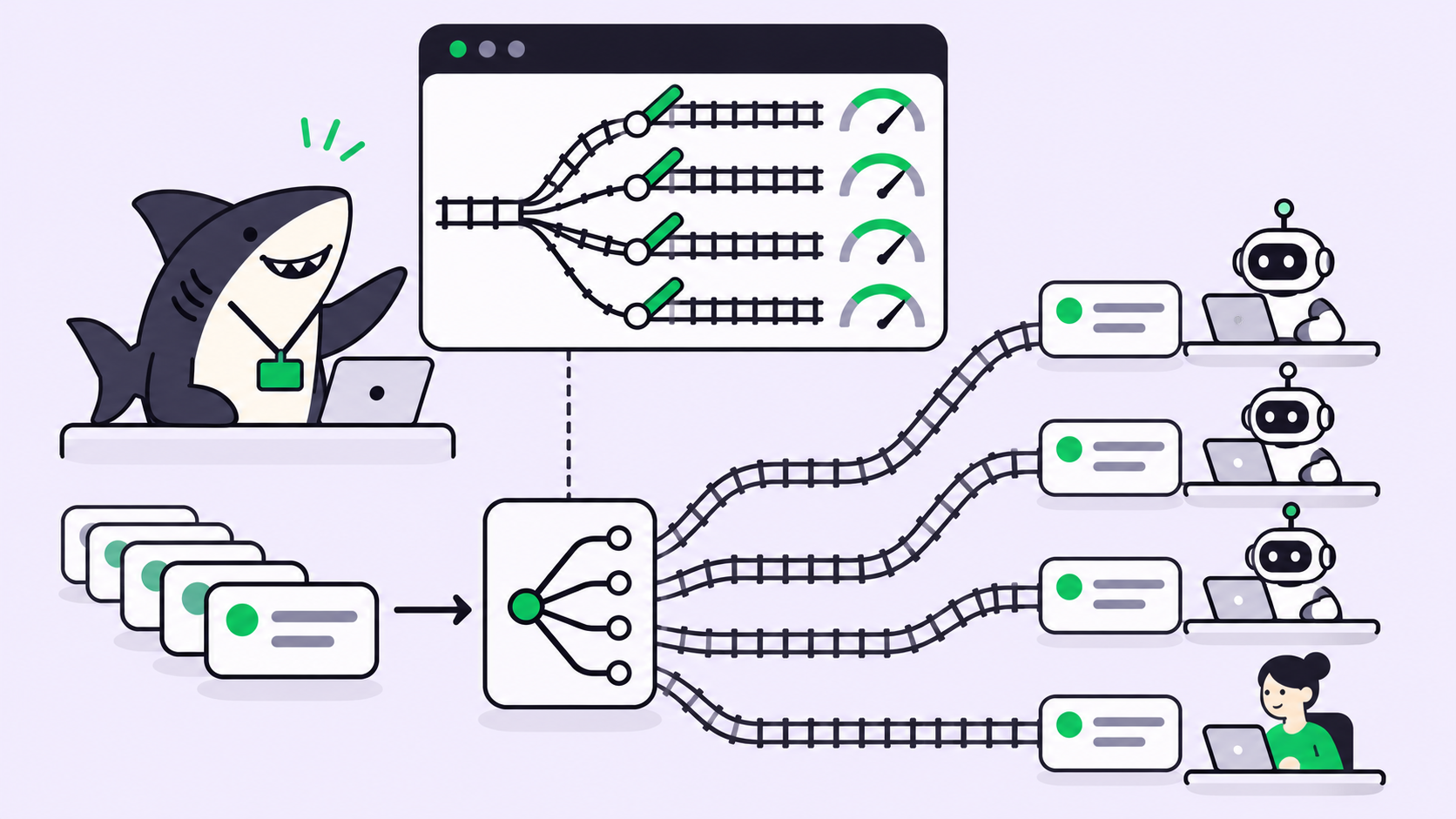
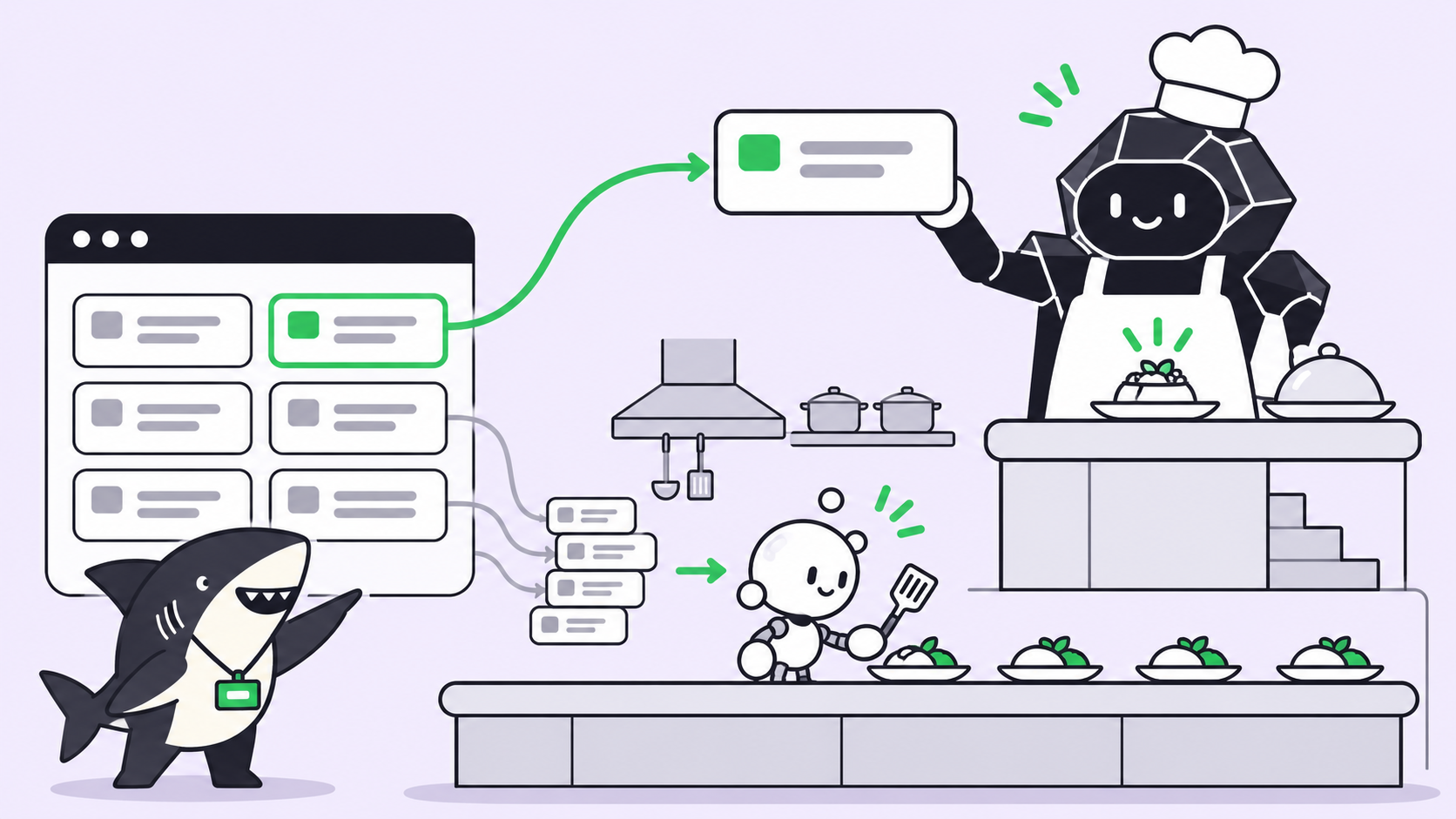
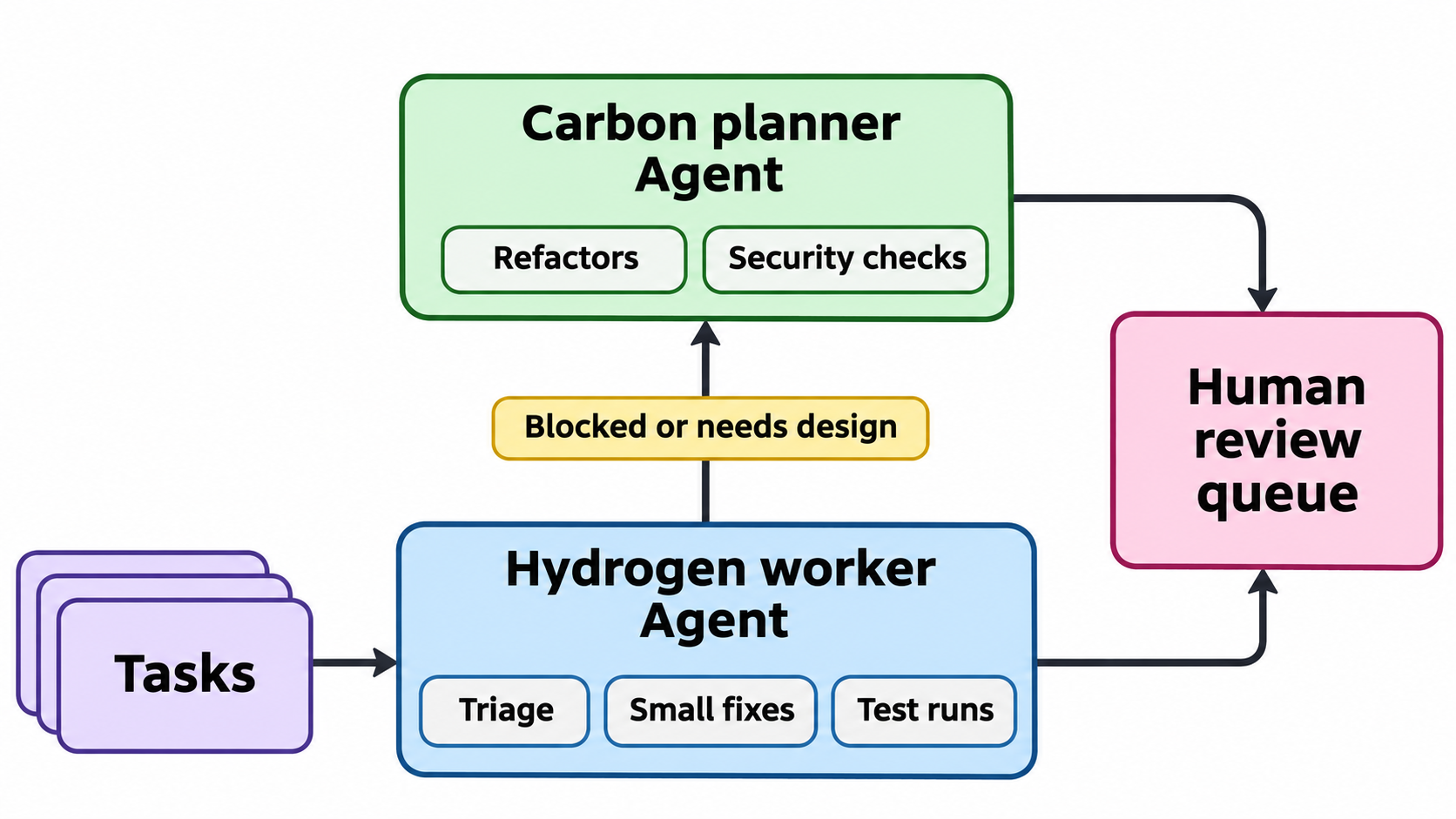
Hydrogen is the worker, Carbon is the planner. Google built Hydrogen to run the everyday steps of agent work fast and cheap, and to hand hard problems up to Gemini 4 Carbon or Gemini 4 Argon. On a board, that becomes two Agents: a Hydrogen Agent that takes most Tasks, and a Carbon Agent that takes the ones Hydrogen bounces. Smoke-test Hydrogen on your Runtime before it gets a Task, keep the default high thinking level, and route every run through review.
What is Gemini 4 Hydrogen?
Gemini 4 Hydrogen is the speed tier of Google’s Gemini 4 family. Google calls it the “daily driver for agentic workflows”: it handles repository coding, debugging, tool calls and multimodal input, alone or paired with Carbon and Argon. It scores 51 on the Artificial Analysis Intelligence Index at its default setting, one point above Argon.
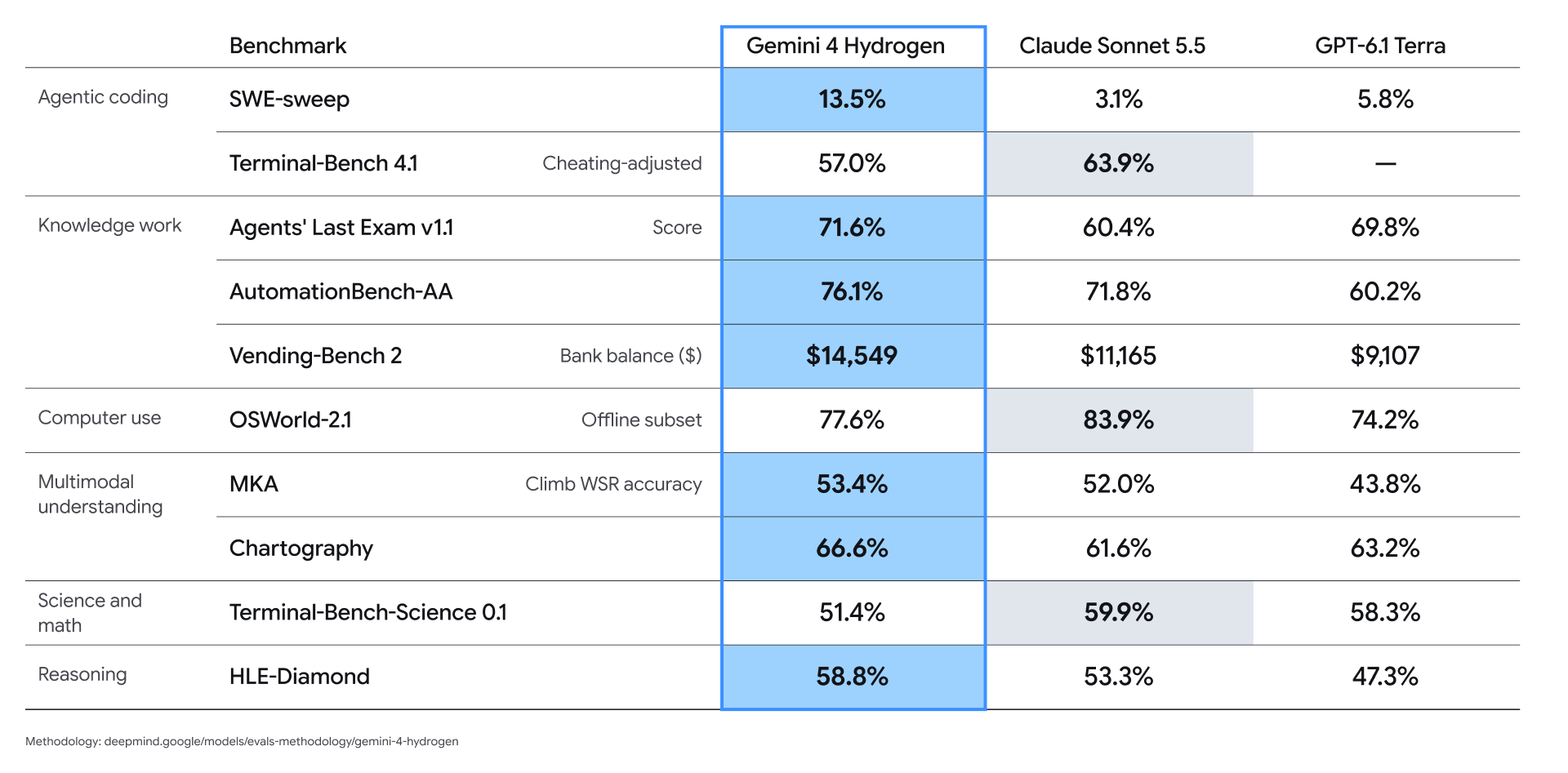
That last number is the surprise. Fast models usually trade intelligence for speed. On Google’s figures, Hydrogen beats Argon on that index at 37.5% of the price Argon charges from December 1, and reaches 54 at its highest thinking level.
Gemini 4 Hydrogen pricing, limits and thinking levels
Here’s the spec card a Runtime config needs, from Google’s AI Studio guide and pricing page:
| Item | Gemini 4 Hydrogen |
|---|---|
| Model ID | gemini-4-hydrogen |
| Paid tier price | $1.50 / 1M input, $7.50 / 1M output, flat across 1M context |
| Cached input | $0.075 / 1M via implicit caching (95% off) |
| Free tier | Yes, rate-limited |
| Context | 1,048,576 tokens shared by input, thinking and output |
| Output per request | 65,536 by default; up to 1M with background execution |
| Thinking levels | low, medium, high (default), xhigh |
Compare the neighbors on the same page. Carbon and Argon cost $2/$10 through November 30, then $4/$20 from December 1, with no free tier. Gemini 3.8 Flash is $0.75/$3.75 through December 31, then $1.50/$7.50, the same price as Hydrogen.
Three migration details bite agent setups. Hydrogen rejects the old minimal thinking level with an error. It ignores temperature, top_p and top_k. And it drops explicit caching, so a config carrying cached_content needs cleaning.
Which thinking level should a coding agent use?
Start at high and move only with evidence. Google’s own guidance, mapped to agent work:
low: bulk labeling, issue triage, changelog drafts.medium: interactive fixes and quick UI changes.high: the default for most coding, tool calls and test runs.xhigh: hard multi-step bugs wherehighalready failed.
Google warns that xhigh “can cause overthinking on simpler prompts.” If a Task needs xhigh twice, it probably belongs to Carbon.
Where Gemini 4 Hydrogen fits on a coding team
Hydrogen earns its place on volume. These are the jobs Google pitches it for, with the numbers behind them. All figures are Google’s or its partners’, not independent results.
- Issue triage. Reading an issue, searching the codebase and asking a clarifying question. Google’s own Antigravity SDK demo assigns triage to Hydrogen agents.
- Small, scoped fixes. Google says Hydrogen makes “focused, surgical edits” without rewriting unrelated files.
- Test runs and verification. Google pitches it for “parallel worker and verifier agents.” On Terminal-Bench 4.1 it scores 57%, against 18.2% for Gemini 3.8 Flash.
- Codebase questions. It batches file reads and searches in parallel. Partners report 2x to 2.8x faster runs and 12% to 23% fewer tokens than 3.8 Flash.
- Dependency bumps and refactors of shared utilities. Google’s Antigravity post shows both.
The number that matters most for unattended work: Google says Hydrogen cuts fabricated claims by more than 5x against 3.8 Flash. It flags missing context instead of guessing. A worker that says “I can’t find the config” beats one that invents it.
Is it safe to run a fast model all day?
Google’s safety numbers, all measured against Gemini 3.8 Flash on Google’s internal evaluations, are worth reading as claims:
- overreach in agentic tasks down up to 81%;
- under-service down up to 79%;
- misaligned actions and task shortcutting cut 12x;
- a 96.7% honesty rate on Google’s agent honesty evaluation;
- 2.3x more resilient on the Gray Swan indirect prompt injection benchmark.
Overreach is the diff that touched files nobody asked about. Under-service is the run that quits early and calls it done. Both still happen. They happen less, so the review step stays, and the model card has the methodology.
When to escalate from Hydrogen to Carbon
Escalate on signals, not on gut feel. Move a Task to Carbon when:
- Hydrogen reports missing context twice on the same Task.
- The fix needs a design decision across modules.
- The Task is a security check or a large refactor.
- A run at
xhighstill fails review.
Carbon is now on the paid Gemini API as gemini-4-carbon. Google built it to spend “more thinking tokens per turn to test hypotheses and verify edge cases.” That’s what you want on the hardest Tasks on your board, and what you don’t want to pay for on the rest.
Google’s own answer to this split is Orchestrator, a model option inside Antigravity that switches between Carbon and Hydrogen mid-run. Carbon plans; Hydrogen edits and tests; Hydrogen hands back when it hits friction. Google reports near-Carbon success on Terminal-Bench with 24% less quota and 19% faster runs on average, per the Antigravity post. It ships to paid Google AI Pro and Ultra subscribers, so it works inside one person’s session. A team board needs the same split as an explicit, visible move.
How to set up Gemini 4 Hydrogen on a Sharkly board
Sharkly puts the coding agents you already run on one board, where Tasks get assigned to People or Agents. Agents run on your Computers through a Runtime, so Hydrogen becomes a Runtime setting, not a new workflow.
Step 1: smoke-test Hydrogen on the Computer
Google hasn’t said which CLIs accept gemini-4-hydrogen. Before Hydrogen gets a Task, run it in a plain terminal on the Computer that will do the work:
export GEMINI_API_KEY="your-paid-project-key"
gemini -m gemini-4-hydrogen -p "Reply with the word ok."
If it returns, rescan the Computer and confirm the Runtime reads Available. Computers in Sharkly covers the statuses. Use a paid key for a worker that runs all day: the free tier is rate-limited, and a throttled Agent stalls Tasks mid-run. Is Gemini CLI free covers which credentials still work.
Step 2: two Agents, one per model
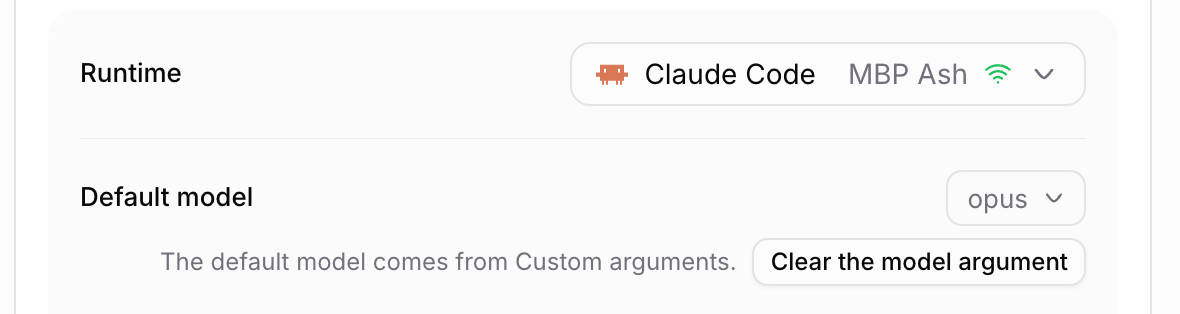
Per the Agents docs, an Agent follows its Runtime’s default model, and each Agent carries its own additional Runtime arguments. So create two:
- Hydrogen worker: instructions for triage, scoped fixes and test runs; model set to
gemini-4-hydrogen; a higher parallel-Task limit. - Carbon planner: instructions for refactors, security checks and design calls; model set to
gemini-4-carbon; a lower limit, because each run costs more.
Step 3: make escalation a board move
Tell the Hydrogen worker to stop and comment when it hits one of the four escalation signals. A person reassigns that Task to the Carbon planner. The handoff is a status change and a comment anyone can read, not a hidden switch inside one session. The execution log keeps both runs, so you can count how often Hydrogen bounces work and tune its instructions.
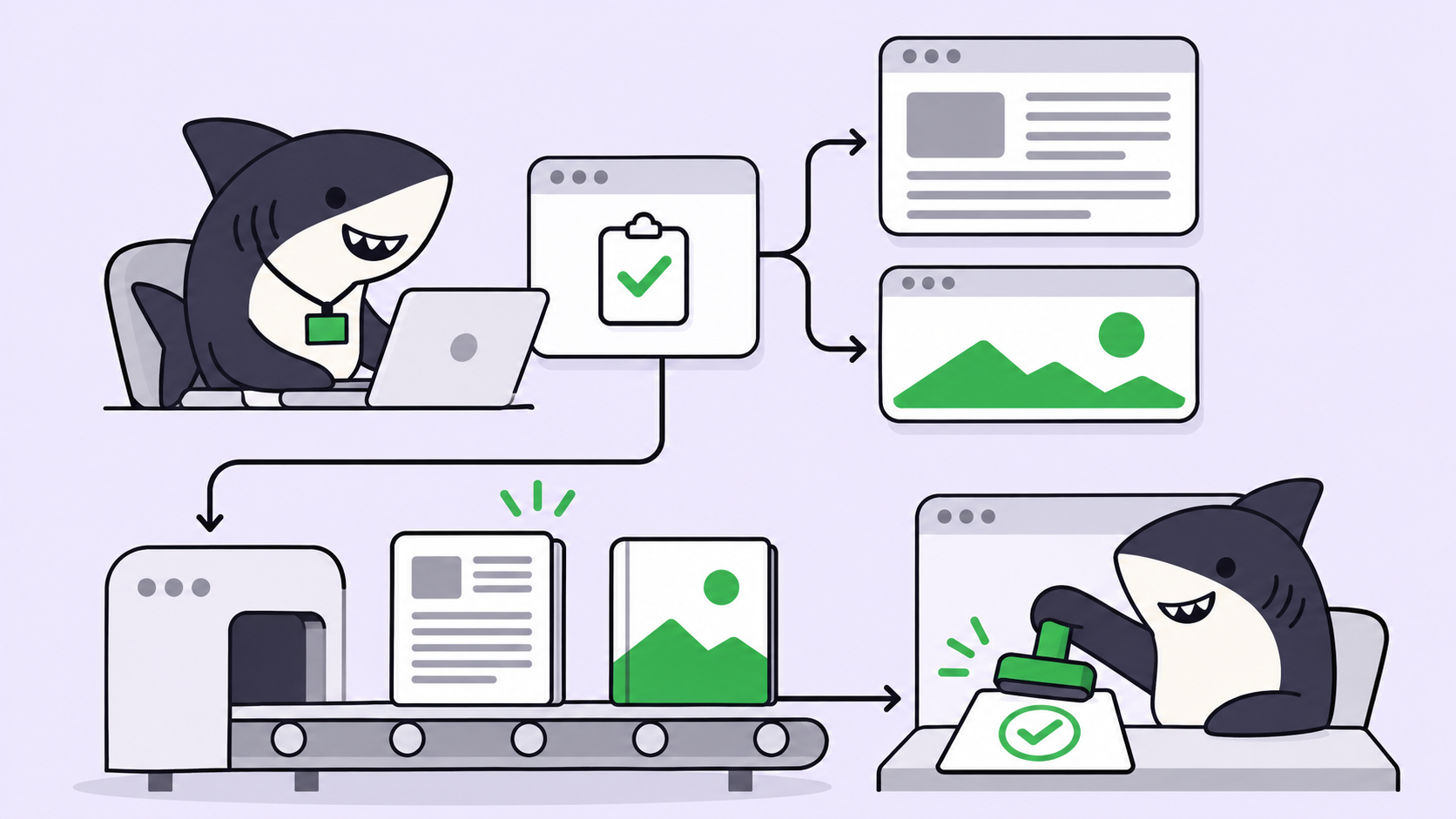
Step 4: keep one review queue
Both Agents open pull requests and stop. A person accepts or requests changes. The approval gates guide covers where to put that stop, and the million-token review queue piece covers why long-context runs need it more. Model costs land on your own Google bill: Sharkly doesn’t sell tokens, as BYOK on an agent platform explains.
Conclusion
Gemini 4 Hydrogen changes the math on agent volume. At $1.50/$7.50, with fewer fabricated claims and a free tier for testing, it’s the model to run all day on triage, fixes and test runs. Keep Carbon for the Tasks Hydrogen hands back, make that handoff visible, and keep one review queue. Sharkly is free to start: connect your Gemini Runtime, create a Hydrogen worker and a Carbon planner, and give each three real Tasks this week.
FAQ
What is the Gemini 4 Hydrogen model ID?
gemini-4-hydrogen. It works with both the GenerateContent and Interactions APIs, per Google’s AI Studio guide.
How much does Gemini 4 Hydrogen cost?
$1.50 per 1M input tokens and $7.50 per 1M output tokens, flat across the 1M context. Cached input is $0.075 per 1M. A rate-limited free tier is also available.
Is Gemini 4 Hydrogen better than Argon for coding agents?
On Google’s Artificial Analysis Intelligence Index figure, yes: 51 against Argon’s 50 at default settings, at a lower price. For long, hard runs, Google still positions Carbon and Argon as the deeper reasoners.
What thinking level should I use for Gemini 4 Hydrogen?
Start with the default high. Drop to medium for interactive fixes and low for bulk triage. Reserve xhigh for hard multi-step bugs.
Does Gemini CLI support Gemini 4 Hydrogen?
Google hasn’t said so in its launch posts. Run a one-line smoke test with gemini -m gemini-4-hydrogen on your Computer before you assign Tasks.
Can I use Orchestrator outside Antigravity?
No. Orchestrator is a model option inside Google Antigravity. Outside it, you build the same split yourself: one Hydrogen Agent, one Carbon Agent, and an explicit escalation step.