Is GPT-6.1 Terra free? No. OpenAI released it on October 26 to Plus, Pro, Enterprise and Edu users in ChatGPT Work and Codex. Free and Go plans are not on that list, the API has no free tier, and OpenRouter lists no free endpoint. What Terra does offer is the cheapest price OpenAI’s middle tier has had, and for a team running several coding agents, that gets the bill close to nothing on routine work.
This post covers the routes that can run GPT-6.1 Terra under an agent, what each one costs, and where the $0 options really are. It follows the same shape as our post on running GPT-6.1 Sol without an API key, so you can compare the two tiers line by line.
TL;DR
No free route runs GPT-6.1 Terra. The cheapest ones that can:
- A Plus or higher ChatGPT plan signed into Codex on a Computer, shared by every Agent that runs there.
- An API key at $1 input, $0.05 cached and $5 output per million tokens.
- Batch or Flex on that key at half price: $0.50 input and $2.50 output.
- Prompt caching, which drops repeated context to $0.05 per million.
- GPT-6 Luna on the ChatGPT Free plan, at $0, for a person rather than a Runtime.
On the platform side, Sharkly is currently free for organizations of up to 5 people. The model line stays on your own accounts.
Every route to GPT-6.1 Terra, and which ones can run an Agent
| Route | Who can use it | What you pay | Can it back a Runtime? |
|---|---|---|---|
| ChatGPT plan signed into Codex | Plus, Pro, Enterprise, Edu | The subscription; runs count against plan limits | Yes. The cheapest practical route |
| API key, Standard | Any API account | $1 / $0.05 cached / $5 per 1M | Yes, billed per token |
| API key, Batch or Flex | Any API account | $0.50 / $2.50 per 1M | Only for work that can wait |
| GPT-6 Luna on ChatGPT Free | Free and Go | $0 on Free | No. A different model, for a person |
A Runtime is the coding agent tool, such as Codex or Claude Code, that Sharkly detects on a Computer and dispatches Tasks to. A Computer is the host it runs on. The table’s last column asks whether the route gives that tool a credential it can use while nobody sits at the keyboard.
Two traps sit in this table. There is no “GPT-6 Terra”: GPT-6.1 Terra replaces GPT-5.6 Terra directly. And OpenAI’s launch wording names Plus, Pro, Enterprise and Edu. Some press coverage adds Business; OpenAI’s text does not, so check your plan before you plan around it.
Route 1: a ChatGPT plan in Codex
For most small teams this is the cheapest way in. You already pay for the seat, and Codex CLI 0.159.0 or later reaches the model with one flag:
codex --version          # 0.159.0 or later
codex -m gpt-6.1-terra   # opens a session on Terra
OpenAI says usage in Work and Codex “goes further” on Terra than it did on GPT-5.6 Terra. Our reading, not an OpenAI statement: at half of Sol’s per-token price and over three times Sol’s average speed, Terra should also stretch a plan further than GPT-6.1 Sol does. Test it on a week of your own Tasks before you count on it.
The catch is the same one the Sol post covers. Every Agent on every Computer signed into one ChatGPT account draws on that account’s limits, and none of them has a share. So set the shares before the week starts with the controls Sharkly does have: a maximum number of parallel running Tasks per Agent, a per-Task timeout, and a concurrency limit per Computer.
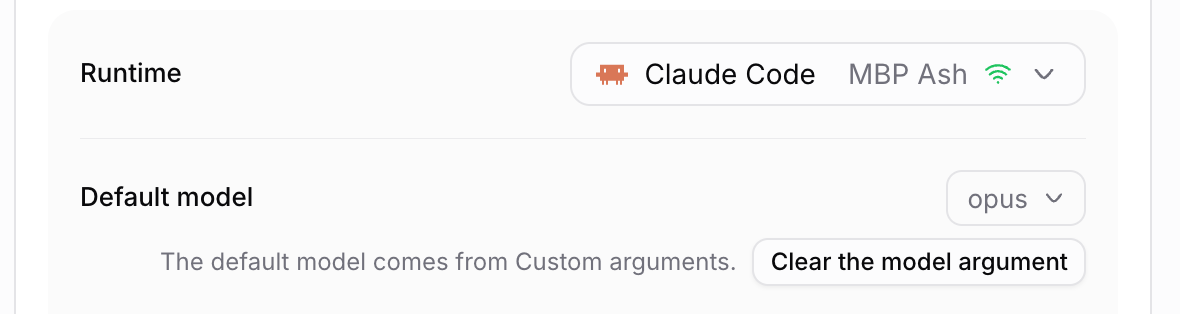
In Sharkly, the model choice lives on the Agent. The Agents documentation says an Agent “follows the Runtime’s model by default,” and that you can “specify one in Custom arguments on the Agent or Runtime.” Create a variant of your existing Codex Agent so its history stays separate from your Sol runs, and add the argument there:
Runtime:           Codex on build-01
Custom arguments:  --model gpt-6.1-terra
Route 2: an API key, and how to push it toward zero
Use a key when a run must not stall at a plan limit: scheduled Automations, overnight queues, Tasks a teammate assigns while the plan’s owner is asleep. The OpenAI pricing page lists Terra at $1 input, $0.05 cached input and $5 output per million tokens. That is exactly half of GPT-6.1 Sol’s $2, $0.10 and $10.
Three levers move the bill further down.
Caching. Agent runs resend the same repository context on every step, so cached input matters more than the headline rate. At $0.05, cached tokens cost a twentieth of fresh ones. A 30-minute cache write costs $1.25 per million, so the saving shows up on runs that reuse context for many steps.
Batch and Flex. Both cost half of Standard. Batch suits work with no deadline, such as a nightly pass over every open lint issue. Flex trades speed for price on interactive-style requests. Whether a given Runtime can request either tier is that tool’s business, so check its docs before you count on it.
Effort. Terra accepts none, low, medium, high, xhigh and max. GPT-6.1 Sol dropped none, and Terra brings it back. Reasoning tokens bill as output, so running renames, dependency bumps and changelog entries at none or low cuts the most expensive line on the bill.
Here is one illustrative agent run: 2M input tokens, 80% of them cached, and 100K output tokens.
| Terra Standard | Terra Batch or Flex | GPT-6.1 Sol | GPT-6 Luna | |
|---|---|---|---|---|
| 400K fresh input | $0.40 | $0.20 | $0.80 | $0.04 |
| 1.6M cached input | $0.08 | $0.04 | $0.16 | $0.016 |
| 100K output | $0.50 | $0.25 | $1.00 | $0.05 |
| Per run | $0.98 | $0.49 | $1.96 | $0.106 |
| 40 runs a day | $39.20 | $19.60 | $78.40 | $4.24 |
The math excludes cache writes. Watch context size too: per the GPT-6.1 Terra model page, a prompt over 272K input tokens is billed at 2x input and cache rates and 1.5x output for the whole request. That turns Standard into $2, $0.10 and $7.50. Splitting a long Task into smaller Tasks with tight context keeps runs under the line.
Route 3: GPT-6 Luna, the only $0 option
If the budget really is zero, the model is not Terra. OpenAI points Free and Go users to GPT-6 Luna in the ChatGPT desktop app. That is a seat for a person working in Work and Codex, not a credential a Runtime can use unattended. We covered the limits of that route in free and cheap tiers for a Crew.
On a key, Luna costs $0.10 input and $0.50 output, a tenth of Terra. The GPT-6 Luna guide covers setting it up as a Runtime, and Luna for the boring 80% covers which Tasks it handles well.
Which agents should run on Terra
Cheap is only useful if the work comes back right. OpenAI built Terra for computer use, writing and visual understanding, and still recommends GPT-6.1 Sol or GPT-6 Astra for the most complex coding. The third-party numbers agree. On Artificial Analysis’s Coding Agent Index, Terra scores 48, GPT-6.1 Sol 54 and GPT-6 Luna 31. Its hallucination rate on AA-Omniscience fell to 38%, from 88% for GPT-5.6 Terra. Artificial Analysis also puts its cost per task at max effort at $0.40, against $1.40 for GPT-5.6 Terra.
A starting split to test on your own board:
| Work | Model | Billing |
|---|---|---|
| Crew leader, ambiguous goals | GPT-6.1 Sol | Plan or Standard key |
| Routine coding, refactors, bugs with a repro | GPT-6.1 Terra, medium |
Plan |
| Docs, release notes, PR descriptions | GPT-6.1 Terra, low |
Plan or Flex |
| Nightly lint and dependency sweeps | GPT-6.1 Terra, none |
Batch |
| Triage and labels | GPT-6 Luna | Key |
The leader row stays on Sol for the reason in our Crew leader guide: a leader’s mistake points every member at the wrong goal. For a written routing rule with a manual escalation path, see model routing for Crews.
Where free actually stops
The platform line can be zero. Per Sharkly’s pricing page, “Free covers organizations of up to 5 people,” and Team is $7 per person billed yearly above that. Agents, Crews, Computers and Runtimes take no seats. “Sharkly does not sell tokens,” so the model line is your plan or your key, which is the point of bring-your-own-key.
The review line never had a free tier. Agents research, execute, test, and report. People set direction, grant authority, and accept the result. Halving the price of a change doubles the changes you can afford, and every one of them still waits for a person. Check your review queue before you double the Crew; human review is the bottleneck covers that side, and coding agent cost management covers tracking the plan and the key side by side.
Your next step: update Codex on one Computer, add a Terra variant of one Agent in Sharkly, and give it three routine Tasks you would have sent to Sol.
FAQ
Is GPT-6.1 Terra free on ChatGPT?
No. OpenAI lists Plus, Pro, Enterprise and Edu in ChatGPT Work and Codex. Free and Go users get GPT-6 Luna instead.
Does GPT-6.1 Terra have a free API tier?
No. The API charges $1 input and $5 output per million tokens, with no free tier, and OpenRouter lists no free endpoint for it.
What is the cheapest way to run GPT-6.1 Terra agents?
A ChatGPT plan you already pay for, signed into Codex on a Computer. For per-token billing, Batch or Flex at $0.50 and $2.50 per million is the floor.
Is there a GPT-6 Terra?
No. GPT-6.1 Terra is the first Terra since GPT-5.6 and replaces it as OpenAI’s middle tier.
Is Terra cheaper than GPT-6.1 Sol?
Yes, by half on every line: $1, $0.05 and $5 against $2, $0.10 and $10. OpenAI also says it runs over three times faster on average than Sol and GPT-6 Astra.
Does Sharkly charge for the model?
No. Sharkly does not sell tokens. Runs bill against the Codex plan or API key on the Computer.