
Yes, Kiro has a free tier, but it is small. Kiro Free costs $0 and gives you 50 credits a month on a limited set of models, Claude Sonnet 4.5 and open weight models, with no way to buy more; past that you wait for the reset or upgrade to Pro at $20 per month for 1,000 credits.
Kiro is an agentic development environment built by a team within AWS: it turns a prompt into structured requirements, a design and tasks (what Kiro calls spec-driven development), then has agents implement them, across a desktop IDE, a CLI and a web app.
What’s free and what you pay
All prices below come from kiro.dev/pricing, checked on October 23, 2026, and are per user per month, before tax.
| Route | Cost | The cap | What you pay past it |
|---|---|---|---|
| Kiro Free | $0 | 50 credits a month, open weight models plus Claude Sonnet 4.5, rate limited | Nothing to buy: wait for the reset or upgrade |
| Kiro Students | $0 for one year | 1,000 credits a month, select universities only | No add-on credits; wait for the reset |
| Kiro Pro | $20 | 1,000 credits, premium models | Add-on credits at $0.04 each |
| Kiro Pro+ | $40 | 2,000 credits | Add-on credits at $0.04 each |
| Kiro Pro Max | $100 | 5,000 credits | Add-on credits at $0.04 each |
| Kiro Power | $200 | 10,000 credits | Add-on credits at $0.04 each |
| Startup credits | $0, if approved | Up to one year of Pro+ | Extra fees above Pro+ or your user count |
New users also get “$20 credited toward your subscription when you first upgrade to a paid plan,” which is a discount on the first paid month, not free usage on the Free tier.
What Kiro Free includes today
Kiro’s billing docs say “New Kiro users automatically start at the perpetual Kiro Free tier.” Perpetual is the key word: this is not a trial that expires. You sign in with GitHub, Google or AWS Builder ID and get 50 credits each month.
Models. The models page has a Free column. Today it ticks Auto (Kiro’s default router), Claude Sonnet 4.5, Claude Sonnet 4.0, DeepSeek 3.2, MiniMax M2.5, MiniMax M2.1, GLM-5 and Qwen3 Coder Next. The newer models are paid only: Claude Sonnet 5, Sonnet 5.5, the Opus line, Haiku 4.5, Kimi K3 and all three GPT-5.6 tiers have no tick under Free.
What a credit buys. Kiro defines a credit as “a unit of work in response to user prompts.” Simple prompts can cost less than one credit, but “executing a spec task, typically cost[s] more than 1 credit.” Every model has a multiplier against Auto at 1.0x. The docs give the example directly: a task that costs 10 credits on Auto costs 0.5 credits on Qwen3 Coder Next (0.05x). Claude Sonnet 4.5 runs at 1.3x, so the same task costs 13.
So model choice is the biggest lever on Free: 50 credits on Qwen3 Coder Next go about 26 times further than on Sonnet 4.5.
Where you can use it. The pricing FAQ says subscriptions work with the Kiro IDE, Kiro CLI, Kiro Web, Kiro Crew and ACP compatible IDEs, and that “Credits are consumed regardless of which interface the work runs on.” One exception: Kiro Web is “Available to Kiro Pro, Pro+, Pro Max, and Power users,” so the browser version is not part of Free.
Where the free tier stops
No top-ups. The add-on credits page is blunt: “You can’t purchase add-on credits on the Kiro Free tier. When you hit your credit limit, you must wait until the next month for your credits to reset.” Unused credits don’t roll over either.
Rate limits. The pricing page says Free access “is subject to rate limits,” but Kiro does not publish the numbers.
Not for organizations. “The free tier is not available in Kiro Enterprise or AWS GovCloud (US) Regions.” If your company signs you in through IAM Identity Center or an external identity provider, you are on a paid plan from day one.
Your content may train models. Kiro’s data protection page says Free tier and individual subscriber content may be used for service improvement, including “model training,” unless you opt out. Free tier inputs may also be stored “for up to 60 days for additional abuse detection,” opt-out or not. Read that page before pointing Free at a work repository.
Is there a Kiro free trial or student offer?
There is no time-limited trial of a paid plan. The two real $0 upgrades are for students and startups.
Kiro for Students. The students page offers eligible university students “1,000 credits per month free for one year,” the same allowance as Pro. The terms:
- Select schools only. Your school must be on the eligible list, your Kiro account tied to your university email, verified through SheerID, and you must be 18 or older.
- No card. “Once verified, you will have access to 1,000 credits per month for one full year. No credit card required.”
- No add-ons. Add-on credits are not available, and after a year “your account will be automatically downgraded to the Kiro free tier.”
Kiro for Startups. The startups page says early stage to Series A startups can apply “for up to 1-year’s worth of free Kiro Pro+” in three sizes: up to 2, 10 or 30 users. You need a business email on your startup’s domain and a matching AWS account. Startups with active AWS Activate credits are not eligible, and some countries are excluded.
The cheapest paid step
Pro at $20 a month is the first paid plan: 1,000 credits, every premium model on the models page, Kiro Web, and add-on credits when you run out. Pro+ doubles the credits for $40; Pro Max ($100) and Power ($200) scale from there.
Three billing details matter:
- The $20 sign-up credit. It applies the first time you upgrade with social login or Builder ID, and a card is required. Kiro bills on the 1st of each month, so the credit is prorated. Kiro’s own example: upgrade to Pro on June 15 and you get $10 credited for June, then pay $10 on July 1.
- Add-ons. They cost $0.04 per credit, in packs from $5 (125 credits) to $100, and expire 12 months after purchase. Plan credits are used first.
- Downgrades. “Downgrades take effect in the following month and upgrades are effective immediately.”
How to use Kiro for free
Kiro Free is enough to learn the spec workflow, not to run it daily.
- Install and sign in. Download the IDE from kiro.dev, or install the CLI with
curl -fsSL https://cli.kiro.dev/install | bash(orbrew install kiro-clion macOS), then runkiro-cliand complete the browser sign-in. Use GitHub, Google or Builder ID; the free models footnote only covers users “who signed up with social logins or AWS Builder ID.” - Opt out of content collection if your code is sensitive (IDE: Settings → User → Application → Telemetry and Content).
- Pick a cheap model. Use Qwen3 Coder Next (0.05x) or MiniMax M2.1 (0.15x) for routine work and save Sonnet 4.5 (1.3x) for planning.
- Keep specs small. Spec tasks usually cost more than one credit, so prefer short task lists.
Students at an eligible school get 20 times the credits on the student tier.
A $0 agent that is not Kiro. If 50 credits is not enough, the free option is a different tool. The OpenCode Zen docs list models priced Free “for a limited time,” such as DeepSeek V4.1 Flash Free. In an earlier test on October 16, 2026, OpenCode 1.19.2 on opencode/deepseek-v4.1-flash-free finished a write-and-run task in 32 seconds with no sign-in (details). You give up Kiro’s spec workflow. For the other common agents, see Is Claude Code free? and Is Cursor free?.
Use Kiro Free when you want to try spec-driven development on a side project. Use Pro, or the student tier, when you want to run it on real work every week.
Where Sharkly fits
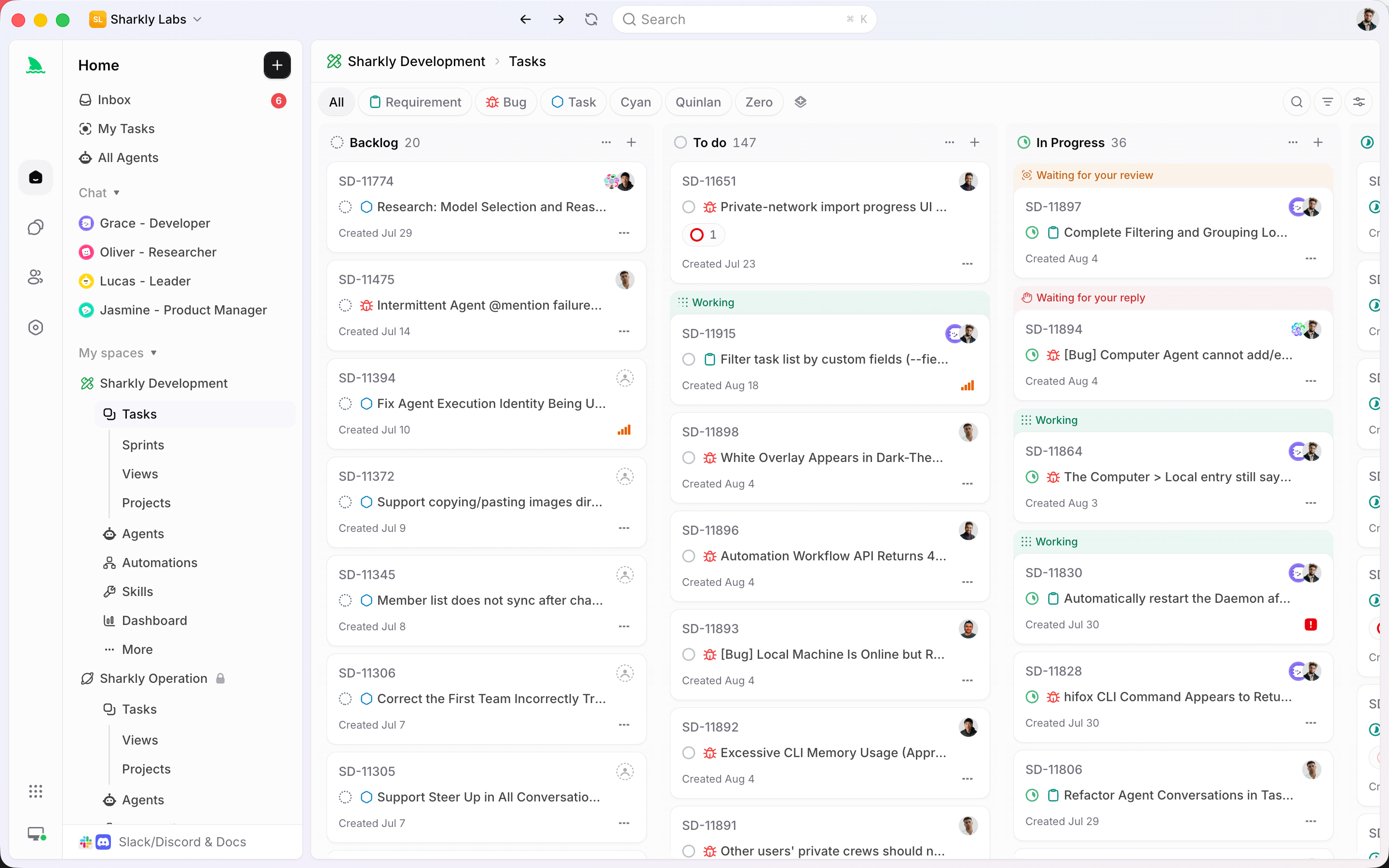
You already have coding agents. Sharkly turns them into a team. You connect your own Computer, Sharkly detects the supported coding tools installed there, such as Claude Code, Codex or OpenCode, and each becomes a Runtime behind an Agent you assign Tasks to from a shared board. Each Task runs in an isolated worktree and the result comes back to the Task for review. Kiro is not on Sharkly’s list of supported Runtimes, and Kiro’s own pricing FAQ says its subscription may not be used “through third-party automation harnesses.” So keep Kiro where it is, and use Sharkly for the agents it does run.
Sharkly does not make Kiro free. Sharkly’s pricing page lists Free for organizations of up to 5 people and Team at $7 per person per month billed yearly beyond that. “Guests, Agents, and Computers do not occupy seats,” and “Sharkly does not sell tokens,” so model usage stays on each tool’s own plan. See Sharkly pricing explained and running an agent Crew on free and cheap tiers.
If you already run Claude Code, Codex or OpenCode side by side, run them through Sharkly.
FAQ
Is Kiro free? Partly. Kiro Free is a permanent $0 tier with 50 credits a month on Claude Sonnet 4.5, Auto and open weight models, with rate limits and no add-on credits.
How many free credits does Kiro give? Fifty a month on Kiro Free, 1,000 a month for one year on the Students tier. Credits reset at the start of each billing month and don’t roll over.
Is Kiro free for students? Yes, at eligible universities. Verified students get 1,000 credits a month for one year with no credit card, then drop to Kiro Free.
Which models can I use on Kiro free? Today’s models page lists Auto, Claude Sonnet 4.5, Claude Sonnet 4.0, DeepSeek 3.2, MiniMax M2.5, MiniMax M2.1, GLM-5 and Qwen3 Coder Next. Claude Sonnet 5, the Opus models and GPT-5.6 need a paid plan.
Is Kiro CLI free? The CLI is a free install, and Kiro says credits are consumed the same way whether you work in the IDE, CLI or web. Kiro Web requires a paid plan.
What happens when my Kiro free credits run out? Kiro pauses usage until the next billing month. On Free you cannot buy add-on credits, so the only immediate option is upgrading to Pro at $20 a month.