The best LLM for browser agents in October 2026 is Claude Opus 5.5 if you want the highest published computer-use score with a strict pass rate attached, Gemini 4 Argon if you want frontier results at the lowest frontier price, and Claude Haiku 5.5 if cost per run matters most. For open weights, Holo4-35B-A3B is the one you can ship commercially. No model finishes most long browser tasks without help, so plan the review step before you pick the model.
Quick answer: best model for browser use, by job
| Pick | Model | Computer-use result (vendor-reported) | API price per 1M tokens (input / output) |
|---|---|---|---|
| Best overall | Claude Opus 5.5 | OSWorld 2.1 offline: 87.2% partial, 53.2% strict | $4 / $20 |
| Best frontier value | Gemini 4 Argon | Agent’s Last Exam: 39.5% pass (top of Google’s table) | $2 / $10 until Nov 30, 2026, then $4 / $20 |
| Longest desktop sessions | GPT-6 Astra | OSWorld-2.0 offline: 72.6% partial | $10 / $50 |
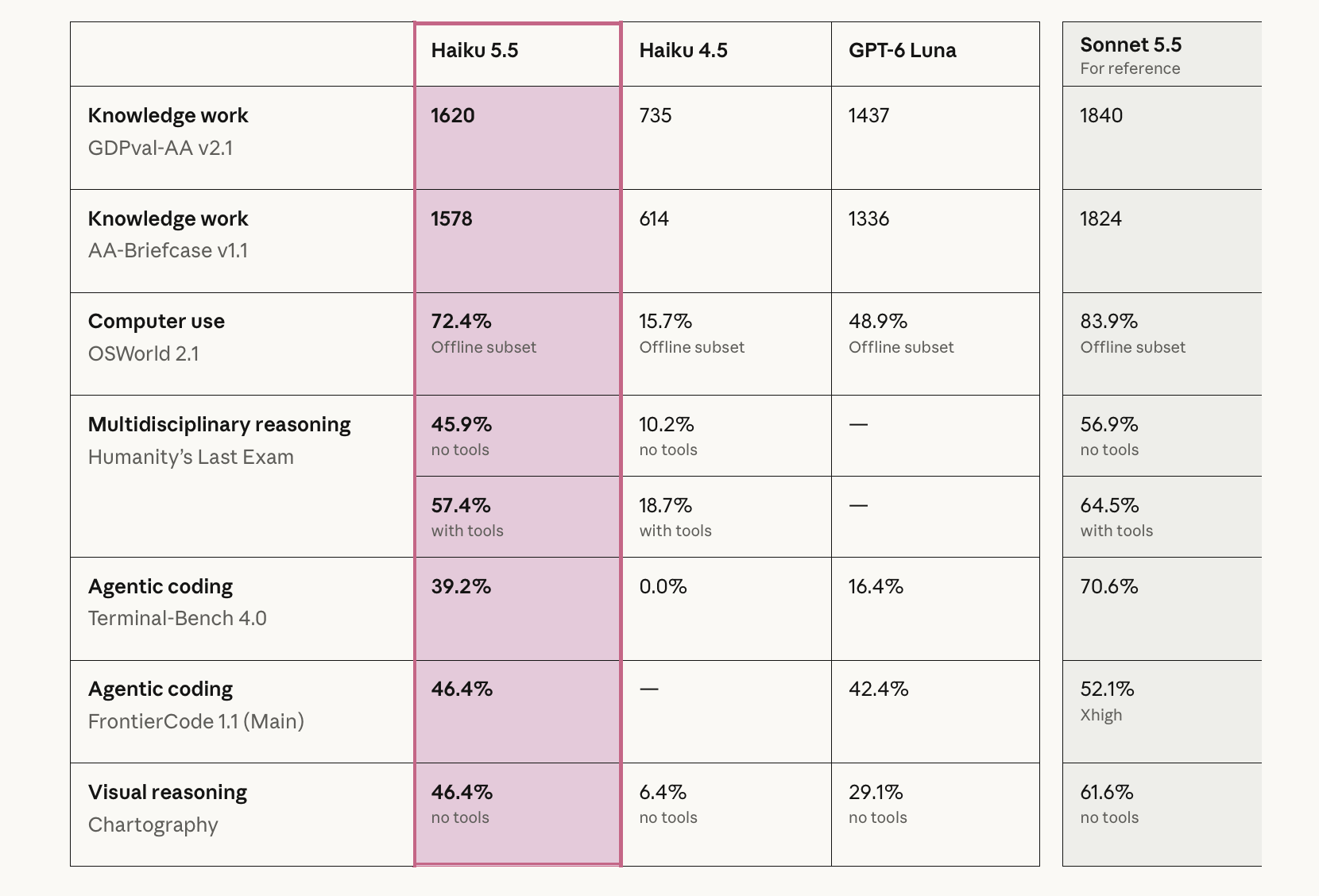
| Best cheap | Claude Haiku 5.5 | OSWorld 2.1 offline: 72.4% partial, 37.1% strict | $0.10 / $0.50 (prompts up to 100K) |
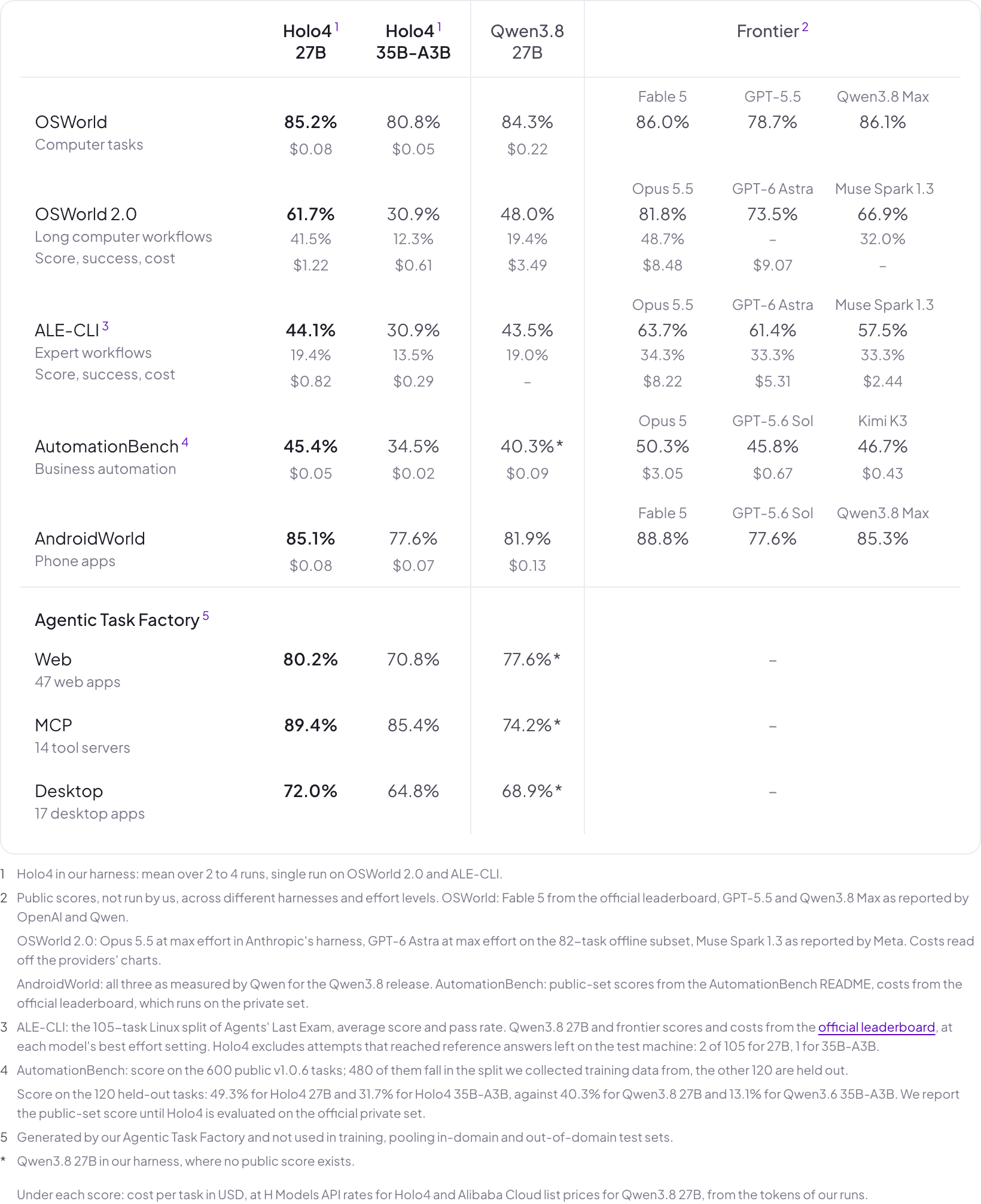
| Best open-weight | Holo4-35B-A3B (Apache 2.0) | OSWorld 2.0: 30.9% at $0.61 per task | self-hosted |
Prices and scores were read on the vendors’ own pages on October 27, 2026. The scores come from different harnesses and benchmark versions, so compare within a row, not across rows.
Why the model matters more for browser agents than for chat
A browser agent is a model that controls a web page through screenshots, clicks, and keystrokes until a task is done. In chat, a weak answer costs you one reread. In a browser, a weak step compounds: one misread button on step 6 sends the next 30 steps somewhere wrong.
That changes what you measure. Four numbers decide a browser model in practice:
- Strict completion rate, the share of tasks where every checkpoint passed, not partial credit.
- Cost per finished task, which is cost per attempt divided by the strict rate.
- Time per task, because a 40-minute run ties up a Computer and a reviewer’s queue.
- Behavior under hostile pages, since every site the agent reads can carry a prompt injection.
The gap between the first two is where teams get surprised. Anthropic’s Haiku 5.5 system card reports partial and strict scores side by side, and every Claude 5.5 model loses 34 to 35 points going from one to the other. Our breakdown of the Haiku 5.5 review queue covers that gap in depth.
How we compared the models
We used only what the vendors publish on their own pages. That rules out most of the benchmarks people search for. None of the current frontier launch posts we read reports Online-Mind2Web or WebVoyager, and BrowseComp measures web research, not page control. What vendors do report:
- OSWorld 2.x: 108 long-horizon tasks on a live Ubuntu desktop, scored as partial credit and strict pass. The benchmark is described in the OSWorld 2.0 paper.
- Agent’s Last Exam: a binary pass rate; Google took the GPT-6 Astra and Opus 5.5 numbers from the public leaderboard.
- AutomationBench: end-to-end business tasks across web and desktop apps.
Model-by-model notes
Claude Opus 5.5: is it the best LLM for computer use?
On Anthropic’s own run of the OSWorld 2.1 offline subset (82 tasks, 1080p, up to 500 steps, max effort), Opus 5.5 scores 87.2% partial and 53.2% strict. That’s the highest strict rate any vendor publishes for a browser-capable model right now. Its launch page lists API pricing at $4 and $20 per million tokens, says output runs more than 30% faster than Opus 5, and calls it more resistant than Opus 5 to prompt injection. In Anthropic’s browser-use injection test, run through its own product harness, no attack succeeded against any Claude 5.5 model across 110 scenarios. That result is for Anthropic’s harness, not yours.
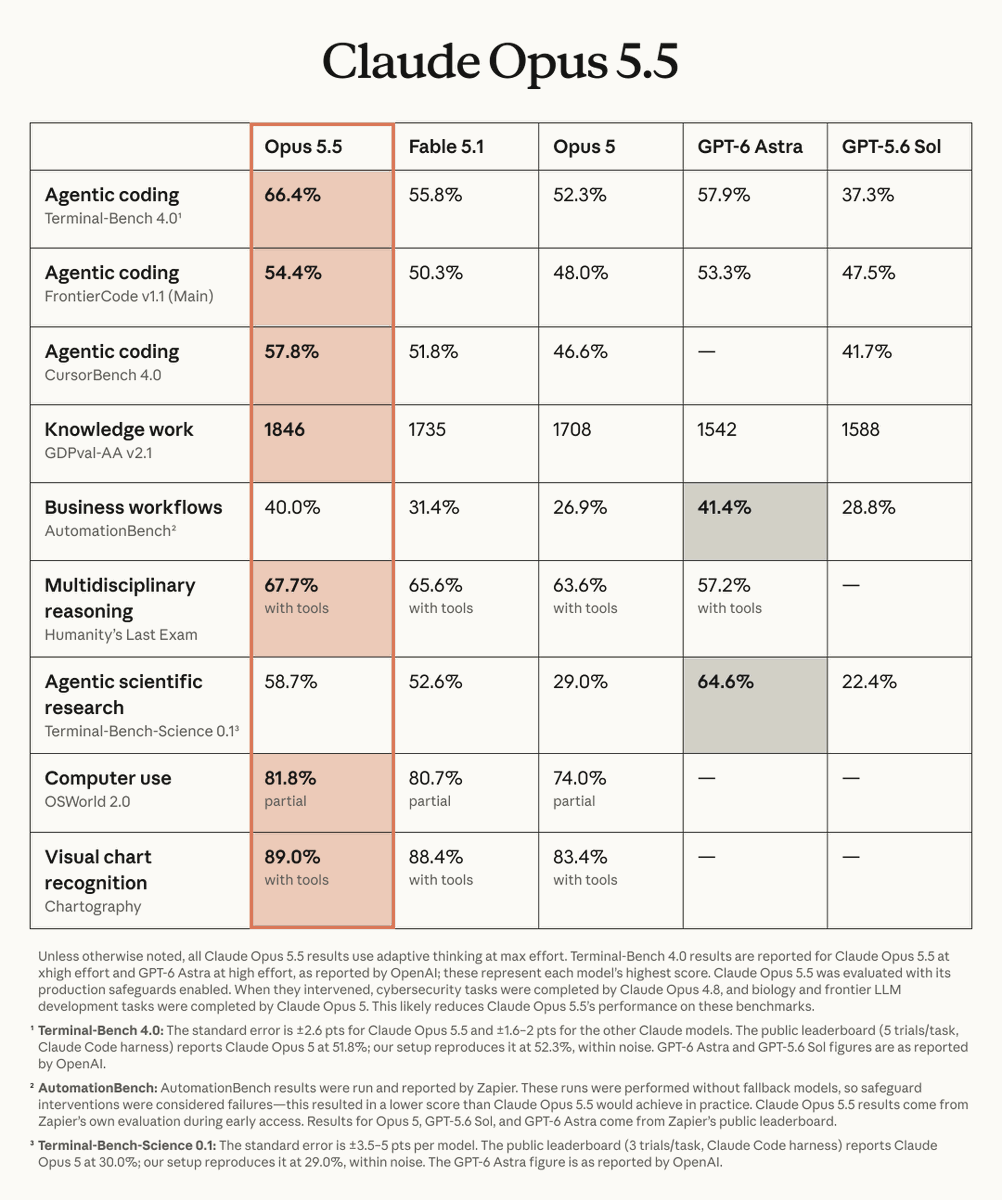
Use Opus 5.5 when a failed run is expensive to redo. Skip it for high-volume form filling, where Haiku’s price wins.
Gemini 4 Argon: best value at the frontier
Google’s Argon launch table puts it first on Agent’s Last Exam at 39.5%, ahead of Opus 5.5 at 38.2% and Astra at 34.2%, and first on AutomationBench at 51.3% (Opus 5.5 42.5%, Astra 41.4%). On the OSWorld-2.0 offline subset it scores 69.2% against Astra’s 72.6%. Google computed several Argon rows itself, so read the table as a vendor claim.
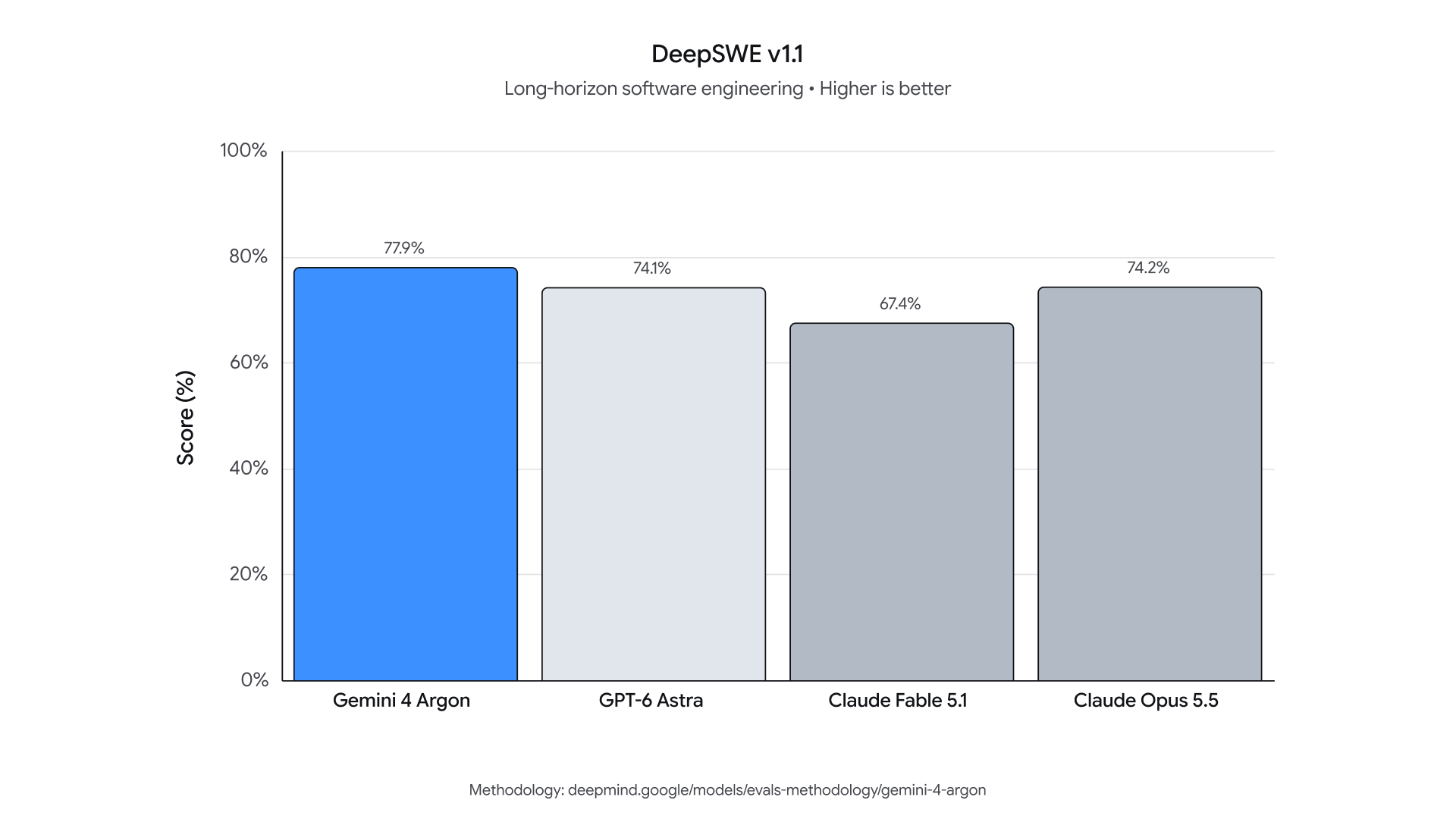
Price is the draw. The Gemini API pricing page lists gemini-4-argon at $2 and $10 through November 30, 2026, then $4 and $20, the same as Opus 5.5. The Gemini computer-use docs add something useful for teams: each proposed action can come back with a safety_decision of allowed, require_confirmation, or blocked. For cheaper runs, the same page names Gemini 3.8 Flash ($0.75 / $3.75 through December 31) as the recommended computer-use model, though Google publishes no OSWorld row for it in that table.
GPT-6 Astra: built for long desktop sessions
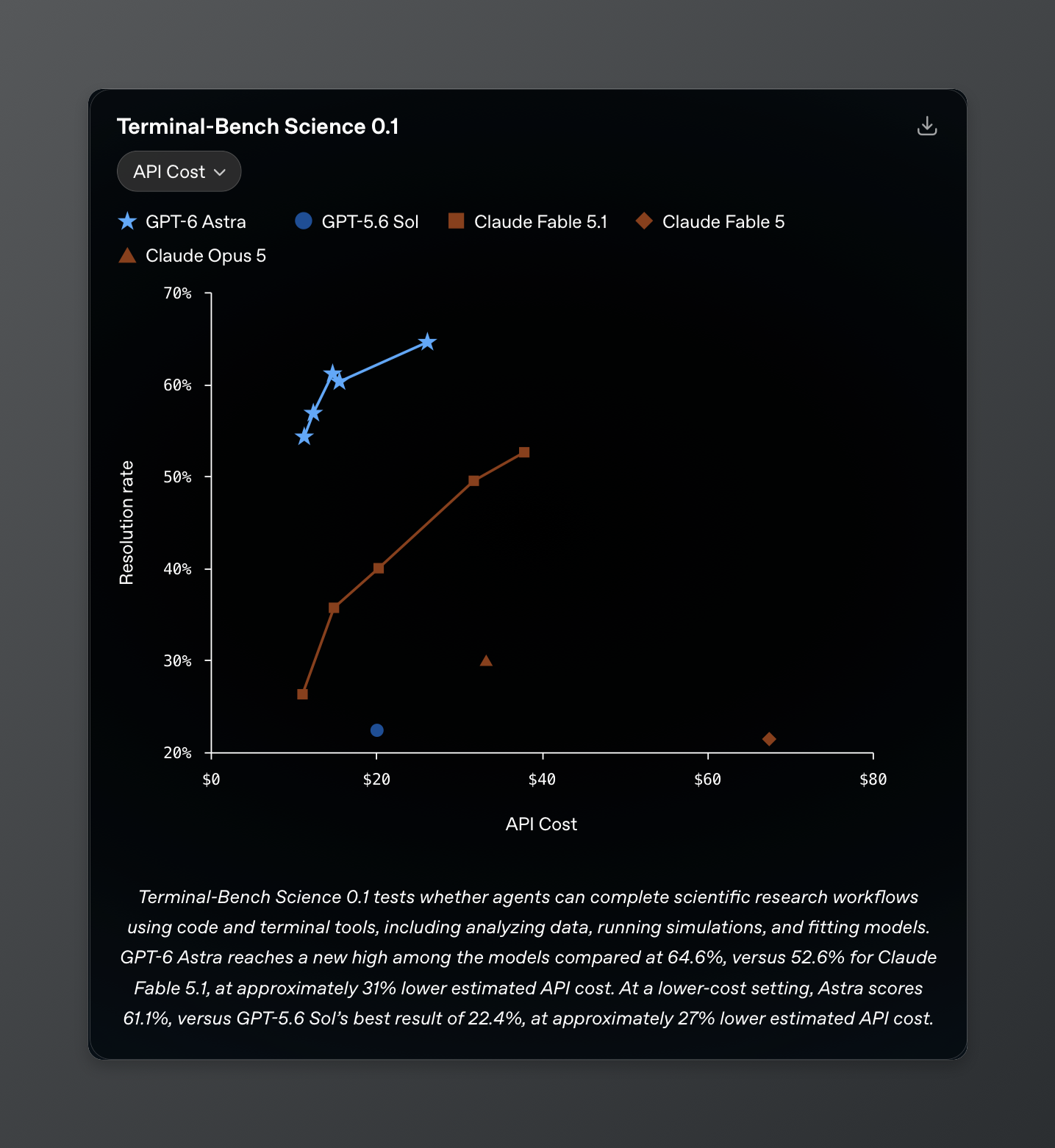
OpenAI’s model page lists gpt-6-astra at $10 input and $50 output per million tokens, a 1,050,000-token context window, and computer use as a supported tool. OpenAI’s launch post reports 72.6% on OSWorld 2.0 at roughly 40 minutes per task. Astra is the priciest model here, and it earns that on full-desktop work: installing software, frontend QA, troubleshooting what’s on screen. For a pure browser lane, Argon and Opus 5.5 match or beat it on the published rows at lower prices. Our post on GPT-6 Astra computer-use guardrails covers how to host it.
Claude Sonnet 5.5 and Haiku 5.5: the cheaper Claude tiers
Sonnet 5.5 scores 83.9% partial and 48.8% strict on the same OSWorld 2.1 run, at $2 and $10. That’s close to Opus quality for half the token price.
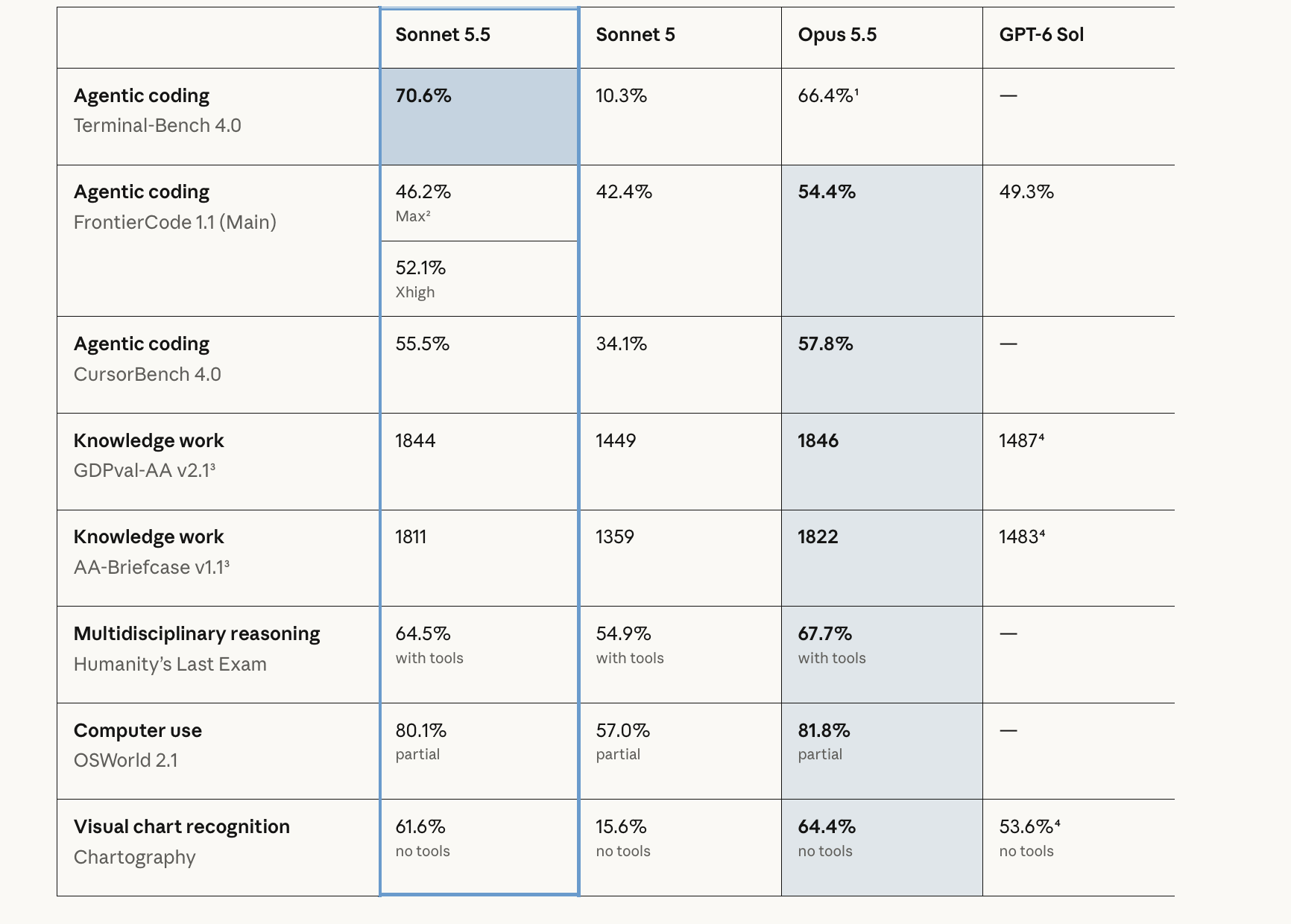
Haiku 5.5 scores 72.4% partial and 37.1% strict at $0.10 and $0.50. The Haiku 5.5 launch post pitches it for “speed-sensitive tasks like live customer support and browser use,” and Anthropic added computer use and browser use to its Python and TypeScript SDKs in beta with the same release. Watch the 100K-token line: longer prompts pay $0.50 and $2.50.
Holo4: the open-weight pick
H Company’s Holo4-35B-A3B model card reports 30.9% on OSWorld 2.0 at $0.61 per task, under an Apache 2.0 license. The larger Holo4-27B scores 61.7% at $1.22 per task, but its license is CC BY-NC 4.0, which rules out commercial use. H also publishes its evaluation trajectories, so you can inspect the runs behind the scores.
Models we left out
GPT-6.1 Terra has no OpenAI model page, so we treat it as unreleased. Kimi K3.1 Pro and Qwen 3.7 Plus may run browser agents, but we found no vendor-published computer-use benchmark for either, and we don’t rank on aggregator numbers.
Cost per task: a worked example
Token prices mislead until you turn them into cost per finished task. Take a 40-step browser task where each step sends about 30K input tokens (screenshot plus history) and returns 400 output tokens. That’s 1.2M input and 16K output per attempt, ignoring caching and thinking tokens.
| Model | Cost per attempt | Strict pass rate | Cost per fully finished task |
|---|---|---|---|
| Claude Haiku 5.5 | $0.13 | 37.1% | about $0.35 |
| Gemini 3.8 Flash | $0.96 | not published | n/a |
| Claude Sonnet 5.5 | $2.56 | 48.8% | about $5.25 |
| Gemini 4 Argon (to Nov 30) | $2.56 | not published | n/a |
| Claude Opus 5.5 | $5.12 | 53.2% | about $9.62 |
| GPT-6 Astra | $12.80 | not published | n/a |
The strict rates come from one benchmark, not your sites, so treat the last column as directional. The bigger lesson sits outside the table. If a person spends three minutes checking each run at $60 an hour, that’s $3 of review per attempt: more than the model bill for every row except Opus 5.5 and Astra. A cheap model with a 37% strict rate also hands a person the unfinished 63%. We dug into this pattern in when cheap models cost more.
How to run browser agents on a team
Whichever model you choose, a browser agent acts on live sites with real sessions. No model on this list makes that safe by itself, and no workflow makes an agent immune to prompt injection. What a team can control is where runs happen, who sees them, and who releases the final step.
That’s the part Sharkly handles. Sharkly runs your Agents through a Runtime on a Computer you connect, so the browser session stays on hardware your team picked. The Agents docs are explicit that an Agent type grants no extra permissions: Space, Computer, Runtime, and resource access still apply.
A workable pattern for a browser lane:
- One Task per job. One form, one batch of records, one acceptance check you can count.
- Stop before outbound actions. Instruct the Agent to halt before any login, purchase, or form submit and report done, not done, and evidence.
- Review in one queue. Runs that need a person show as “Needs review” in the Task Chats module, per the Inbox docs.
- Release with a comment. A person approves the final step by @ mentioning the Agent on the Task.
Agent instructions (browser lane)
- Work only in the browser profile on this Computer.
- Never submit, purchase, or sign in to a new account.
- Before any submit button: stop, list fields filled, attach evidence,
  and wait for a comment that @ mentions you.
- Report: Done / Not done / Evidence.
For where to draw these lines, see approval gates for coding agents and our notes on prompt injection and agent guardrails with Opus 5.5. Sharkly is currently free for organizations of up to 5 people, per the pricing page, and you bring your own model keys.
FAQ
What is the best model for browser use?
Claude Opus 5.5 has the highest published strict pass rate (53.2% on OSWorld 2.1 offline). Gemini 4 Argon leads Agent’s Last Exam and costs half as much through November 30, 2026.
What is the cheapest LLM for browser agents?
Claude Haiku 5.5 at $0.10 input and $0.50 output per million tokens, with a 37.1% strict pass rate. Budget for review.
Is there a good open-weight browser agent model?
Holo4-35B-A3B is Apache 2.0 licensed. Holo4-27B scores higher but is non-commercial.
Are OSWorld scores comparable across vendors?
Only loosely. Anthropic runs OSWorld 2.1, Google and OpenAI report OSWorld 2.0, and harnesses differ.
Does the model choice stop prompt injection?
No. It lowers the odds. Keep humans on outbound actions.
Conclusion
Pick Opus 5.5 when a failed run is costly, Argon when you want frontier scores at the lowest frontier price, Haiku 5.5 for volume, and Holo4-35B-A3B when you must self-host. Then measure cost per finished task on your own sites, not per token. To run that browser lane as a team, put each job on a Task, gate the submit step, and review in one place: start with Sharkly and connect your first Computer today.