Quick answer: Claude Fable 5.2 pricing is $8 per million input tokens and $40 per million output tokens on Anthropic’s standard API. Fast mode costs $16 and $80 respectively. Budget across the entire workflow: repeated context, thinking, retries, coordinating agents, tools, and human review. Rates checked November 10, 2026.
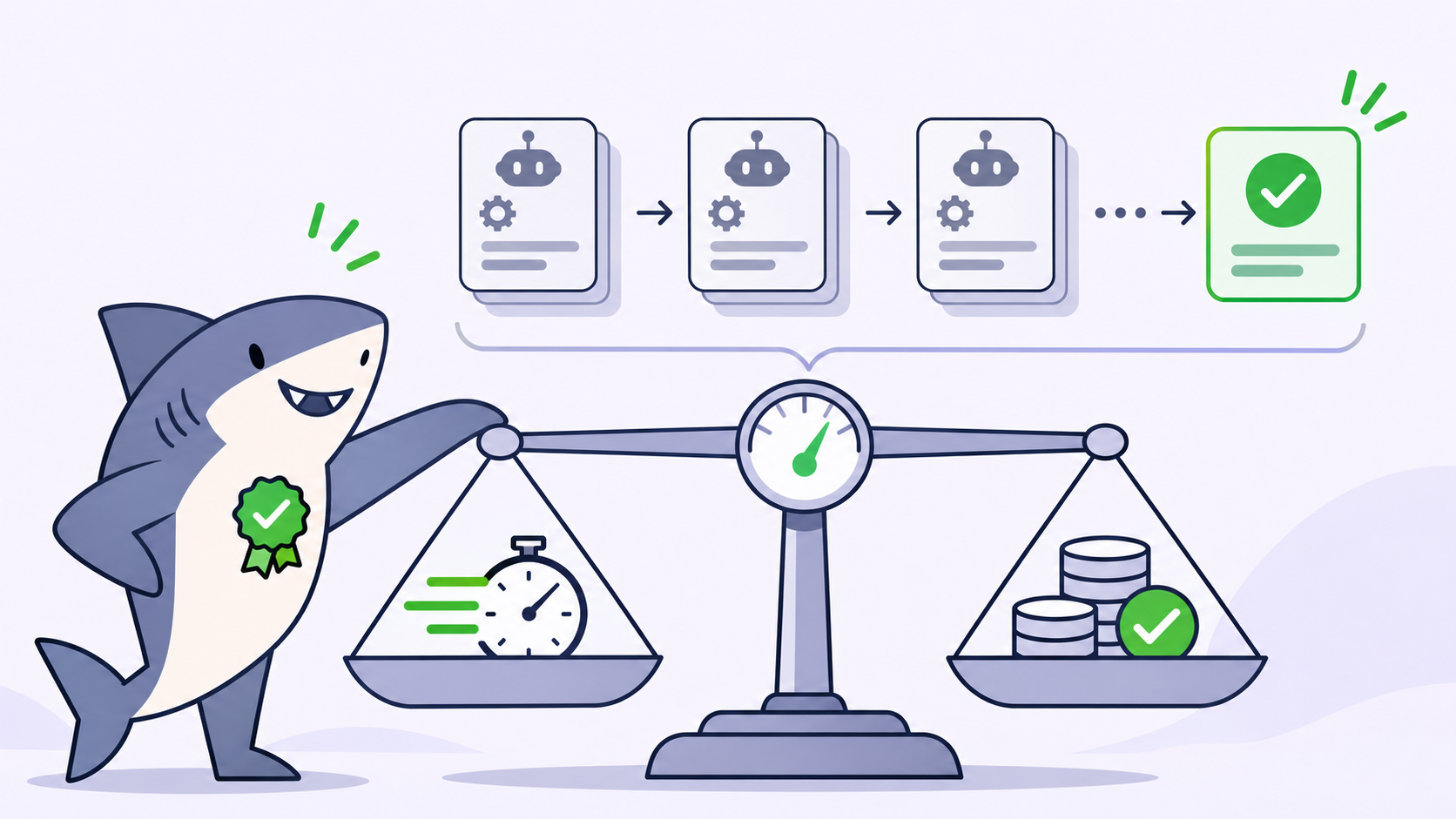
A token price tells you what a model call costs. Your engineering budget needs the cost of an accepted result. A migration that requires three attempts, another agent’s review, and a human correction has several bills attached to one deliverable.
If you’re running several coding agents, Sharkly gives you a shared place for their Tasks and results. Start your cost analysis there: define what counts as finished before comparing models.
What does Claude Fable 5.2 cost?
Anthropic charges separately for input and output tokens, with distinct rates for caching, batch processing, and fast mode. One MTok means one million tokens. The following USD rates come from the official pricing documentation, checked November 10, 2026. They describe API usage, rather than a flat monthly coding subscription.
| Billing category | Input per MTok | Output per MTok |
|---|---|---|
| Standard API | $8 | $40 |
| Fast mode | $16 | $80 |
| Batch API | $4 | $20 |
| Standard five-minute cache write | $10 | Not applicable |
| Standard one-hour cache write | $16 | Not applicable |
| Standard cache hit | $0.20 | Not applicable |
Cache writes and hits are input categories, not discounts on output. Fast-mode cache pricing applies the caching multipliers to fast-mode input rates. Batch processing gives a 50% input/output discount, but fast mode cannot be combined with Batch.
Fable includes the full one-million-token context window at standard per-token rates. That still makes a large context expensive: uncached input accumulates across calls. Partner-operated cloud platforms can have different pricing; confirm the endpoint that invoices your team.
How do you calculate a workflow budget?
For a standard uncached call, multiply input tokens by $8 per million and output tokens by $40 per million, then add the results. Repeat for every call in every attempt. Add separate tool and infrastructure charges, followed by human review time, to estimate the full delivery cost.
# Hypothetical standard-API example, not a measured benchmark.
input_tokens = 100_000
output_tokens = 20_000
api_cost = input_tokens / 1_000_000 * 8
api_cost += output_tokens / 1_000_000 * 40
print(f"${api_cost:.2f}")  # $1.60
Here, output means total billable output, including thinking where applicable. Don’t substitute the visible answer length for the usage reported by the provider.
Suppose you run 20 tasks with those token totals. Five tasks need one identical retry. Assume a coordinating agent adds $2 in total, and one reviewer spends 15 minutes at an internal cost of $80 per hour.
| Hypothetical component | Calculation | Cost |
|---|---|---|
| Initial attempts | 20 × $1.60 | $32 |
| Additional attempts | 5 × $1.60 | $8 |
| Coordinator | Assumed aggregate model spend | $2 |
| Human review | 0.25 hours × $80 | $20 |
| Total | Before tools, infrastructure, and taxes | $62 |
If all 20 tasks are accepted, that example costs $3.10 per accepted task. If only 16 are accepted, the same $62 costs about $3.88 per accepted task. The denominator changes the decision.
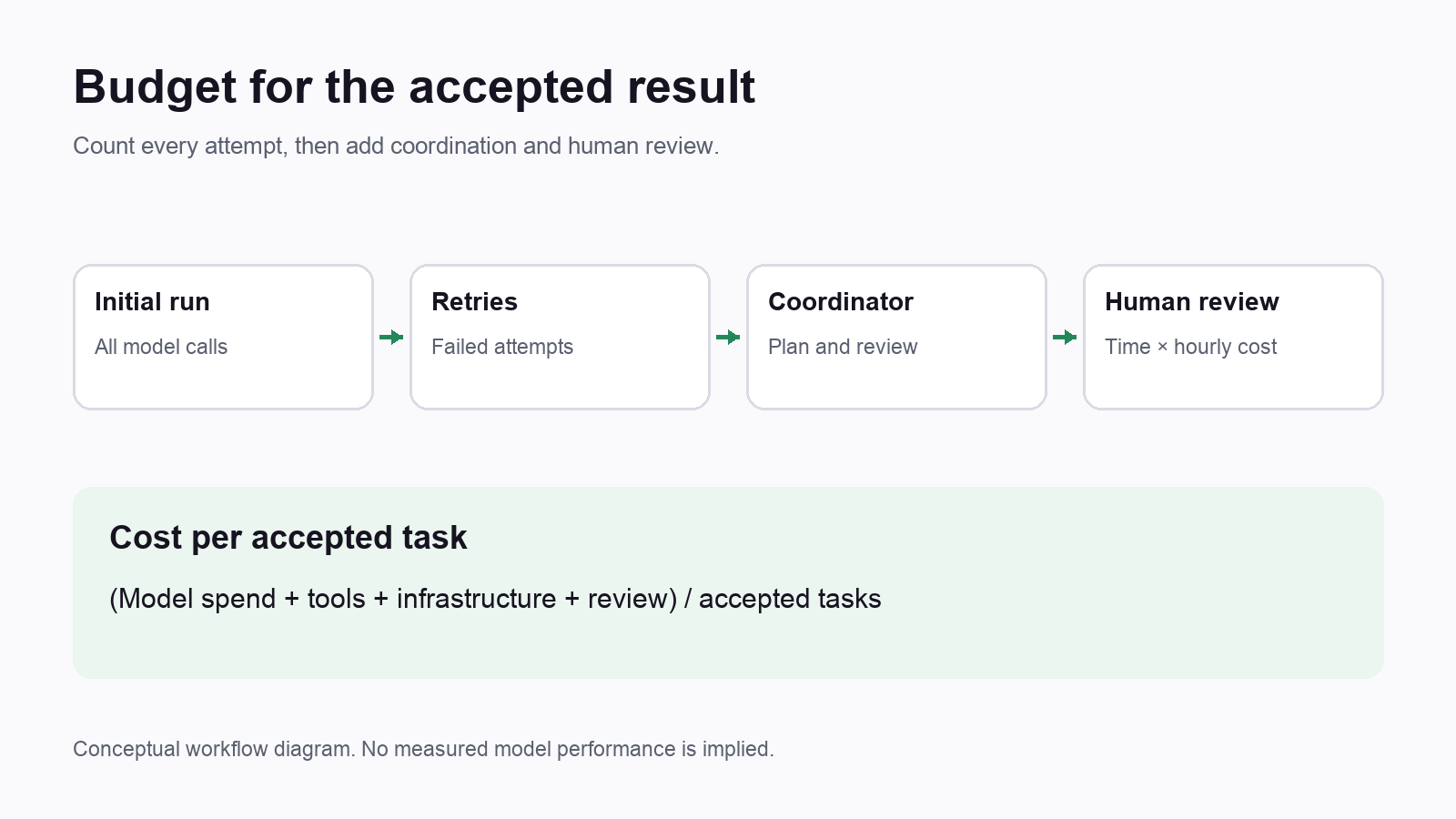
These are planning assumptions, not observed Fable performance. Replace them with your token totals, retry counts, acceptance results, and review time. Our guide to pricing agent runs per accepted change explains why this comparison matters.
Fast mode and effort settings change different costs
Fast mode raises token rates to reduce generation time. Effort changes how much work the model does, including thinking and tool calls. Treat them as separate controls: faster generation doesn’t guarantee a shorter end-to-end workflow, and a lower effort setting doesn’t establish a fixed spending cap.
Anthropic’s launch announcement claims fast mode generates tokens up to 2.5 times faster. That’s a provider claim about generation, not a guarantee that builds, tests, network calls, or human review finish 2.5 times faster.
At identical token counts, the $1.60 example becomes $3.20 in fast mode. Use fast mode when the value of reduced waiting exceeds the premium. Use standard mode for unattended work when generation latency doesn’t constrain delivery.
The effort documentation lists Low, Medium, High, Xhigh, and Max for Fable 5.2. Its API default is High. The announcement identifies Medium as the default in Claude apps and Claude Code. Record the product and explicit setting in your comparison.
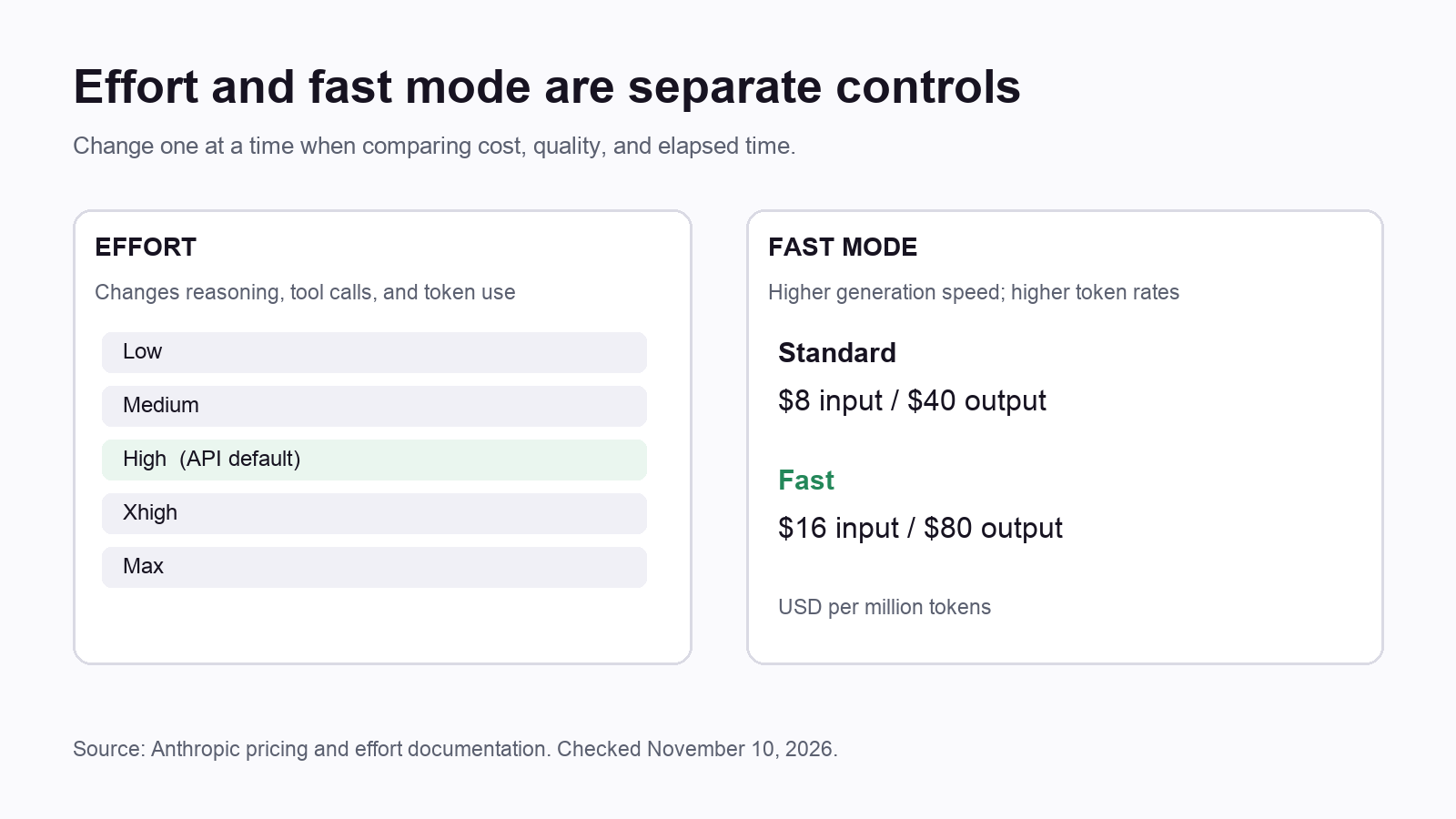
Anthropic recommends starting API workloads at High, lowering effort where evaluations retain quality, and moving to Xhigh where difficult work shows a measured gain. Max prioritizes capability without regard to token cost. Effort is a behavioral signal; enforce actual spending limits in your application and operating process.
Control repeated context, retries, and orchestration
Use these six controls before increasing your agent count:
- Measure every attempt. Keep failed and abandoned attempts in the same task’s cost total.
- Cache stable context. Reuse repository instructions and unchanged documents when the workload qualifies for prompt caching.
- Bound retries. Define a retry limit and require a diagnosis before another expensive attempt.
- Route by difficulty. Escalate unresolved reasoning instead of assigning every extraction or formatting step to Fable.
- Budget coordination. Count planning, dispatch, summaries, and reviewer calls alongside worker calls.
- Limit review arrivals. Match completed work to the number of changes your reviewers can assess.
Tool definitions and tool results add model input. Some server-side tools carry separate charges, as Anthropic’s pricing guide explains. A command returning an enormous log can increase later context costs even when the command itself costs little.
Caching also needs measurement. For a hypothetical 100,000-token prefix, a standard five-minute write costs $1. A subsequent cache hit costs $0.02, versus $0.80 for uncached input. These figures exclude new input and output. Check actual cache-hit usage before assuming savings.
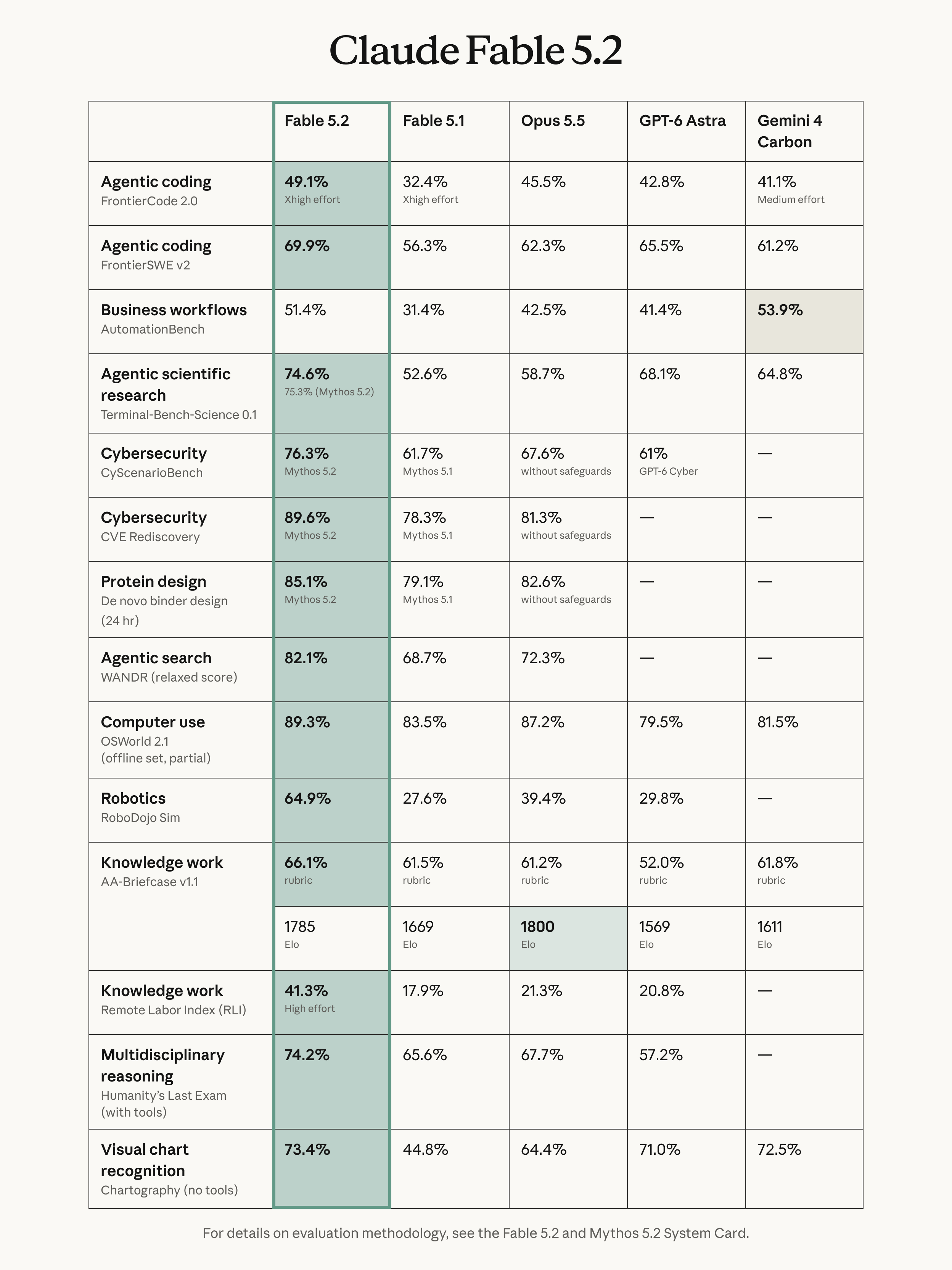
For a repeatable routing policy, use the model overview. Anthropic recommends Opus 5.5 for most workloads and Fable for demanding reasoning or long-horizon work. That’s a starting policy to evaluate, not proof that any model wins on your repository.
What should you measure in a pilot?
Keep the task scope and acceptance tests identical across configurations. Separate queue time, model generation, tool execution, and human review in your timing notes. Otherwise, a slow test suite can hide the benefit of faster generation, or an easy task mix can make a costly setting look economical.
Record cached input separately from uncached input. Keep the actual provider usage totals with each attempt rather than estimating tokens from file size. When you change an effort setting, compare accepted outcomes and rework as well as the first response. A shorter initial run can leave a larger correction bill.
Set a stop condition before the pilot begins: an attempt count, a spend threshold, or a review checkpoint. A model that keeps investigating can consume your budget while making progress you cannot yet accept.
Keep the budget attached to the work
Sharkly’s official product description puts Tasks, coding agents, connected Computers, and human reviews in one workspace. You keep the API accounts or coding subscriptions configured in your tools. Model usage stays on those provider accounts.
Use that shared work record to report the model, effort, attempts, evidence, and review outcome. For a migration, ask the Agent to return test results and known limits with its changes. People then accept the work or request corrections. Read how to review AI-generated code with task-level evidence for a practical review structure.
For a small fix, assign one Agent. Use a Crew when separate specialists and coordination serve the task. Extra agents introduce additional calls and handoffs, so measure the result before making parallel work your default. The mixed-model Crew guide explores those handoffs.
Start with ten representative tasks. Record total spend, elapsed time, acceptance rate, and reviewer minutes for each configuration. Connect one Computer in Sharkly, assign one bounded Task, and request that evidence with the delivery. Expand after you can explain the cost per accepted result.
FAQ
Is Claude Fable 5.2 fast mode twice the price?
Its listed input and output token rates are twice the standard rates. Your workflow total also depends on token counts, caching, tools, and retries.
Does Medium effort change the token price?
Effort changes model behavior and token consumption. It doesn’t replace the listed input and output rates with a separate effort-based tariff.
Is a subscription budget the same as an API budget?
No. This article calculates metered API usage. Check the terms and allowances of your connected coding subscription separately.
Can batch processing reduce the bill?
The Batch API lists $4 input and $20 output per million Fable tokens. Use asynchronous processing where the workflow can wait; fast mode isn’t available with Batch.
Does a lower cost per call mean cheaper delivery?
Only if retries, acceptance, orchestration, and review preserve that advantage. Compare total spend against accepted tasks, using the same acceptance criteria.
Additional resources
For related workflow planning, read coding-agent cost management and human review capacity for parallel agents. Recheck Anthropic’s linked pricing and effort documentation before applying these rates to a new budget.