
An agent can consume an allowance faster than a chat because it reads context, calls tools, and retries work. Before you start one, identify the account paying for those requests. Selecting a model and qualifying for an offer are separate checks.
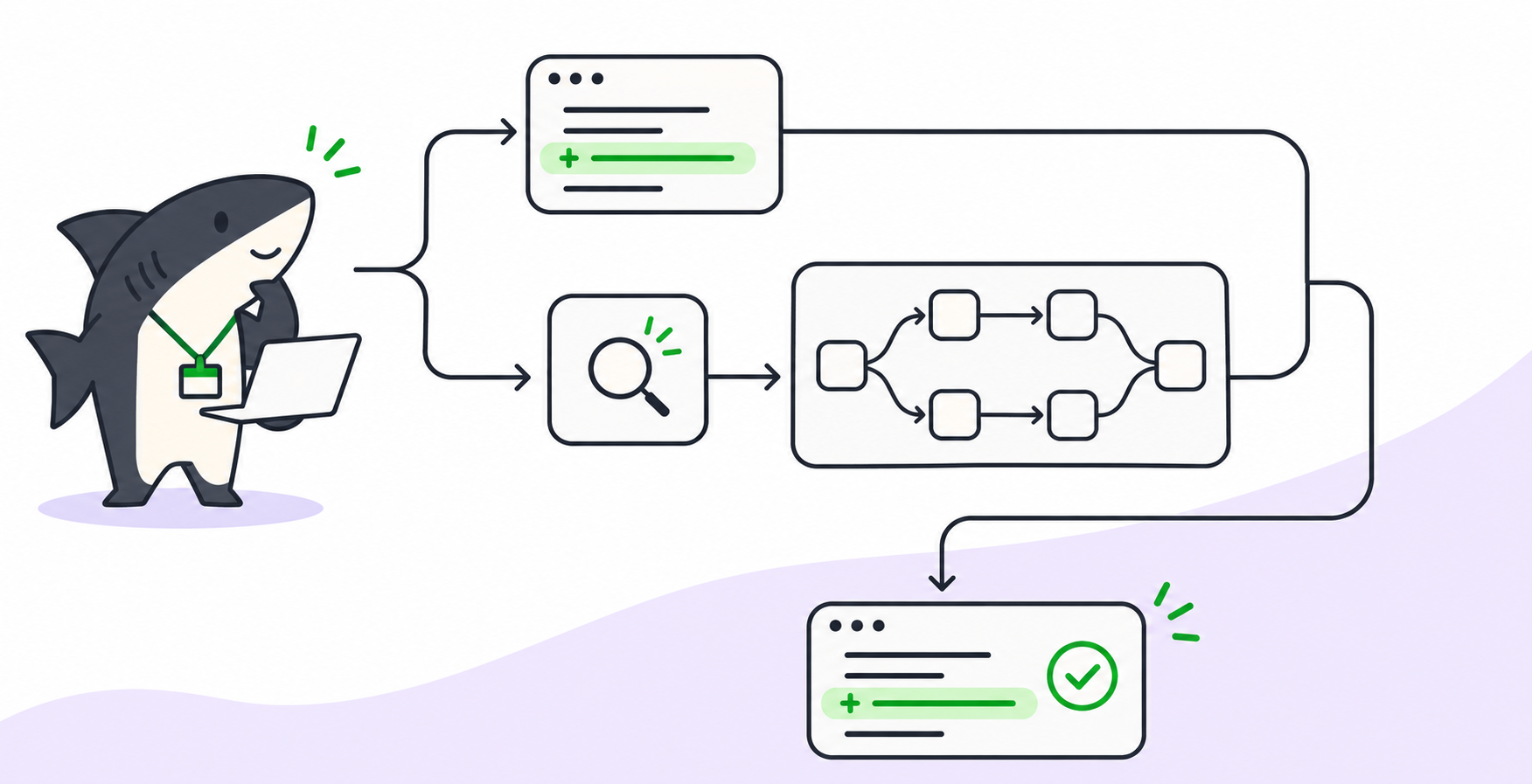
If several people share agent work, Sharkly gives that work a shared Task and review record. Model access still comes from the subscription or API account configured in the execution tool.
Can you use Fable 5.2 without paying?
The verified launch promotion is a benefit for paid subscribers, not a free tier. Anthropic’s official offer terms explicitly exclude Free accounts. They also exclude several Enterprise seat and billing arrangements. A model appearing in a picker does not establish that your account can use it without additional charges.
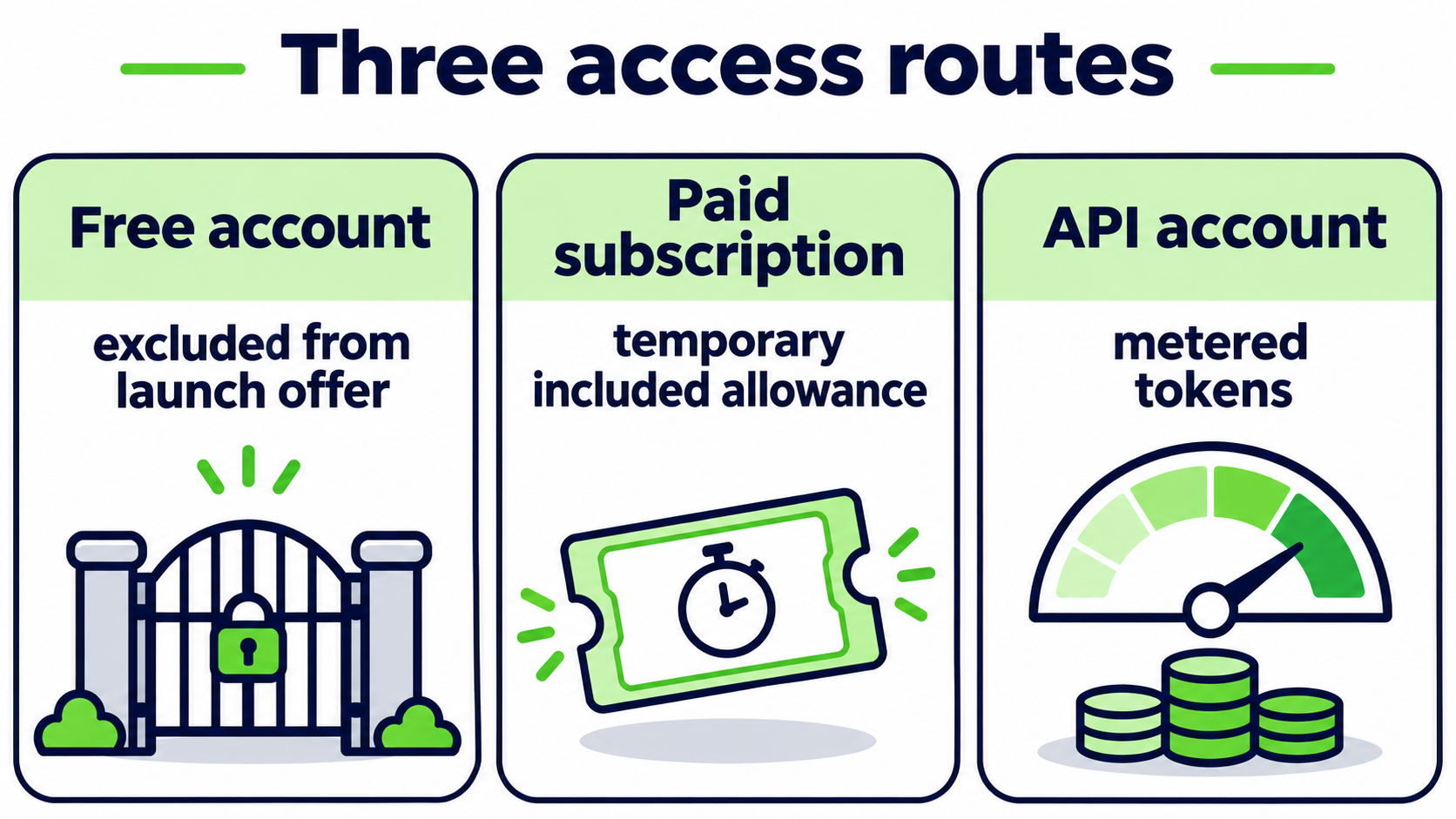
Separate three meanings of “free” before comparing options:
- Free account access: the launch offer does not provide it.
- Included paid-plan usage: eligible subscribers can use a temporary allowance without an extra usage charge.
- A limit reset: eligible accounts recover consumed allowance, subject to existing limits and an expiry date.
None of those establishes free API calls for a custom agent. Standard API rates of $8 per million input tokens and $40 per million output tokens. Fast mode doubles those rates. See our Fable 5.2 pricing guide for budgeting beyond the promotion.
Which paid plans qualify for the launch offer?
Anthropic separates the promotion into temporary included access and resets. The applicable route depends on your plan and seat type, not merely whether your organization pays Anthropic.
| Plan or seat | Launch benefit | Important boundary |
|---|---|---|
| Free | Excluded | No launch-offer entitlement |
| Pro or standard Team seat | One week of included Fable, up to 50% of weekly limits, plus one eligible reset | Included access ends November 16, 2026 at 11:59 pm PT |
| Max, Ultra, premium Team seat | One to three Fable resets | Number depends on paid subscription history |
| Premium legacy seat-based Enterprise | One to three Fable resets | Organization billing and seat eligibility apply |
| Standard legacy Enterprise, self-serve Enterprise, usage-based Enterprise | Excluded | Do not infer eligibility from the Enterprise label |
For resets, paid billing must have been in place before November 9, 2026 at 10:00 am PT. Team and Enterprise seat holders must also have joined before that cutoff. The terms distinguish trial arrangements, so check your account rather than assuming every trial qualifies.
Pro and standard Team included access runs from launch on November 9 through November 16 at 11:59 pm PT. After the allowance is spent or the window ends, Fable runs against usage credits if enabled. Unused included allowance does not carry over.
For Max, Ultra, and eligible premium seats, less than six months of paid subscription history earns one reset. Six to 12 months earns two; more than 12 months earns three. Those resets expire March 8, 2027 at 11:59 pm PT. Pro and standard Team promotional resets expire with their November window.
How do you select Fable 5.2 in Claude Code?
Use Claude Code when you want a documented agent route. Anthropic’s model configuration documentation says Fable 5.2 requires version 2.1.321 or later. Update the client, inspect the active account, and select the exact model before assigning work.
claude update
claude --model claude-fable-5-2
In an interactive session, you can select the model explicitly:
/model claude-fable-5-2
The exact ID avoids a documented alias difference: fable resolves to Fable 5 in Claude apps gateway sessions unless configured otherwise, and to Fable 5.2 elsewhere. A gateway must serve the requested model; changing its base URL does not grant model access.
These commands follow the documentation; this article does not report an executed Fable trial. Organization restrictions and provider availability can still block a request. Check the model picker, the active billing route, and your account’s Usage page before starting a long task.
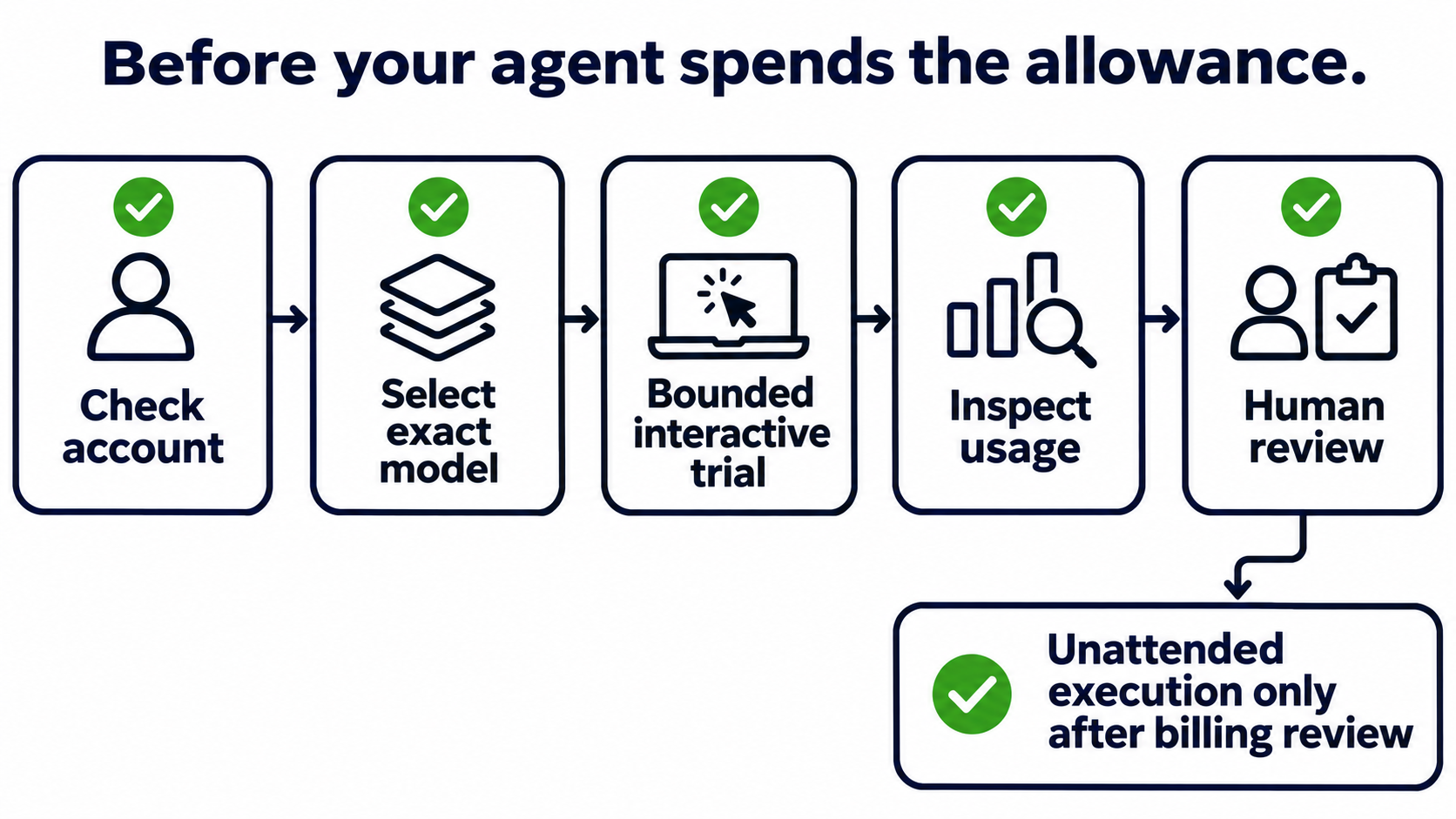
Start with an interactive session when testing eligibility. Review any usage-credit notice before continuing. Do not move the same setup into unattended execution until you understand what it will charge.
Why can a headless agent charge you without asking?
Interactive consent and headless billing behave differently. Claude Code’s documentation says non-interactive -p mode bills usage credits without prompting when a Fable request requires them. An Agent SDK application that does not show the consent prompt behaves the same way. Silence therefore does not prove that a run stayed within included usage.
For example, a scheduled agent may begin while the promotional allowance remains available and continue after it is exhausted. If usage credits are enabled, later requests can use that billing route. A successful task result tells you what completed; it does not establish which allowance paid for it.
Write down four facts before enabling automation: the account, the requested model ID, the credit setting, and the stop condition. Check usage after a small trial. Keep application-side limits and account billing controls separate: a task timeout does not establish a dollar cap.
How should you spend the temporary allowance?
Use the promotion for a bounded evaluation with an answer you can inspect. A difficult bug with a reproducible test is a stronger trial than an open-ended request to improve an entire repository. Our codebase evaluation guide explains how to compare accepted results.
- Choose one repository and one unresolved problem.
- Record the current failure and acceptance criteria.
- Note the account, model ID, effort setting, and remaining allowance.
- Ask the agent for a patch, verification output, and known limitations.
- Review the diff and rerun the relevant checks.
- Inspect account usage before assigning another task.
Treat a reset as recovered capacity. It restores Fable usage already consumed from the weekly limit, while other models’ weekly usage remains. Where a five-hour limit exists, the reset refills that window too. It does not increase your underlying limits.
Anthropic recommends starting with Opus 5.5 for most coding work and escalating when the task warrants it. Use Fable for the problem you want to evaluate; keep routine work on your usual model. The Fable versus Opus comparison helps frame that decision without turning temporary access into a permanent routing policy.
Keep agent access and team review visible
Sharkly manages the work around your existing coding agents. Its execution documentation describes how a Task, assigned Agent, Runtime, and connected Computer come together, with progress and results returning to the Task.
For this trial, put the billing assumption and promotion expiry in the Task alongside the acceptance criteria. Have the agent return the patch, checks, and limits of its investigation. A reviewer should be able to judge the result without reconstructing a private terminal session.
Agents investigate, execute, test, and report. People approve spending authority and accept the result. Sharkly adds that shared work record; it does not supply Anthropic credits or change the provider’s eligibility rules.
Start with one trial you can account for
Check your plan and seat against the official offer, then confirm the exact model and billing route. Run one bounded interactive task before considering unattended execution. Recheck the terms at expiry rather than leaving an old promotional assumption inside an automation.
To coordinate the trial, create one Task in Sharkly with a named reviewer and a clear stopping point. You keep the coding agent you already use and give its result a place the team can inspect.
FAQ
Is Fable 5.2 available on Claude Free?
The verified launch offer excludes Free accounts. This article establishes no legitimate zero-payment agent route.
Is included Pro usage the same as free API access?
No. The temporary subscription benefit and metered API billing are separate access routes. Check which account your agent uses.
When does Pro’s included Fable access end?
The terms specify November 16, 2026 at 11:59 pm PT, with a cap of 50% of weekly limits during the window.
Does a Fable reset raise my limits?
No. It restores consumed usage within existing limits. Reset availability and expiry depend on the plan and eligibility rules.
Will Claude Code ask before using paid credits?
Interactive sessions can show a consent prompt. Documented headless and certain SDK flows can bill credits without asking.