Quick answer: An Anthropic distillation accusation is a notice that Anthropic believes your API traffic is being used to train another AI model on Claude’s outputs. Its terms prohibit that. If you get one, answer fast: ask which keys and traffic were flagged, rotate those keys, and send records that show what each request was for.
A founder posted on Hacker News that Anthropic had accused their company of distilling Claude. They wrote that they don’t train their own models. The only unusual traffic they could name was automated regression benchmarks that run whenever they change AI settings. They had 24 hours to prove their innocence.
If your team runs Claude agents at volume, you’re exposed to the same question. This guide covers what counts as distillation under Anthropic’s terms, which legitimate workloads can look like it, and how to build the record before you need it. If your agents already run through Sharkly, part of that record exists today: every agent run is tied to a task.
What is an Anthropic distillation accusation?
Distillation is training a smaller or weaker model on the outputs of a stronger one. Anthropic’s February 2026 post calls it “a widely used and legitimate training method” in general. Using Claude’s outputs to do it without permission breaks Anthropic’s terms, and an accusation is Anthropic saying your account did that.
Two documents set the rule. The Commercial Terms (section D.4) say a customer may not “access the Services to build a competing product or service, including to train competing AI models.” The Usage Policy bans using outputs “to train an AI model (e.g., ‘model scraping’ or ‘model distillation’) without prior authorization from Anthropic.”
The same Usage Policy also bans coordinating multiple accounts “to avoid detection.” That matters later: opening a fresh account after a flag makes your position worse.
What Anthropic says distillation traffic looks like
Anthropic has published two posts on how it spots distillers. They describe detection signals, not a checklist you can audit yourself against.
The February post named DeepSeek, Moonshot AI and MiniMax, with over 16 million exchanges through about 24,000 fraudulent accounts. It listed these hallmarks:
- Massive volume concentrated in a few topic areas.
- Highly repetitive prompt structures.
- Prompts that try to pull out chain-of-thought reasoning.
- Shared payment methods across accounts.
- Coordinated timing between accounts.
- Proxy networks spreading traffic over thousands of accounts.
The October 12, 2026 post added a two-stage classifier and stricter limits for users who “continually try to extract reasoning.” It says Anthropic bans accounts when it detects “repeated and persistent attempts at distillation,” and that the classifier’s false positive rate is under 0.1%.
Neither post describes an appeal process. That’s why the record you keep matters more than the argument you make.
Can regression benchmarks look like distillation?
Yes, on the first two signals. An eval suite sends the same prompt templates at high volume, often in bursts after a config change. To a classifier looking at prompt shape and volume alone, that pattern can resemble harvesting. The difference lies in what happens to the outputs: scored and discarded, or stored as training data.
| Legitimate workload | Signal it can resemble | What proves the difference |
|---|---|---|
| Regression benchmarks after a prompt or model change | Repetitive structures, burst volume | Eval code, its git history, run timestamps |
| Batch classification or extraction | Volume concentrated in one domain | Product spec, customer-facing feature it powers |
| Agents asking Claude to explain its reasoning | Reasoning extraction | Task context showing the human question behind it |
| Several teams sharing one org | Coordinated timing | One org, one billing account, named owners per key |
| A leaked API key | Any of the above | Key rotation log, traffic from unknown IPs |
The last row deserves a check before anything else. Several HN commenters asked the founder whether a key had leaked. If someone else is running a harvest on your key, the traffic is real and the fix is a rotation.
How to respond to a distillation accusation in the first 24 hours
Speed counts, and so does the order. The Commercial Terms (D.2) say customers “must cooperate with reasonable requests for information” to verify compliance, so treat the notice as an information request.
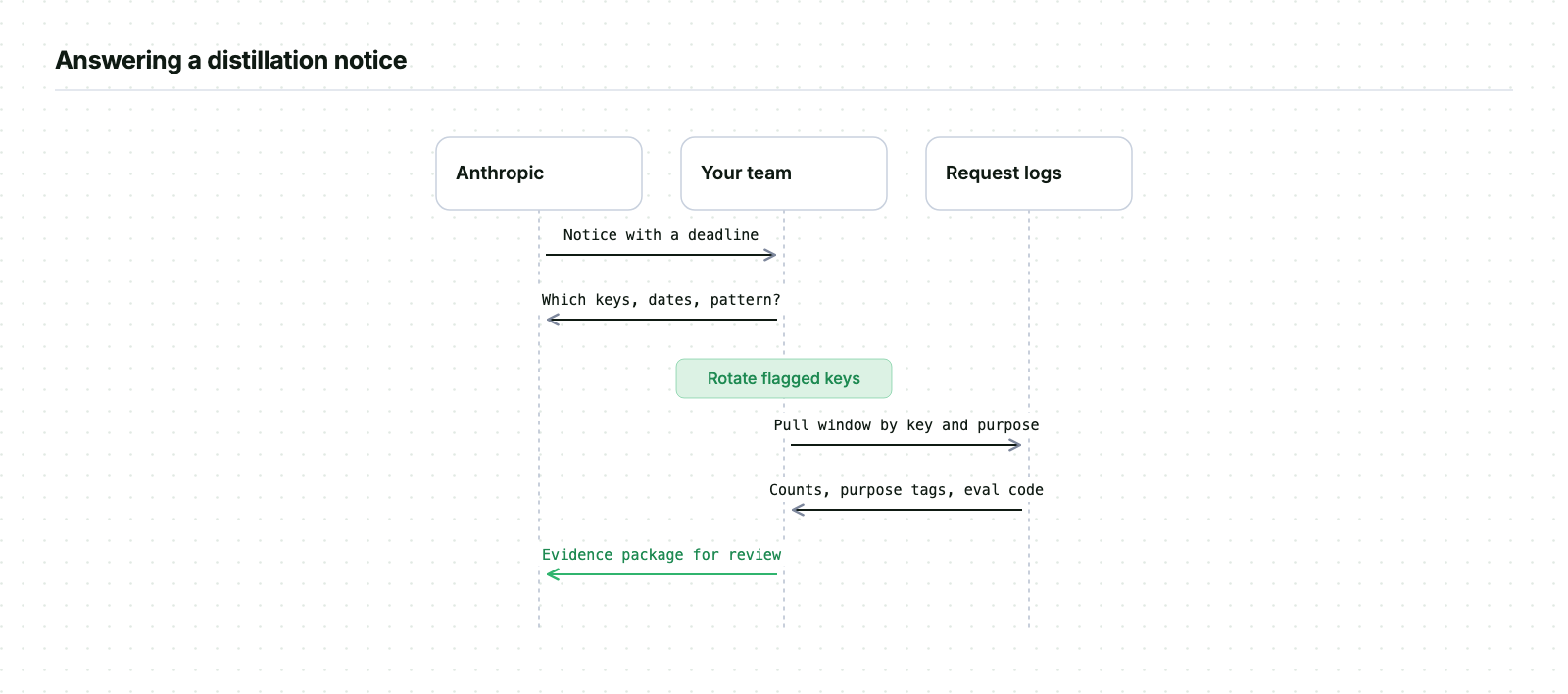
- Ask what was flagged. Request the keys, date range and traffic pattern behind the notice. You can’t explain traffic you can’t see.
- Rotate the flagged keys. This rules out a leak and stops any traffic you don’t control.
- Pull request logs for the window. Group requests by key and by purpose: product, evals, agents, internal tools.
- Explain each high-volume pattern. For evals, include the harness code and its commit history. One HN commenter suggested sending “the code that generates the false distilling usage pattern along with its git history.”
- State where outputs go. Say whether outputs are stored, for how long, and confirm none feed a training pipeline.
- Don’t open a second account. The Usage Policy bans multi-account evasion, and it would undercut everything else you send.
Keep the reply factual and short. One owner per workload, one paragraph per pattern, links to code and logs. You’re writing for a reviewer who has a classifier score and a deadline of their own.
How do you prove you’re not distilling without exposing user data?
That was the founder’s real question. You rarely need raw prompts. Request counts per key, per hour, per purpose tag, plus the code that generated them, explain most patterns. Share a small redacted sample only if Anthropic asks for one.
How to keep a record before you need it
The founder had to reconstruct the evidence under a 24-hour clock. You can build it now, at almost no cost.
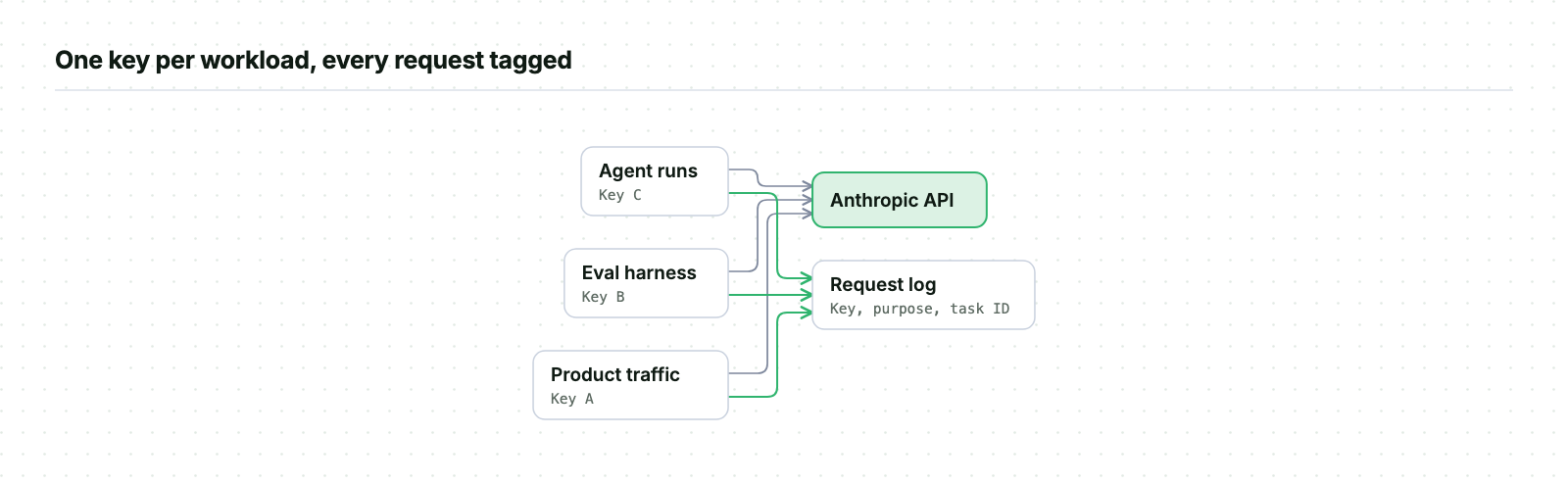
- One API key per workload. Product, evals and agents each get their own key, so a flag points at one workload, not the whole company.
- Tag every request with a purpose. Log the key, a purpose label and a task or ticket ID next to token counts.
- Version your eval harness. Keep benchmark code in git, so its history shows when and why volume spiked.
- Write down your output retention rule. Note how long outputs live and confirm none enter a training set.
- Name an owner per key. Someone who can answer for that traffic within hours.
A minimal log line looks like this:
{
  "ts": "2026-11-24T16:02:11Z",
  "api_key_id": "key_evals_03",
  "purpose": "regression-benchmark",
  "task_id": "EVAL-118",
  "model": "claude-sonnet-5-5",
  "input_tokens": 1840,
  "output_tokens": 412,
  "output_retained": false
}
Anthropic’s October post also notes a change for API accounts created on or after August 31, 2026: on Claude Opus 5.5 and Fable 5.1, “preserved thinking” stops them from editing prior context. If your agents ask Claude to restate its own reasoning, log why. That pattern sits close to what the classifier watches for.
How Sharkly keeps the record for you
Sharkly is a work management platform for coding agents. It doesn’t replace Claude Code or the API; it assigns work to agents and records what each run did. Model usage stays on your own keys: runs bill against the Claude Code subscription or API plan configured on the Runtime (the agent tool on a connected Computer). For a distillation question, that structure gives you the purpose tag for free.
Every agent run starts from a task, and the task is the purpose. The execution log records the trigger source, when the run started and ended, tool calls and Runtime events. Each task also carries a Token usage panel with input, output and cache tokens and the number of runs.
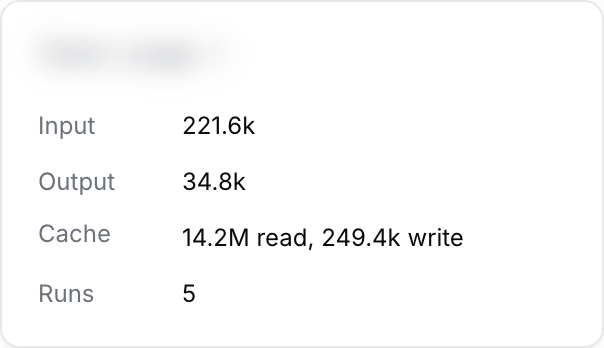
When Anthropic asks what a burst of traffic was for, you can answer per task instead of per key. From the CLI:
# Every run for one task, with status and timing
sharkly run list --task <task-id> --output json

# Runtime usage on one Computer over the last 30 days
sharkly computer usage <computer-id> <runtime-id> --days 30 --output json
Use Sharkly’s record for agent work, and keep your own request log for product traffic and evals that don’t run through agents. The two together cover every key you hold. See coding agent observability for the signals worth watching, and why an agent platform shouldn’t sell you tokens for how BYOK keeps spend on your own accounts.
What else reduces the risk?
Records reduce the damage of a false flag. These steps reduce the chance of one:
- Spread eval traffic over time. Run benchmarks on a schedule rather than in one large burst after every change.
- Size eval runs to the decision. Run the full suite before a release and a smaller sample on routine config changes.
- Keep a second provider tested. Several HN commenters suggested routing through more than one provider. A working fallback turns a suspension into a degraded day instead of an outage.
- Scope agent permissions. Agents with narrow permissions generate traffic that’s easier to explain.
For the cost side of running Claude at volume, see coding agent cost management and what Anthropic’s IPO means for Claude Code pricing.
Build the record this week
The founder’s question, “How can I prove I’m not distilling?”, has a practical answer: with records you already kept. Split keys by workload, tag requests by purpose, version your evals and write down where outputs go. If your agents run through Sharkly, the task, the execution log and the token panel cover the agent side. Connect a Computer and assign your next eval run as a task, so its traffic has a named purpose from the first request.
FAQ
What counts as distillation under Anthropic’s terms?
Using Claude’s outputs to train an AI model without Anthropic’s prior authorization. The Commercial Terms also bar accessing the API to build a competing product, including training competing models.
Can Anthropic suspend my API access for suspected distillation?
Yes. Section I.3 of the Commercial Terms lets Anthropic suspend access if it “reasonably believes or determines” a violation occurred. It will “use reasonable efforts” to give written notice and restore access where the issue is curable.
Do regression benchmarks violate Anthropic’s policy?
Neither policy names benchmarks as a violation. Running evals and discarding the outputs doesn’t train a model. The risk is that high-volume, repetitive eval traffic looks like harvesting, so keep the harness code and logs.
Is there an appeal process for a distillation ban?
Anthropic’s two distillation posts don’t describe one. The Commercial Terms set 45 days of informal dispute resolution before arbitration, so a written, documented reply is your main route.
Can a leaked API key trigger a distillation accusation?
It can. Anyone harvesting outputs on your key produces traffic billed and logged to you. Rotate flagged keys first and compare traffic sources against your own infrastructure.
Does zero data retention protect me from a distillation flag?
No. Retention settings govern what the provider stores, not how your traffic pattern looks to a classifier. Your own logs are what prove purpose.