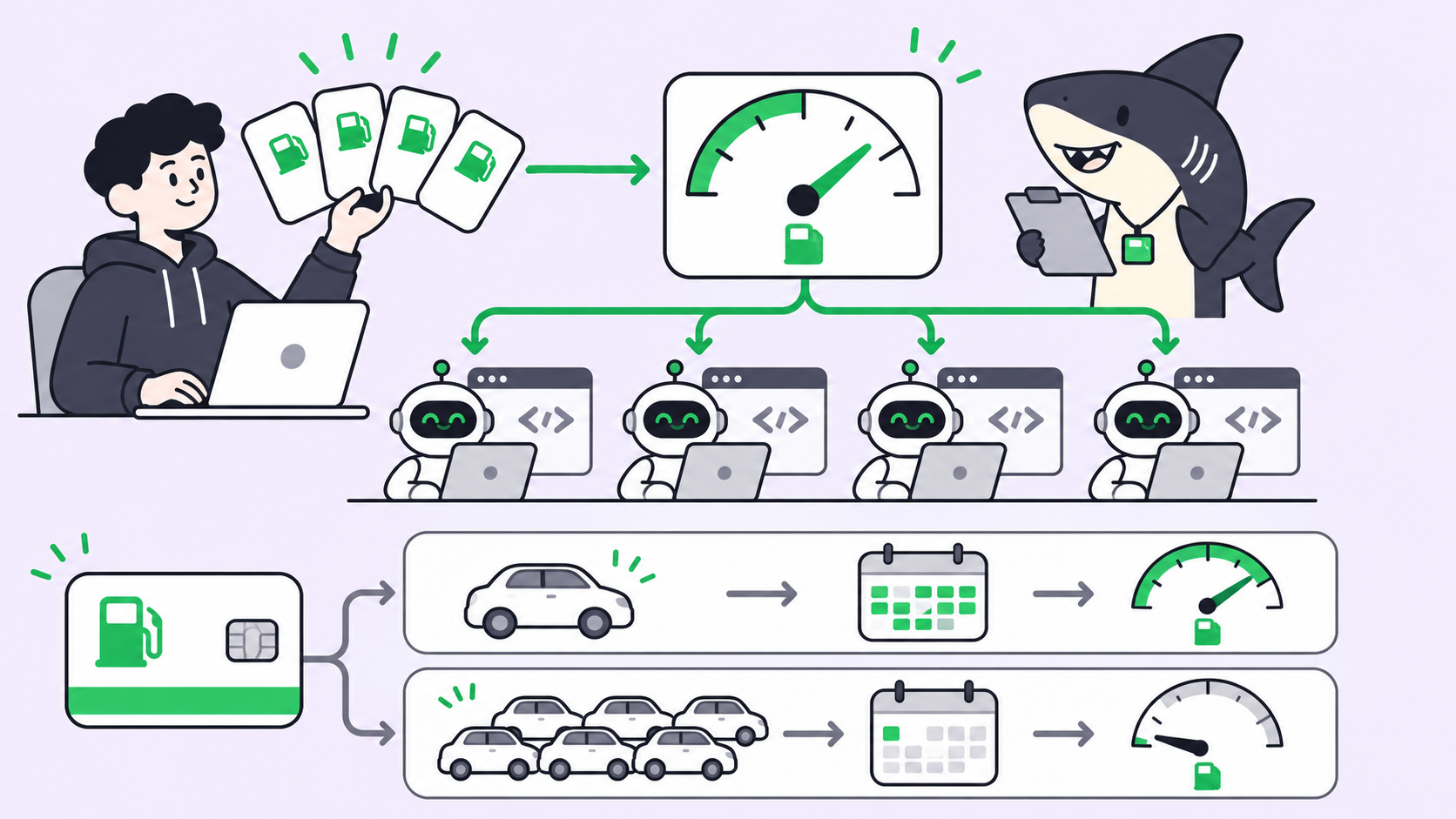
The Anthropic IPO priced on November 18, 2026, and the stock started trading on Nasdaq the next day under the ticker ANT. If your team runs Claude Code every day, the question behind the headlines is narrower than the market cap: does Claude Code pricing change now that your coding agent’s vendor answers to public shareholders?
The short version is no, not yet. Nothing in the offering touched a plan price. This guide covers the IPO facts, today’s Claude Code pricing, the signals worth watching, and how teams that run agents on a shared board with Sharkly can keep vendor risk small without leaving Claude Code.
TL;DR
The Anthropic IPO raised about $81.3 billion at $83 a share and changed no Claude prices on day one. Claude Code still comes with every paid plan: Pro at $20 a month, Max at $100, Ultra at $200, and Team seats from $20. The pricing page says plans can change “at Anthropic’s discretion.” Track spend per task and keep a second Runtime ready.
The Anthropic IPO in numbers
Anthropic’s own pricing announcement and CNBC’s live coverage agree on the core facts.
| Item | Figure | Source |
|---|---|---|
| Offer price | $83.00 per Class A share | Anthropic |
| Shares offered | 980,000,000 (956,351,354 sold by Anthropic) | Anthropic |
| Exchange and ticker | Nasdaq Global Select Market, ANT | Anthropic |
| First trading day | November 19, 2026 | Anthropic |
| Money raised | About $81.3 billion | CNBC |
| Day-one open and close | $111.50 open, $97.17 close | CNBC |
| Market cap at the first close | About $1.8 trillion, fully diluted | CNBC |
| Revenue, nine months to Sept. 30 | $33.24 billion, per the prospectus | CNBC |
Two governance details matter for anyone weighing long-term vendor risk. Anthropic stays a public benefit corporation, and CNBC reports that its Long-Term Benefit Trust can elect and remove a majority of the board. Developers noticed: the Hacker News thread on the debut passed 1,800 comments.
Claude Code pricing today
Claude Code pricing is the cost of the Claude plan you sign in with, because Claude Code ships inside every paid plan instead of as a separate product. The plan sets your price and your usage limits. Here is what claude.com/pricing listed on November 20, 2026.
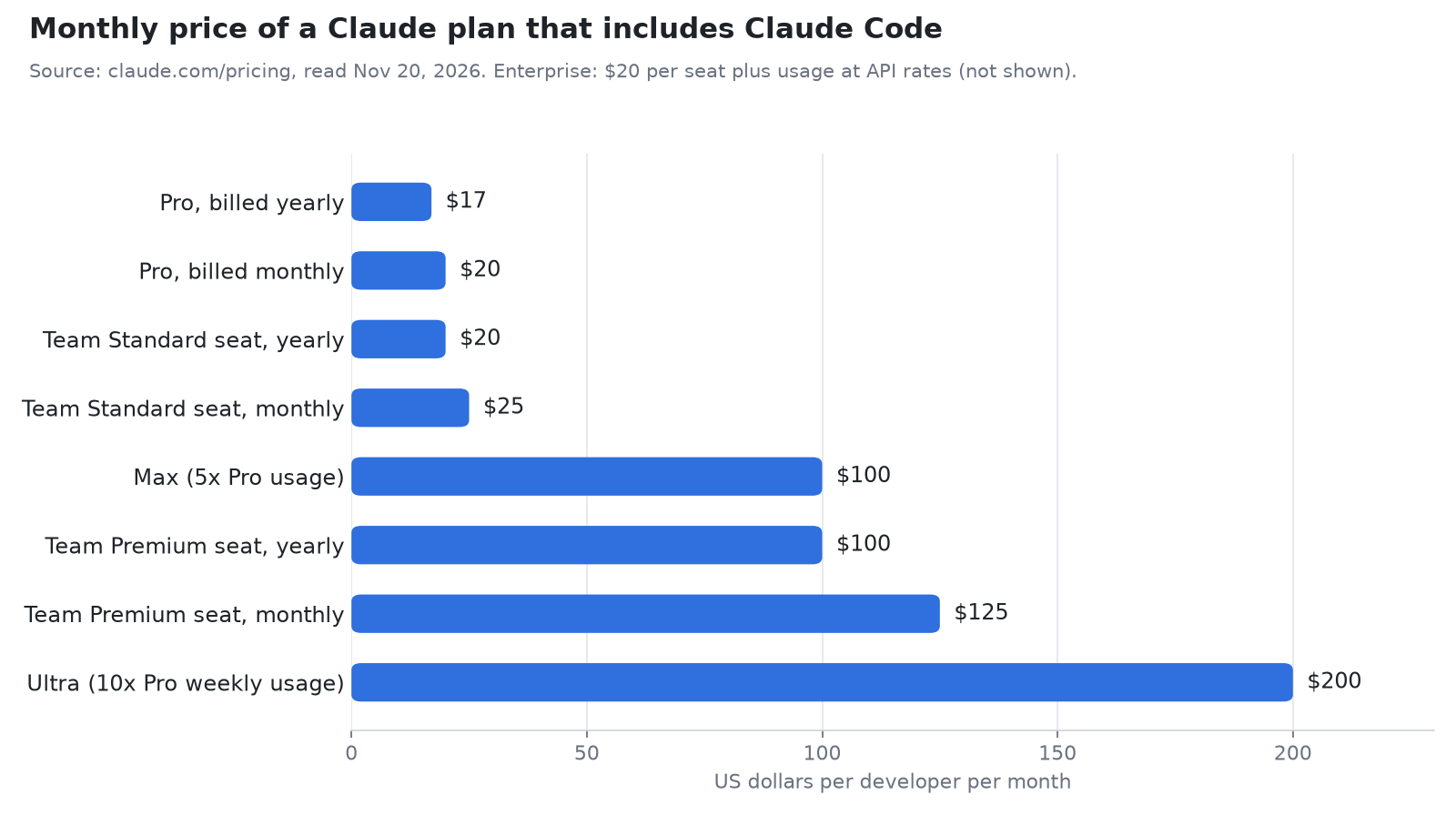
| Plan | Price | Claude Code usage |
|---|---|---|
| Free | $0 | Not included |
| Pro | $20 a month, or $17 a month billed yearly | Shared 5-hour and weekly limits |
| Max | $100 a month | 5x Pro, every 5 hours and every week |
| Ultra | $200 a month | 10x Pro weekly, no 5-hour limit for verified accounts |
| Team, Standard seat | $20 a seat yearly, $25 monthly | More than Pro |
| Team, Premium seat | $100 a seat yearly, $125 monthly | 5x a Standard seat |
| Enterprise | $20 a seat yearly, 20-seat minimum, plus usage at API rates | Scales with use |
Three rules from Anthropic’s Claude Code plan guide shape what you pay in practice:
- Claude Code and the Claude apps draw from one usage pool, so heavy chat days shrink your coding budget.
- Once you hit a limit, you can wait for the reset, upgrade, or turn on usage credits billed at standard API rates.
- The monthly API credits that come with Max and Ultra can’t be spent in Claude Code.
For the limit mechanics in detail, read our guide to Claude Code usage limits.
Does the Anthropic IPO change Claude Code pricing?
No. The offering documents and the first day of trading changed no plan price, seat price or usage limit. What changed is the audience: from now on, Anthropic reports results to public shareholders every quarter, and pricing becomes one of the levers analysts watch. The pricing page already says prices and plans “are subject to change at Anthropic’s discretion.”
What a public Anthropic could change for teams
Nobody outside Anthropic knows the pricing roadmap, and this article won’t guess at numbers. What you can do is watch the signals that would move your bill first.
Usage limits move faster than list prices
Pro lists at $20, while the allowance behind it is described in relative terms: “1x,” “5x,” “10x.” A relative limit can change without a price change. The pricing FAQ adds that Anthropic “may limit your usage in other ways, such as weekly and monthly caps.” If your team plans capacity around a plan, plan around observed throughput, not the label.
Seat plus usage is the enterprise template
Enterprise already charges a $20 seat plus usage at API rates, with admin spend limits per user and per organization. That structure ties revenue to consumption. Teams that push dozens of agent runs a day should model what their month would cost at API rates, because that is the shape a usage-based plan takes.
More disclosure, on a schedule
A listed company files quarterly reports with the U.S. Securities and Exchange Commission, searchable on SEC EDGAR. For a buyer, that is new information: revenue mix, risk factors and spending trends arrive on a calendar instead of through leaks. Read the risk factors before your next annual renewal.
How to cut vendor risk without leaving Claude Code
Vendor risk, for a coding team, is the cost you’d pay if one provider changed price, limits or terms overnight. You don’t reduce it by switching tools in a panic. You reduce it by making your work portable, so a change at one provider moves tasks, not your whole workflow.
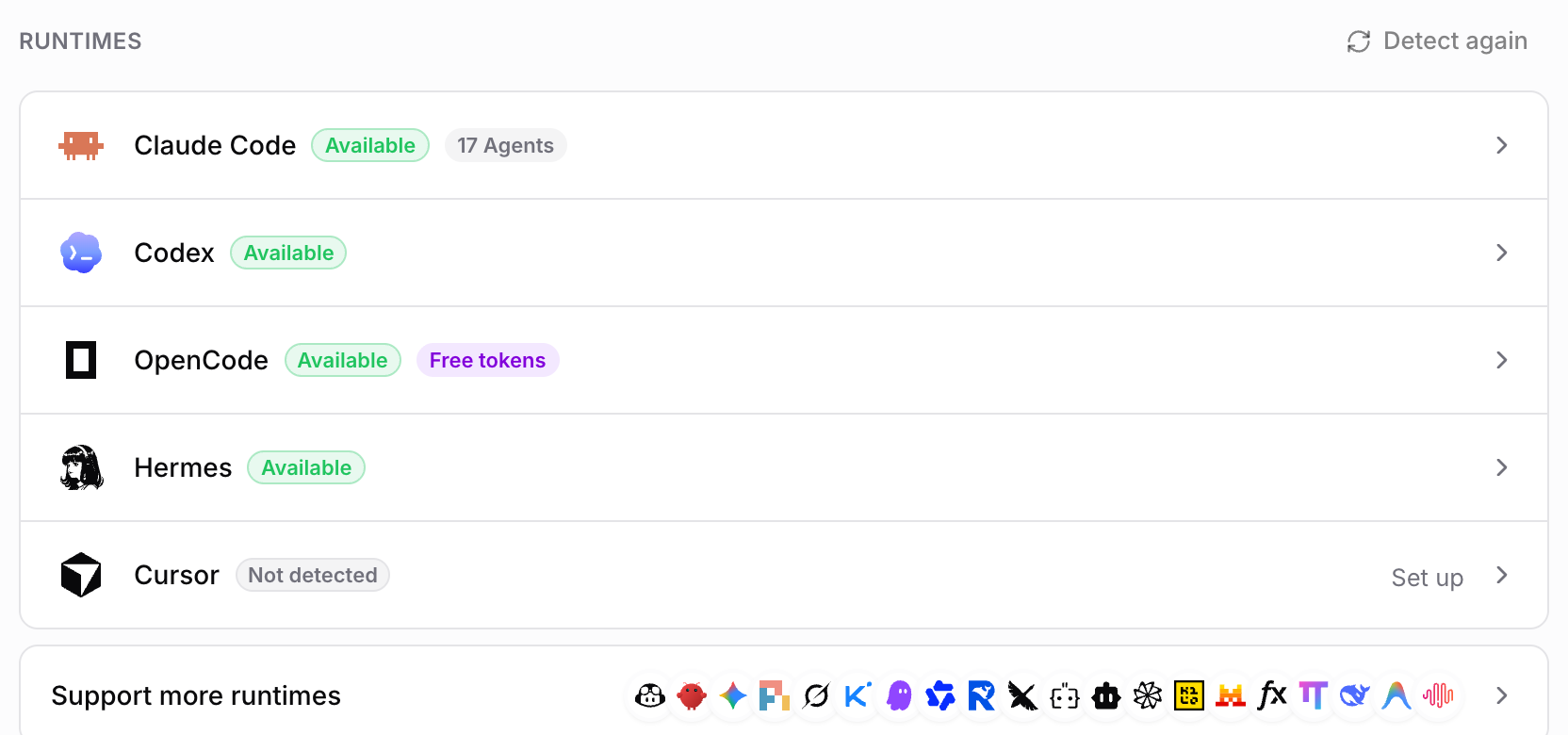
In Sharkly, an Agent’s execution target is a Computer plus a Runtime. A Computer is a connected host, and a Runtime is a coding tool the local service detects on it, such as Claude Code or Codex. The Computers docs list each Runtime’s state, and the screen above shows one Computer with four Runtimes available. Model usage stays bring-your-own: runs bill against the Claude Code, Codex or API plan already attached to the Runtime.
Track spend per task, not per invoice
A monthly invoice tells you what you spent. It doesn’t tell you which work burned the limit. Put every agent job on a task and assign it to an Agent. Each task keeps its own run history, so you can see which work consumed the runs. Our guide to tracking spend across coding agents walks through the setup.
Keep a second Runtime warm
Keep a second Runtime authenticated on at least one Computer and run a few real tasks on it each week. If the selected Runtime stops being usable, the Agents docs say to choose another eligible Runtime; the task, its context and its review trail stay on the same board. We covered the setup in running Claude Code and Codex on one codebase.
Use one Runtime when a single plan covers your load and nobody hits limits. Add a second when the team hits a weekly limit more than once a month or when a renewal is coming up.
Check which bill your agents hit
If ANTHROPIC_API_KEY is set in a shell environment, Claude Code uses that key instead of your subscription, and you pay API rates. Run /status inside Claude Code before a long session to see your remaining allowance:
# Which credentials will Claude Code use on this Computer?
env | grep ANTHROPIC_API_KEY || echo "No API key set: subscription login applies"

# Inside a Claude Code session
/status
Check this on every Computer that runs agents. A stray key on a shared build box quietly turns a plan budget into an API bill.
Real-world scenarios
A five-person startup on Pro. Two developers hit the weekly limit by Thursday. Moving them to Max costs $160 more a month in total. Before upgrading, look at which tasks consumed the limit: often it’s one long refactor that belongs on a Runtime billed by usage.
A 40-person team on Team seats. The renewal lands six weeks after Anthropic’s first quarterly report. Read the report, price the same load at Premium seats and at Enterprise usage rates, and enter the negotiation with your own per-task numbers.
A platform team worried about concentration. Leadership asks what happens if Claude Code’s terms change. A tested second Runtime and a task history that doesn’t live inside one vendor’s tool answer that in one sentence. Our post on Goldman Sachs pulling Claude Code shows how fast that question can arrive.
Conclusion
The Anthropic IPO is a financing event, not a price change. Claude Code pricing on November 20, 2026, matches what it was the week before, and Anthropic keeps the right to change plans at its discretion. The practical response is the same one that protects you from any provider change: know your spend per task, keep one more Runtime ready, and keep the work itself on a board you control. Connect a Computer to Sharkly and run your next Claude Code task from a shared board.
FAQ
Did Anthropic raise Claude Code prices after the IPO?
No. On November 20, 2026, the day after trading began, the pricing page still listed Pro at $20 a month, Max at $100 and Ultra at $200, with Claude Code included in every paid plan.
Is Claude Code included in the Claude Pro plan?
Yes. Claude Code is included in all paid plans, starting with Pro. It shares the plan’s 5-hour and weekly limits with Claude on web, desktop and mobile.
What is Anthropic’s stock ticker?
ANT, on the Nasdaq Global Select Market. Shares priced at $83 and began trading on November 19, 2026.
What happens when Claude Code hits its usage limit?
You can wait for the reset, move to a higher plan, or turn on usage credits billed at standard API rates. Max users can also upgrade to Ultra, which has no 5-hour limit for verified accounts.
Can Max plan API credits pay for Claude Code?
No. Anthropic’s help center states that the monthly API credits included with Max and Ultra can’t be used in Claude Code or the Claude apps.
How do I reduce dependence on one coding agent vendor?
Keep work on tasks that live outside any single tool, keep a second Runtime authenticated and tested, and track usage per task. Then a pricing change moves some tasks, not your whole process.