
Your team already runs coding agents. Someone kicks off Claude Code on a bug, someone else has Codex refactoring a module, and a third person is babysitting a Gemini CLI session in another repo. Each run lives in its own terminal, and the only trace anyone else can see is a Slack message: “starting the export fix”, then twenty minutes later “ok it opened a PR, can someone look?” Multiply that by five people and three agents each, and the coordination layer is a scroll of half-finished threads that no one can reconstruct on Monday.
The problem is not the agents. The problem is that a coding-agent run has no shared home, so every run borrows a chat thread as one. A thread is a bad database: it has no status, no owner, no acceptance step, and it drops off the screen the moment the next message lands. What a team actually needs is one operating model that every run passes through, instead of a fresh conversation each time.
That operating model is what Sharkly provides. You already have coding agents; Sharkly turns them into a team by giving every run the same shape: who assigns it, who runs it, who reviews it, who accepts it. This article walks through that shape, the statuses that replace the thread, and one worked example from a ticket to a merged pull request.
The operating model: who assigns, who runs, who reviews, who accepts
A shared coding-agent workflow is a division of labor with four roles, and the whole point is that people and Agents never blur into each other. Agents research, execute, test, and report. People set direction, grant authority, and accept the result. Automation stops where team judgment is required.
Map that onto the four questions:
- Who assigns. A person, or a leader Agent shaping requirements, turns a need into a Task with scope and acceptance criteria. Nothing runs until there is a Task to run against.
- Who runs. An Agent claims the Task and executes it on a connected Computer, in an isolated worktree so its changes never collide with another run.
- Who reviews. A person reads the diff, the test output, and the change summary the Agent attached, then approves or asks for changes.
- Who accepts. A person makes the final call on merge and release.
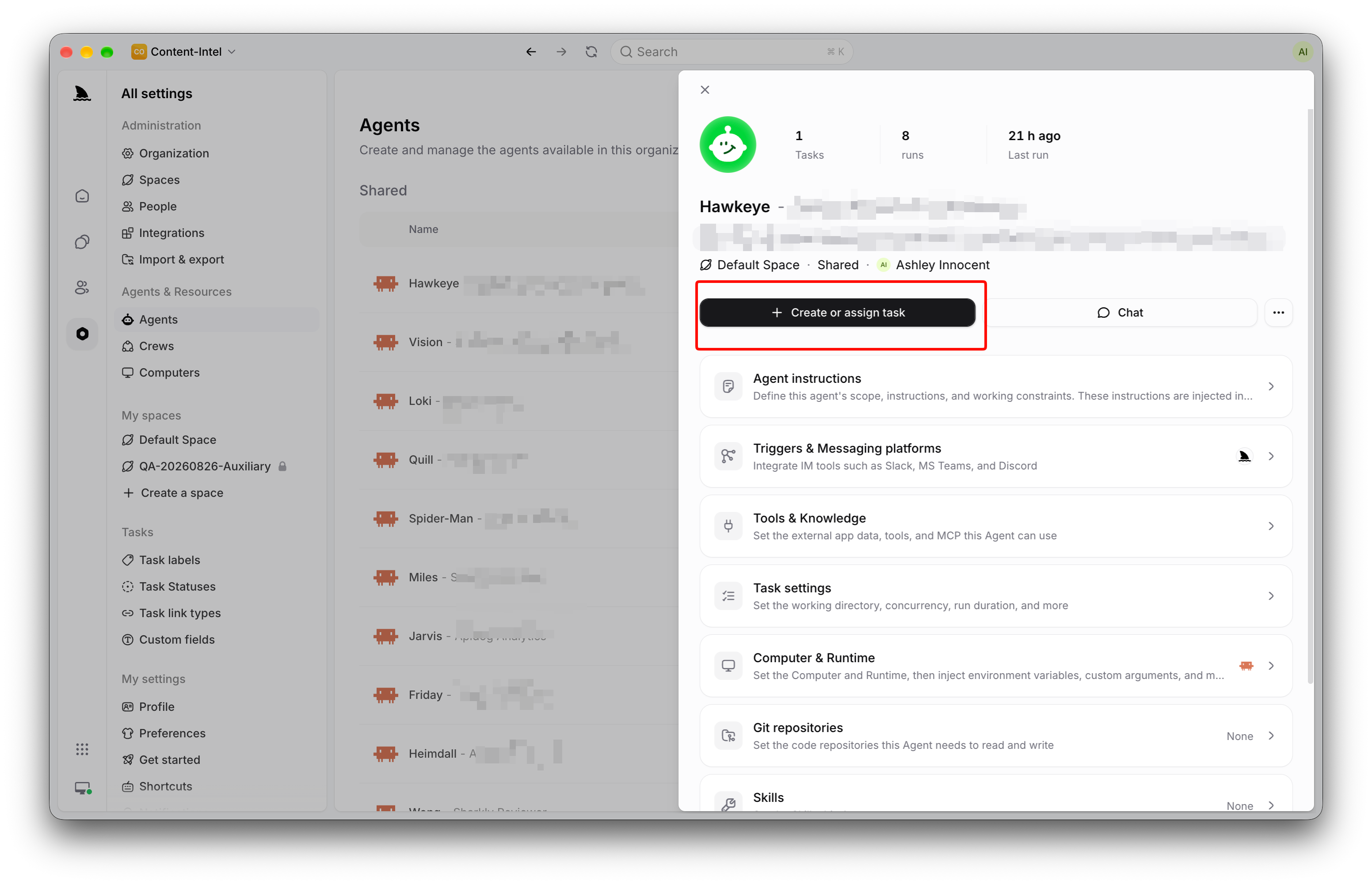
The Task is the shared record that ties those four together. The Agent defines how the work is handled, the Computer supplies the host and local resources, the Runtime performs the actual session, and the Task stays the one place the team looks. Execution, blockers, results, and follow-up discussion return to the Task timeline instead of disappearing into a private terminal. That is the difference between a run you can see and a run you have to ask about in Slack.
The statuses that replace the thread
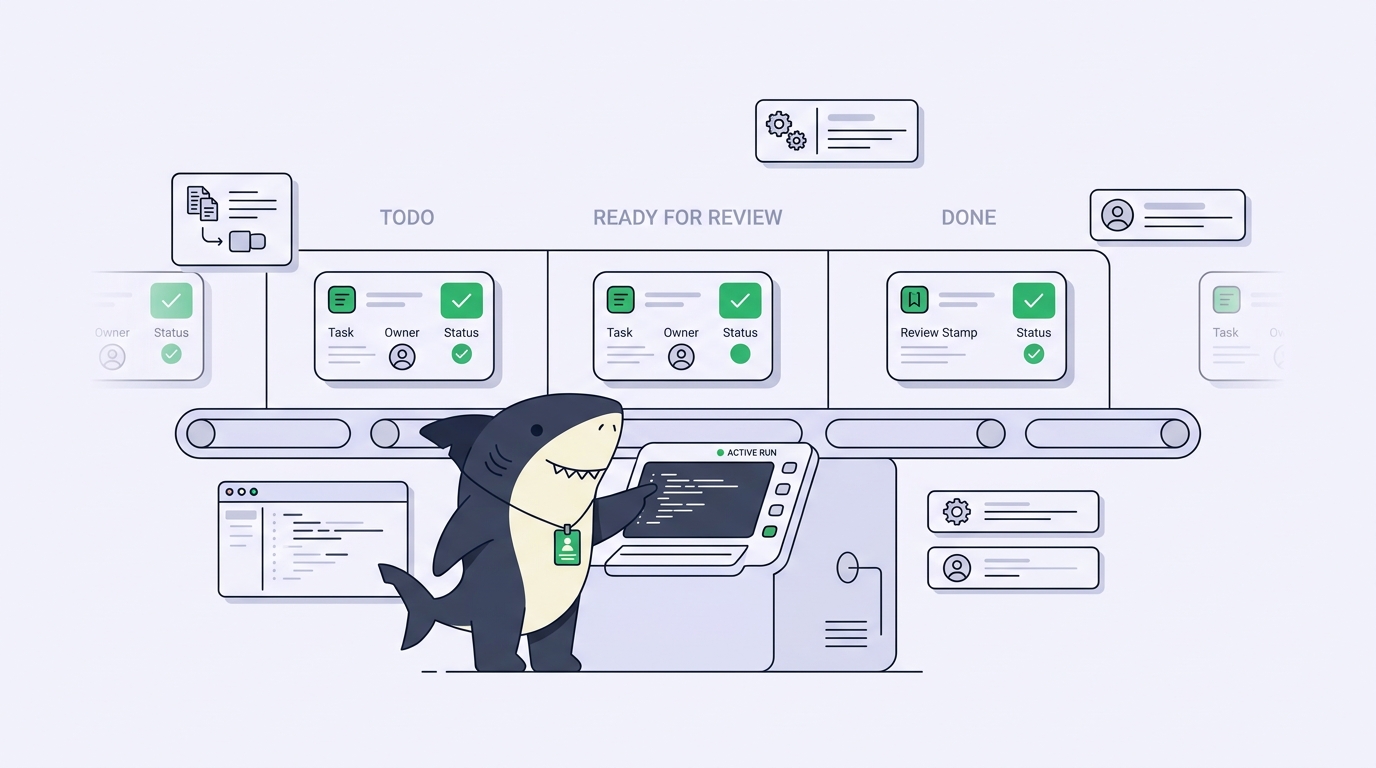
A thread has no state. A Task does, and the states are what let a team of people and Agents hand work back and forth without narrating every step.
Here is a workable set of statuses. Adjust the names to your team, but keep the gates:
| Status | Who moves it here | Meaning |
|---|---|---|
| Triage | Person | A need exists, not yet shaped into runnable work |
| Todo | Person or leader Agent | Scope and acceptance criteria are set; ready to claim |
| In progress | Agent | An Agent has claimed it and is executing |
| Ready for review | Agent | Execution done, evidence attached, waiting on a human |
| Changes requested | Person | Reviewer sent it back with specific asks |
| Done | Person | Accepted, merged, released |
The rule that makes this hold together is a boundary: an Agent can move a Task to Ready for review, but only a person moves it to Done. An Agent never accepts its own work. That single line is the review gate, and it is the reason you can let several Agents run in parallel without losing the plot. The queue of “Ready for review” Tasks becomes your team’s actual coordination surface, replacing the “can someone look?” message that used to scroll away.
This is not a status board for its own sake. It is where the human-in-the-loop review lives. When an Agent finishes, it does not ping a channel; it moves the Task and attaches what a reviewer needs. The reviewer works from a queue, not from memory of who said what.
One ticket, from request to merged PR
Walk a single unit of work through the model. Say the Task is SH-312: rate-limit the export endpoint.
- Assign. A backend engineer writes the Task: the endpoint, the target limit, the acceptance criteria (returns 429 past the limit, existing tests still pass, a new test covers the boundary). She sets it to Todo and assigns the backend Agent.
- Run. The Agent claims SH-312, moves it to In progress, and spins up an isolated worktree on its Computer. It reads the codebase, adds the middleware, and writes the boundary test. A parallel Task on the same repo,
SH-318, is being handled by a different Agent in its own worktree, so the two runs never touch each other’s files. - Report. The Agent runs typecheck, the test suite, and the build. It opens a pull request, attaches the change summary, the passing test output, and one known limit (“the limit is per-process, not shared across replicas”), then moves SH-312 to Ready for review. No Slack message.
- Review. The engineer opens the Task, reads the diff and the evidence in one place, and notices the per-process caveat matters for their deployment. She moves it to Changes requested with a specific ask: use the shared cache. The Agent picks the Task back up, adjusts, re-runs the tests, and returns it to Ready for review.
- Accept. The engineer confirms the fix, approves the PR, merges, and moves SH-312 to Done. The whole path, from a one-line request to a merged PR, is readable on the Task without a single reconstructed conversation.
Notice what did not happen: nobody asked “which branch was that on”, nobody lost the caveat about replicas, and the second Agent’s parallel work never entered the picture. The context that would have been scattered across a thread stayed attached to the work. For a deeper look at what belongs in that evidence bundle, see how to review AI-generated code with task-level evidence.
When you don’t need a shared workflow
Be honest about the boundary. If you are one developer running one agent in one repo, this is overhead you can skip. Assign the work to yourself, run Claude Code or Codex in your terminal, review your own diff, and merge. The moving parts are already at zero, and a status board would only add ceremony.
The equation changes when any of three things is true: more than one person needs to see a run, more than one Agent is working the same repo, or a run needs review by someone other than the person who started it. At that point the Slack thread stops being a shortcut and starts being the bottleneck, because it cannot answer “what is ready for me to review right now” or “who owns this”. That is the threshold where a shared operating model earns its keep. If you are already there, managing parallel coding agents is the concrete version of this problem.
Setting it up without rebuilding your process
Adopting a shared workflow should not mean throwing out the tools your team already understands. Keep the agents you run, keep your repos, keep your review habits. What changes is that runs become assignable and traceable: each one gets a Task, a status, an owner, and an acceptance step, instead of a thread.
In practice that means connecting one Computer, creating one Agent, and routing a single low-risk Task through the full path before you scale it to the team. Keep the projects, tasks, and statuses your team already uses, and connect Sharkly so Agent execution moves work forward inside them rather than beside them. The team workflow for Claude Code and the handoff patterns between agents and humans both start from that same small step.
If you are already running several coding agents and the coordination is happening in chat, Sharkly gives you one place to assign their Tasks, watch progress, and review results, with the acceptance decision left where it belongs, with a person. Start by routing one Task through it and see whether the thread goes quiet.


