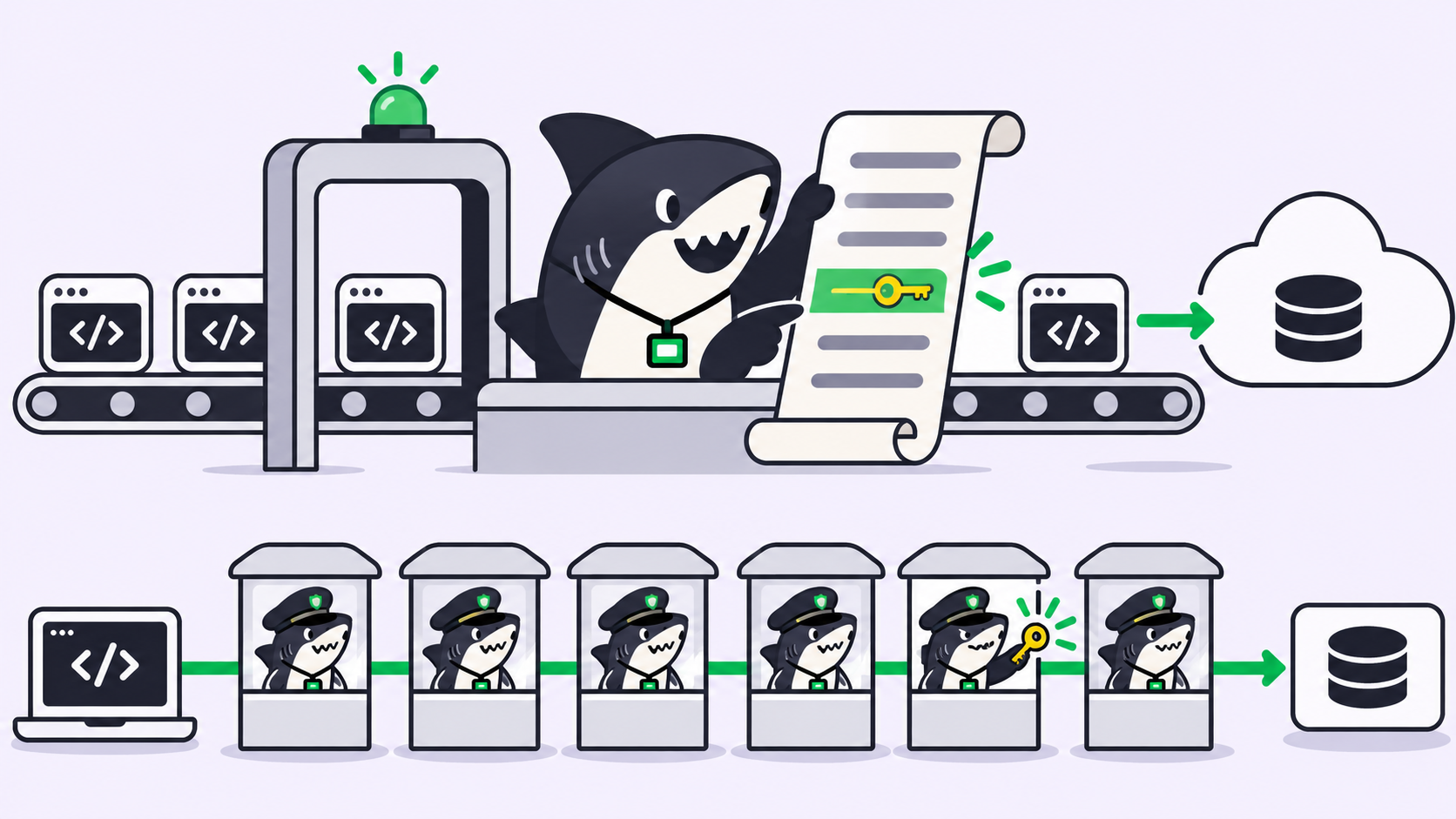
Most multi-agent workflows don’t fail on the hard part. The agent writes the code, runs the tests, opens the pull request. They fail on the seam: the moment work leaves one agent and is supposed to arrive somewhere else. A backend Agent finishes an endpoint and the frontend Agent never learns it’s ready. A refactor lands in a worktree and sits there, green, because no human was told to look. The task didn’t break. The handoff did.
An AI agent handoff is the transfer of a piece of work, plus its context, from one worker to the next: agent to agent, or agent to human. When you run one coding agent in one terminal, handoffs are invisible because there aren’t any. The moment you run two agents, or one agent and one reviewer, every completed step has to land somewhere the next worker will find it. That landing spot is the whole game
This article walks through the handoff patterns that hold up in practice, using Sharkly as the workflow: the layer that sits above your coding agents and keeps context, progress, blockers, results, and human review visible from request to release. You already have coding agents. The problem this piece solves is what happens in the gaps between them.
The short version
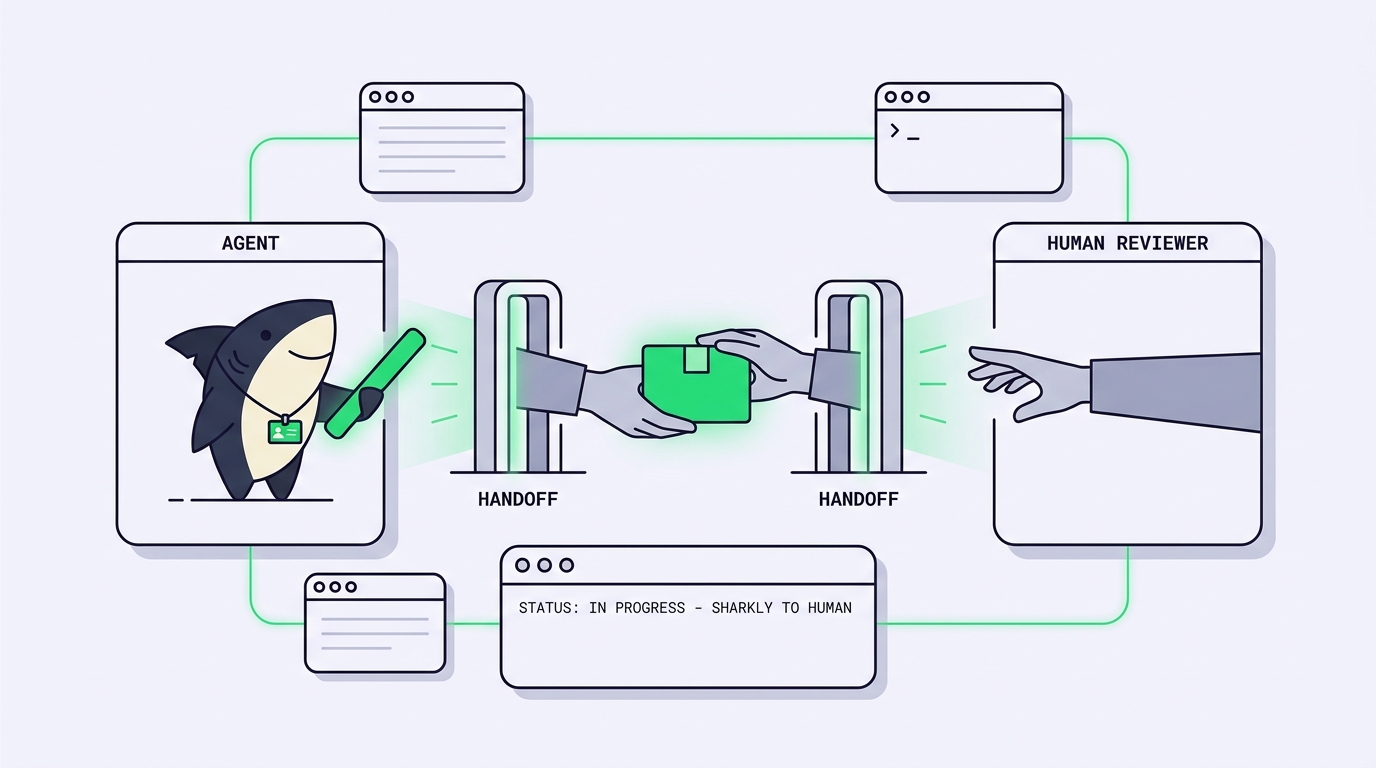
A handoff is where work and its context move from one worker to the next. Agent-to-agent handoffs pass a finished sub-task to the next agent; agent-to-human handoffs stop autonomous work at a review gate. Make both explicit with statuses: Agents move a Task to Ready for review, People move it to Done. When the handoff is a status change on a shared Task instead of a message in a terminal, nothing gets silently dropped.
What an agent handoff is, exactly
A handoff has three parts, and skipping any one is how work goes missing: the artifact (the diff, the PR, the migration), the context (what was asked, what changed, what’s still uncertain), and the recipient (the specific agent or person who owns the next step).
Terminal-based workflows carry the artifact and lose the other two. The commit exists, but the reasoning lives in a scrollback buffer only one agent saw, and “who’s next” is whoever happens to check. This is why orchestrating agents is less about launching them and more about routing what they produce.
A clean handoff moves all three together: the change, the summary of what was and wasn’t done, and an unambiguous signal that it’s the recipient’s turn. In Sharkly terms, execution, blockers, results, and follow-up discussion return to the Task timeline, so the next worker reads one record instead of reconstructing three.
Two handoff patterns
The two patterns look similar but have opposite defaults. An agent-to-agent handoff should flow automatically: the next Agent claims a ready sub-task and keeps going. An agent-to-human handoff should stop by default: the Agent finishes its slice and waits, because a person has to decide.
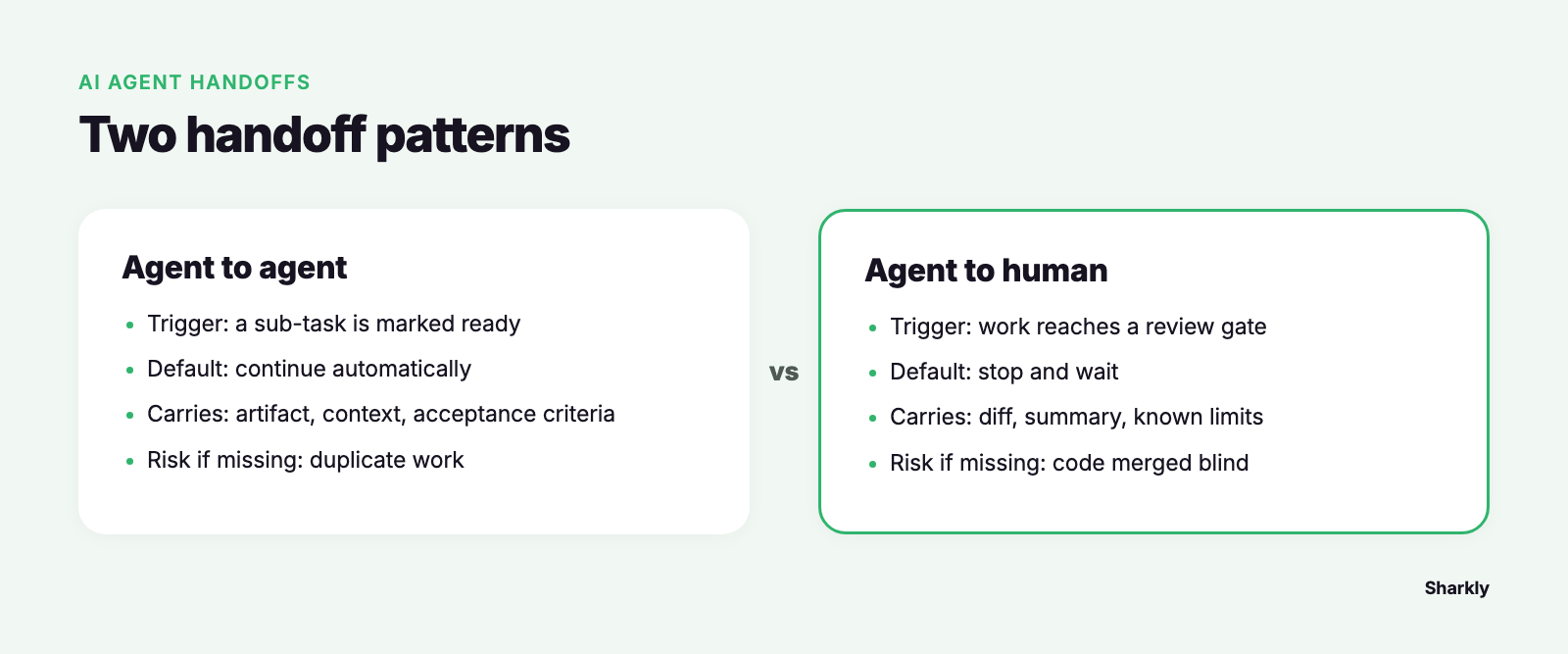
| Agent-to-agent | Agent-to-human | |
|---|---|---|
| Trigger | A sub-task is marked ready | Work reaches a review gate |
| Default | Continue automatically | Stop and wait |
| Carries | Artifact + context + acceptance criteria | Diff + change summary + known limits |
| Risk if missing | Duplicate or conflicting work | Unreviewed code merged blind |
Here’s the decision pair that keeps you honest. Automate the agent-to-agent handoff when the next step is well-defined and its acceptance criteria are already written: “run the test suite,” “generate the migration,” “update the OpenAPI spec.” Force an agent-to-human handoff when the next step requires judgment the agent can’t own: merging to main, changing a public contract, touching auth or billing, or accepting a result as finished.
The mistake is treating every handoff the same. Auto-flow everything and you merge unreviewed work; gate everything and you’ve rebuilt a slow manual pipeline with extra steps. This connects to knowing where to place approval gates so agents stop before the expensive mistakes, not after every trivial one.
Statuses make the handoff a gate, not a hope
The operating model comes down to four verbs and who owns each: who assigns, who runs, who reviews, who accepts. Agents research, execute, test, and report. People set direction, grant authority, and accept the result. Automation stops where team judgment is required.
Statuses are how that contract becomes mechanical instead of aspirational. Every Task moves through the same lane:
- Todo: assigned, not started. A person or a leader Agent put it here.
- In progress: an Agent claimed it and is working in an isolated worktree.
- Ready for review: the Agent’s boundary. It has run typecheck, tests, and the build, attached the change summary and known limits, and stopped.
- Done: a person’s boundary. Someone accepted the result and made the merge and release decision.
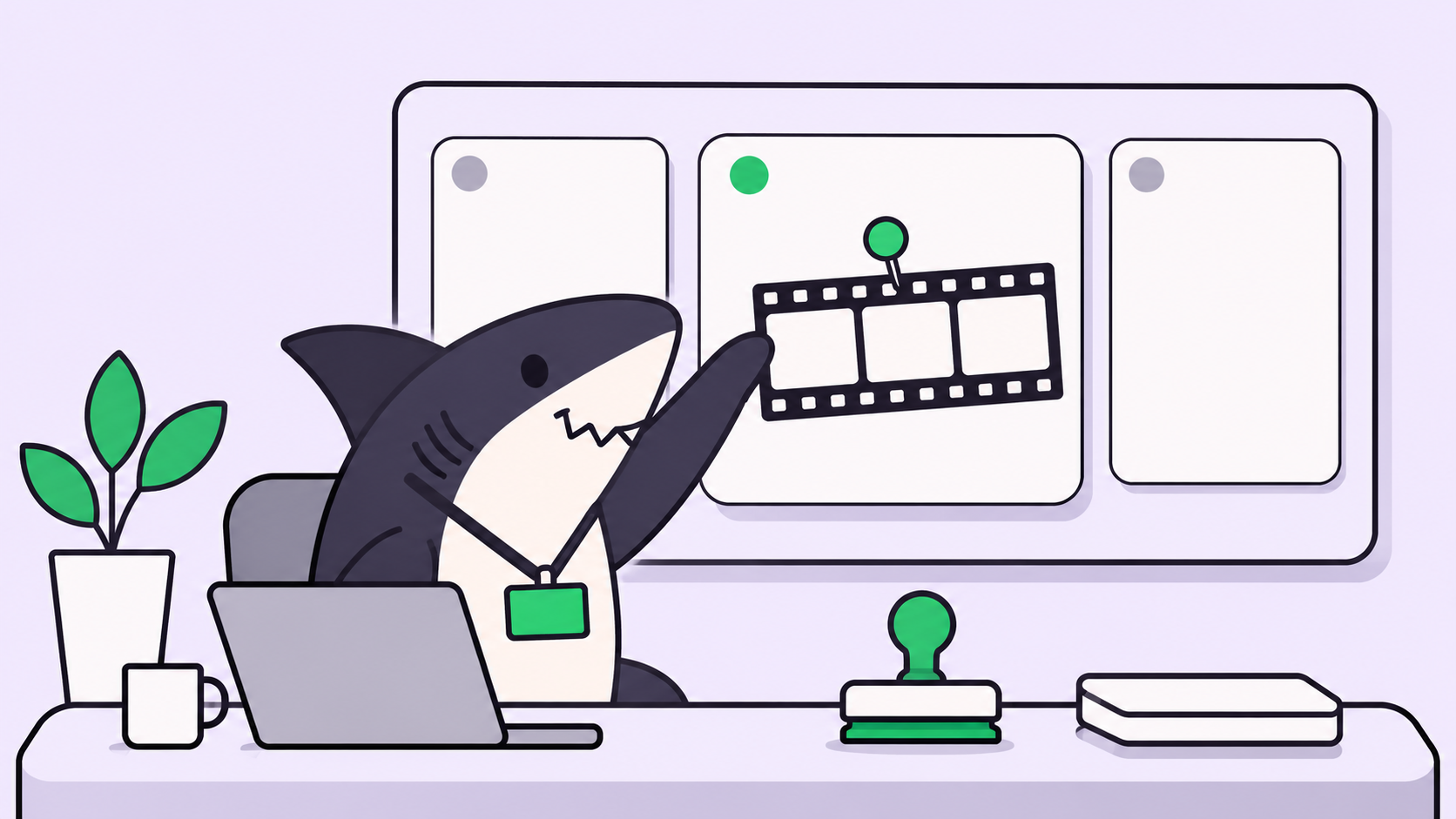
The rule that makes the whole thing legible: Agents move a Task to Ready for review; People move it to Done. An Agent never marks its own work Done, and a person never has to guess whether a green Task is safe. The status is the handoff. When ten agents are running, you don’t scan ten terminals; you read the board and see exactly what’s waiting on you, what’s waiting on another agent, and what’s still executing. That visibility is the difference between tracking what agents completed and hoping the commit log tells the story later.
A worked example: from ticket to merged PR
Take a real-shaped Task, SH-312: “Add rate limiting to the public API.” Watch the handoffs, not the code.
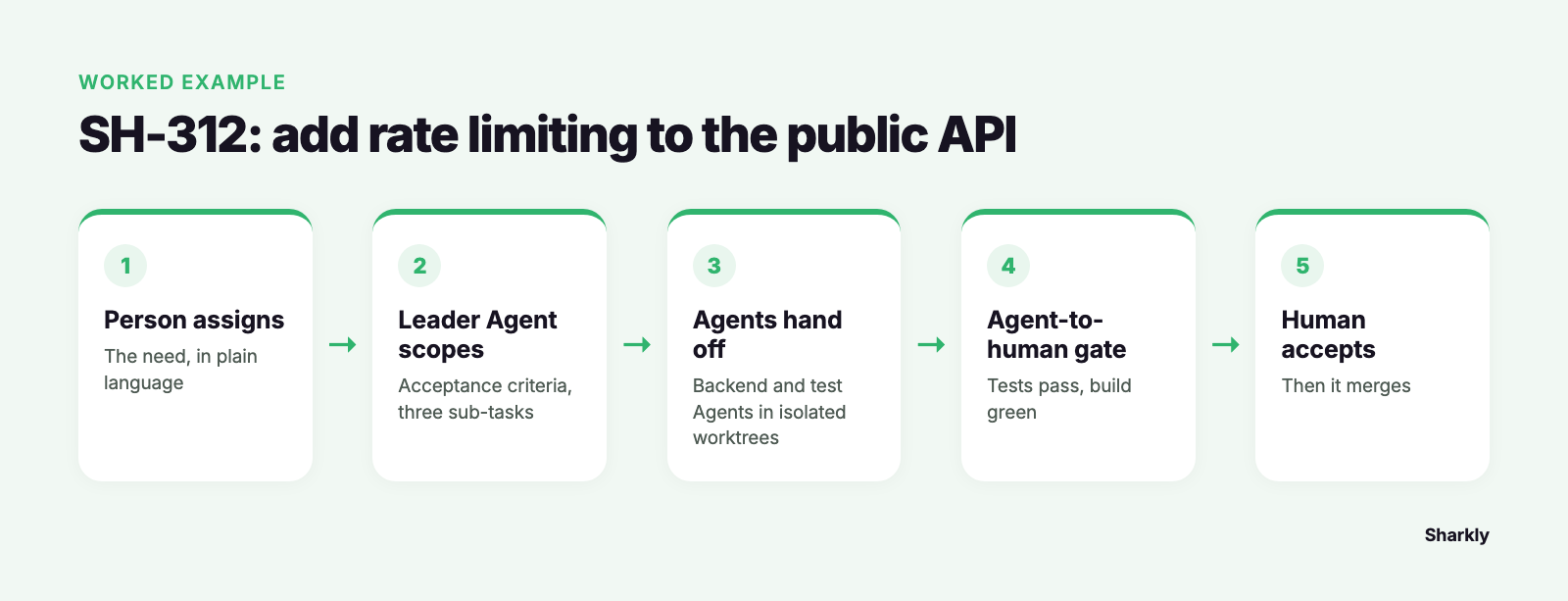
A person describes the need in natural language and assigns it. A leader Agent researches the codebase and historical tasks, writes the scope and acceptance criteria (limit per API key, return 429 with a Retry-After header, cover the three busiest endpoints), and splits SH-312 into three executable sub-tasks. That’s the first agent-to-agent handoff: goal in, ready sub-tasks out.
Sub-tasks flow automatically. A backend Agent claims the limiter logic; a test Agent claims coverage. Because each runs in an isolated worktree, they don’t collide on the same files, and each result returns to SH-312 rather than to a private session. When the backend Agent finishes, it doesn’t ping a human; it marks its sub-task ready, and the test Agent picks up the real implementation instead of a stub.
Then the handoff type flips. With the limiter built, typecheck clean, tests passing, and the build green, the work hits the agent-to-human gate. The Agent moves SH-312 to Ready for review and attaches the diff, a change summary, and one known limit: “Redis-backed counter assumes a single region; multi-region needs a follow-up.” A person reads that in one place, checks the 429 behavior, and moves it to Done, which triggers the merge. Ticket to merged PR, with a record of who did what at every seam. This is the same requirements-to-code path made traceable end to end.
Where handoffs break, and how to hold them
Handoffs fail in three predictable ways, and each has a structural fix rather than a “try to remember” fix.
Context evaporates. The agent knew why it made a choice; the reviewer doesn’t. Fix: the handoff carries the change summary and known limits as part of moving to Ready for review, not as an afterthought. Ownership blurs. Two agents grab the same work, or none do. Fix: an Assignee on every Task and sub-task, so “your turn” is a field, not a vibe. Review never happens. Autonomous work merges because nobody was told to stop it. Fix: a status the agent cannot cross alone.
You can build all of this by hand with worktrees, a naming convention, and discipline. That works until the number of agents, tasks, and repositories climbs and the discipline is the first thing to go. If you’re already running several agents, Sharkly gives you one place to manage their tasks and results: shared Tasks, per-Task Assignees, isolated worktrees, and a status lane where Agents reach Ready for review and People decide Done. Keep the coding agents you already use; add the layer that makes their handoffs visible. Download Sharkly when the seams between your agents start costing more than the work itself.
FAQ
What is an AI agent handoff? It’s the transfer of a task, along with its context and the signal that it’s now someone else’s turn, from one worker to the next. The two forms are agent-to-agent (a finished sub-task flows to the next agent) and agent-to-human (autonomous work stops at a review gate).
What’s the difference between agent-to-agent and agent-to-human handoffs? Agent-to-agent handoffs should continue automatically when the next step’s acceptance criteria are already defined. Agent-to-human handoffs should stop and wait, because a person has to exercise judgment: merging, changing a public contract, or accepting a result.
Should agents mark their own work as done? No. Let Agents move a Task to Ready for review after running tests and attaching a summary; leave the move to Done, and the merge decision, to a person. Separating those two boundaries is what keeps unreviewed code from shipping. See human-in-the-loop coding agents.
How do statuses prevent dropped work? When the handoff is a status change on a shared Task instead of a message in a terminal, the next worker sees exactly what’s waiting on them. Nothing depends on someone watching the right scrollback at the right moment. An agent Inbox surfaces the items that need you.
Do I need a tool for this, or can I do it manually? You can run it with worktrees and a shared board. A dedicated layer pays off once you coordinate multiple agents across multiple repositories and manual tracking becomes the bottleneck. Compare the assistant-versus-teammate mental model to decide.