You have a real bug open, and two agents that could fix it: Claude Code and Codex. The tabs are full of opinions about which one is smarter, and none of them tell you which one to point at this bug, in this repository, today. Public benchmark numbers do not either. A leaderboard measures a fixed set of open-source problems with a tuned harness. Your bug is a private problem: your conventions, your flaky test, the module one person understands.
The honest way to answer “Claude Code or Codex” is to run both on the same bug, under the same conditions, and read what each one hands back. That sounds simple and turns into a mess fast: two agents editing the same files, two terminals, two sets of test output, and no clean way to compare them side by side. The comparison you want is about the agents. The work in front of you is keeping them from colliding.
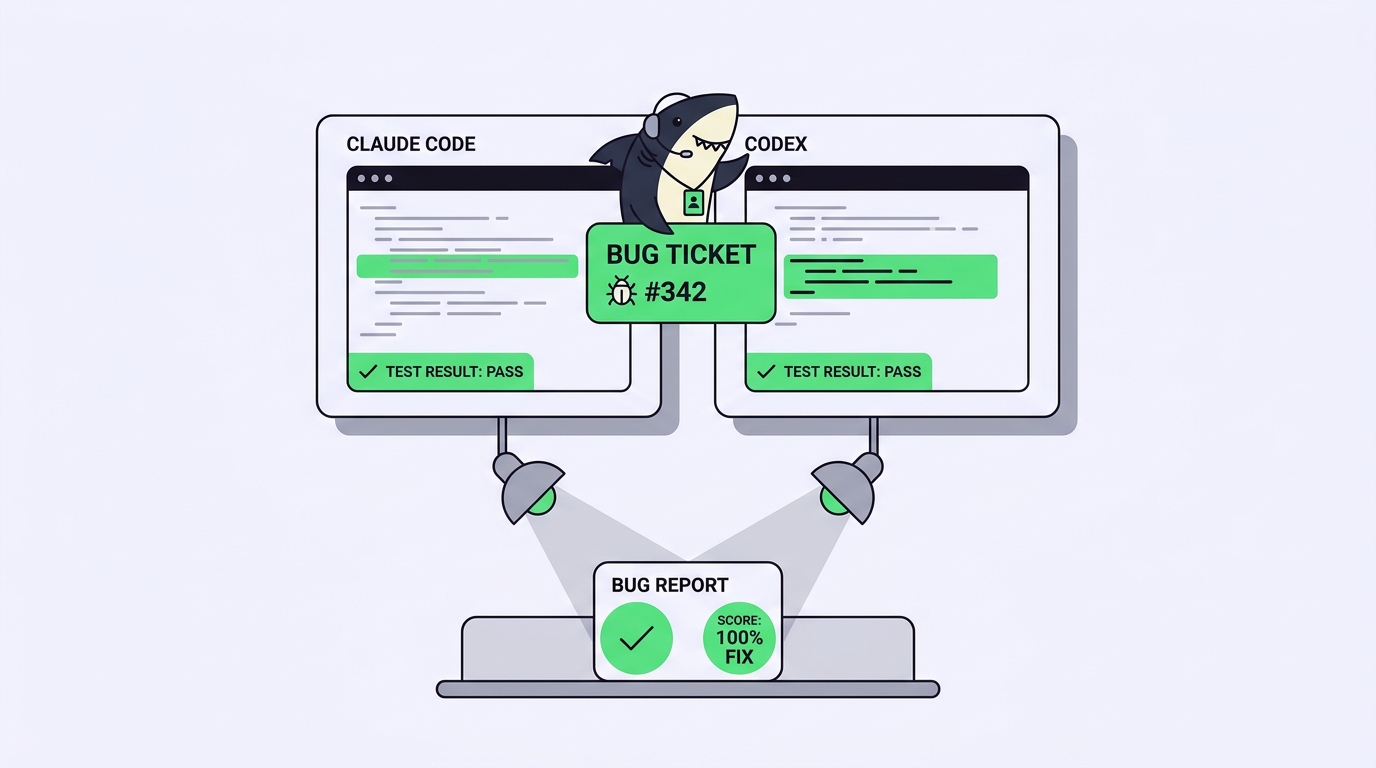
That collision is what Sharkly removes. Sharkly is an all-in-one Agent command and management platform: you assign the same Task to two different Agents, each runs on a connected Computer in its own isolated worktree, and every run returns its diff, its test results, and its review to one place. Sharkly is not a replacement for Claude Code or Codex, and it is not a benchmark harness. It is the layer that makes a fair head-to-head possible without opening a second terminal. This guide walks through the method, a scoring rubric for a single bug, and where each agent tends to win.
The quick answer
To compare Claude Code and Codex honestly, give both the identical bug, the same starting commit, and the same acceptance test, each running at its best configuration. Then score what returns: does the fix pass, does the diff stay in scope, and how long does the change take you to review. The agent that wins one bug has won one bug. Run the method across several before you trust the verdict.
Why “which is better” is the wrong question
Claude Code and Codex are both terminal-first coding agents. They read your repository, edit files, run commands, and report back. They differ in how you configure them and how they behave under pressure, but neither is universally ahead on the work that fills a normal sprint.
A single global ranking hides the part you care about. “Which is better” collapses everything into a number that does not survive contact with your codebase. “Which is better on this kind of bug, in my repo, at review time” is answerable, and it is the only version worth the effort. If you are still deciding which model each agent should run, matching models to agent roles is a better first question than any leaderboard.
Run both on the same bug: a method you can trust
A fair comparison holds everything constant except the agent. Four rules make that true.
- Pick one real bug, not a toy prompt. Choose a contained defect from your backlog with an acceptance test you can run and a diff you can read in a few minutes. Write it out the way your tracker would: a task like
SH-312: fix the timezone drift in the invoice export. “Build a todo app” tells you nothing about your code. - Give both the identical input. Same task description, same starting commit, same acceptance criteria. If Claude Code gets a richer prompt than Codex, you are measuring your prompt, not the agent.
- Run each at its best. Give Claude Code its
CLAUDE.md, give Codex itsAGENTS.mdand config, and give each the permissions and model its own docs recommend. Comparing a well-set-up agent against a bare one measures which one you bothered to configure. - Isolate the two runs. Each agent needs its own working copy. Two agents in one checkout will overwrite each other, and you will spend the afternoon untangling a merge instead of reading two clean attempts. This is what isolated worktrees are for.
Run the two attempts, then throw away the losing branch. You keep the fix you trust and the evidence of why.
A scoring rubric for a single bug fix
“Did it pass” is one bit of information. A real fix is decided by more than that, and writing the rubric down before you look keeps the comparison honest.
| What you score | The question it answers | Why it matters |
|---|---|---|
| Correctness | Does the acceptance test pass, and does nothing else break? | The floor. An agent that prints “done” has not passed anything. |
| Scope discipline | Did the diff touch only what the bug needed? | A fix that rewrites four unrelated files costs more to review than it saves. |
| Test quality | Did the agent add or update a test that would catch the regression? | A fix with no test is a fix you will make again. |
| Review time | How long did it take you to trust the change? | Often the real bottleneck, and easy to ignore until it is your afternoon. |
| Honesty | Did the agent flag its own limits and assumptions? | The run you can trust is the one that tells you what it did not verify. |
Score both attempts on the same five, on the same bug, and the winner stops being a matter of taste. Review time deserves extra weight: two agents can both finish in twenty minutes and still cost an hour each to check. That hour is often the true limit on how much agent work a team can absorb.
Where each one tends to win
No invented numbers here, just what to watch for. Claude Code leans on its CLAUDE.md project memory and tends to stay inside repository conventions on multi-file changes, which shows up on refactors that span several modules. Codex is comfortable in a sandboxed, config-driven setup and often structures new code and its tests cleanly, which shows up on contained fixes. Both wander more as the repo grows, and both will confidently hand you a change that does not pass. Run your own bug before you treat any of this as settled.
Here is the honest part most comparisons skip. If you only use one agent and live in a single terminal, you do not need a platform to run this. A well-tuned Claude Code session in one worktree, or one Codex run, is enough, and you can eyeball the diff yourself. The equation changes the moment you are comparing two agents, on more than one bug, and you want the results in a form someone else can read.
Running the head-to-head in Sharkly
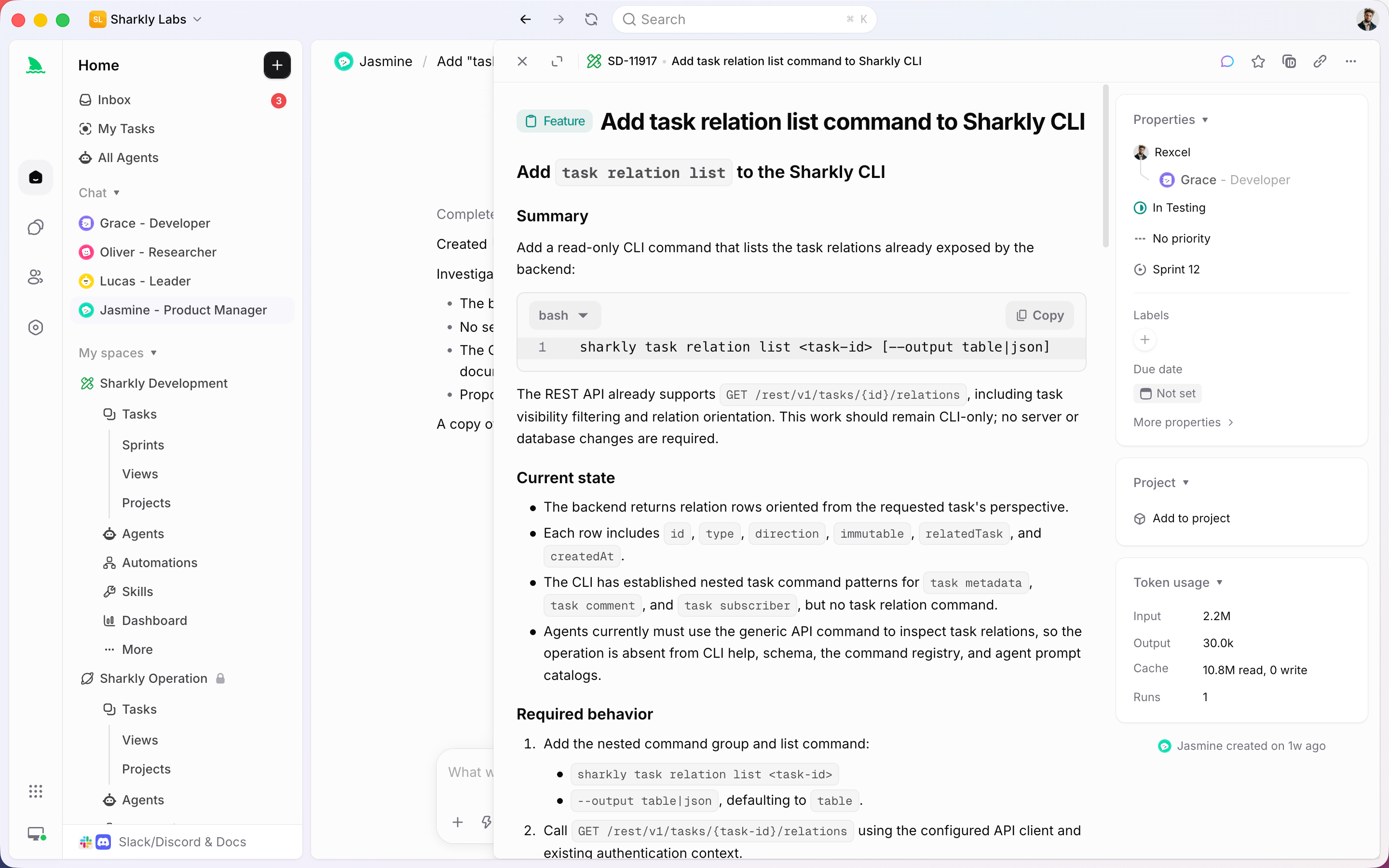
This is where Sharkly earns its place. You create one Task for the bug, then assign it to both a Claude Code Agent and a Codex Agent. Each Agent runs on a connected Computer in its own worktree, so the two attempts never touch the same files. Execution, blockers, results, and the change summary return to the Task timeline, and you read the two diffs and two test runs against each other in one view instead of remembering which terminal held which.
The division of labor stays clear. Agents research, execute, test, and report. People set direction and accept the result. Automation stops where your judgment is required, and Sharkly keeps context, progress, blockers, results, and human review visible from request to release. You are not handing the decision to a tool; you are getting both attempts laid out so it takes minutes. When you want to keep both agents for daily work instead of a one-off test, running Claude Code and Codex together on one codebase is the same workflow, made routine.
Which to reach for, by team size
The right choice depends on who is doing the choosing and what the comparison has to survive.
| Team size | Weight most heavily | What to reach for |
|---|---|---|
| Solo developer | Review time and own-machine execution | Whichever agent you review faster; you are the only reader |
| Small team | Parallel runs and shared visibility | Both, assigned through one Task so everyone sees the same evidence |
| Platform team | Integrations and provider neutrality | Keep both; the workflow has to survive whichever agent leads next quarter |
That last row is the real reason to run the comparison instead of picking a favorite and defending it. The best agent this quarter may not be the best next quarter, and rebuilding your process every time the lead changes is its own tax. Comparing on your own bugs, in a workflow that runs any agent, keeps you free to switch when the answer changes.
If you want to keep using multiple coding agents rather than committing to one ecosystem, that is the problem Sharkly is designed around. Download Sharkly, connect one Computer, and assign the same real bug to both agents. The verdict you get back is about your codebase, which is the only one that predicts your week.
FAQ
Is Claude Code or Codex better at fixing bugs? Neither wins in general. On the same bug, at their best configuration, one usually edges the other, and which one flips with the kind of bug and the size of the repo. Run both on a real defect from your backlog and score correctness, scope, tests, and review time.
Can I run Claude Code and Codex on the same bug at the same time? Yes, if each has its own working copy. Two agents in one checkout overwrite each other. Give each an isolated worktree, or assign the Task to both in Sharkly and let each Agent run on its own Computer.
Do benchmark scores tell me which agent to use? They tell you which agents are worth testing, not how one behaves in your repository. A public dataset can never contain your internal libraries, your lint config, or your untested module. Treat the leaderboard as a filter, then run the comparison that counts on your own code.
Does Sharkly replace Claude Code or Codex? No. Sharkly is the assignment, context, and review layer around the coding agents your team already runs. The agents perform execution; Sharkly manages the Task, keeps the runs visible, and leaves acceptance to people.
How many bugs should I compare before deciding? One bug tells you about one bug. Run the method across a handful of defect types before you trust a pattern, and keep the rubric identical each time so the results stack up.