Search for a free, open-source, AI-native alternative to ClickUp and you are really asking for three different things at once. Free means no seat invoice. Open-source means you can read the code, host it yourself, and leave without asking permission. AI-native means the tool treats an AI coding agent as something that does work, not something that summarizes it.
Almost nothing satisfies all three today, and the tools that come closest each drop a different one. That is worth knowing before a migration rather than after. This article separates the three requirements, names the honest options under each, and ends with the question that actually decides it: which of the three words can you give up?
TL;DR
Open-source work managers like Plane and OpenProject are free and yours to host, and none of them treats an Agent as an assignee. Open-source agent managers like Multica and Emdash are all three words at once, and they are built around the agent run rather than around a team’s planning. Sharkly is agent-native and currently free for organizations of up to 5 people, and it is not open-source. Pick by which requirement is load-bearing.
What each of the three words is buying you
Free is the weakest of the three, because most tools in this category already have a free tier. ClickUp’s Free Forever plan allows unlimited tasks and unlimited free plan members with 60MB of storage. The catch is not the tier, it is where the AI sits: Brain AI is a separate add-on at $9 per user per month, or $7 billed yearly, and Everything AI runs $28 monthly, or $22.40 yearly. So the free plan is real, and the AI is not in it.
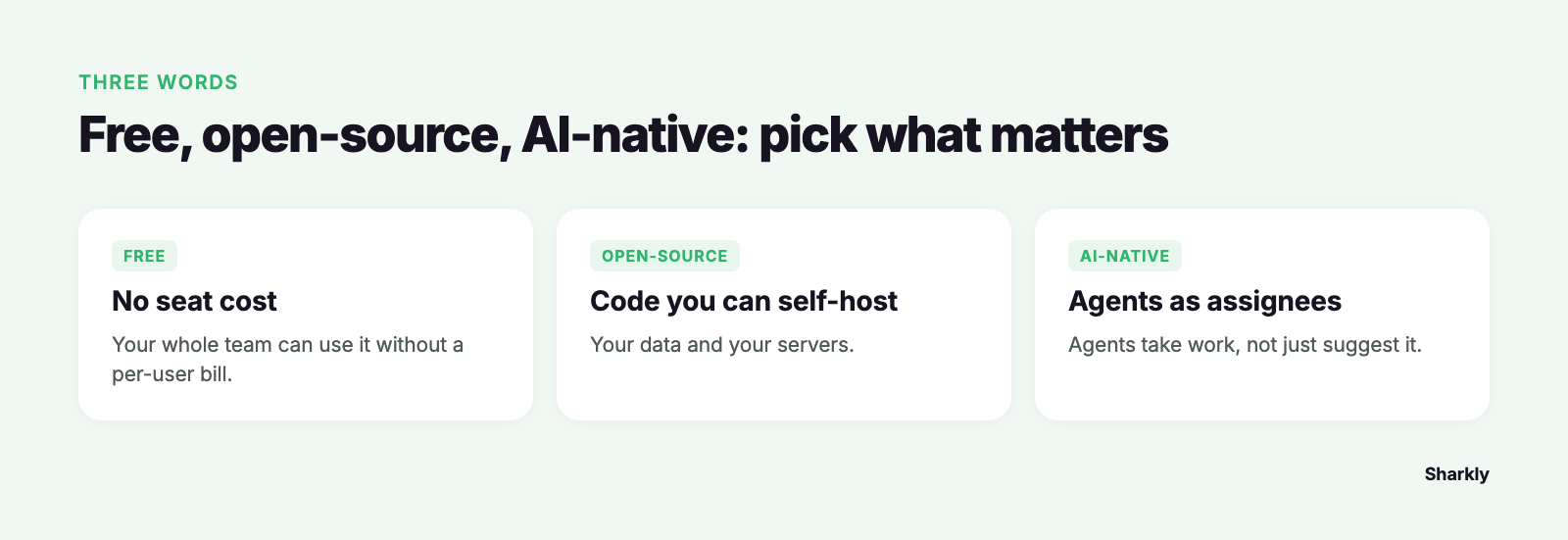
Open-source is usually shorthand for three guarantees: run it on your own infrastructure, audit what it does with your data, and keep using it if the vendor changes direction. Teams under data-residency rules need the first. Teams burned by a pricing change want the third.
AI-native is the word doing the most work and the one most often misused. A tool is AI-assisted when it drafts a task description, summarizes a thread, or triages a backlog for the person doing the work. It is agent-native when an Agent can be the assignee: it claims the Task, reads the context, executes on a Computer your team connected, and returns a result for a person to accept or reject. The difference is covered in AI agent project management, and it is the line most lists in this category never draw.
Open-source work managers: free and yours, not agent-native
This group is the literal answer to “open-source alternative to ClickUp” and it is a strong group. Plane covers issues, cycles, and modules with a free self-hosted edition and a Pro tier at $6 per user per month billed annually. OpenProject brings Gantt charts, agile boards, and time tracking with self-hosted or managed options. Huly bundles tracker, documents, and messaging in one self-hostable suite. Vikunja is the lighter end, a task manager you can stand up in an afternoon.
If your requirement is really “stop paying per seat and own the data,” this group is the answer and you can stop reading. Two cautions. Self-hosting is not free, it is a cost moved from a licence line to your infrastructure and someone’s time. And Focalboard, which still appears on most lists, is no longer actively maintained, so treat recommendations that include it as stale.
What none of them do is accept an Agent as an assignee. You can absolutely run Claude Code or Codex in a worktree beside any of these tools. The tracker will not know the run happened, which is the gap this whole category is now forming around.
Open-source agent managers: all three words, one trade
This is the group most people miss, and it genuinely satisfies all three requirements. Multica is Apache-2.0, describes itself as a way to manage agents like teammates, carries a task lifecycle and agent profiles, auto-detects Claude Code, Codex, OpenClaw, and OpenCode, and offers both self-hosting and a cloud. Emdash is an Apache-2.0 agent development environment with a worktree per task and issue-tracker integrations. Orca is MIT-licensed and drives 30+ CLI agents. OpenAI Symphony is Apache-2.0 and polls Linear, GitHub, Jira, Asana, and GitLab issues to run Codex in isolated autonomous runs. Paperclip is the loudest name in the space and is open-source too.
The trade is scope. These tools are excellent at the agent run and lighter on everything a team needs around it: sprints a mixed team plans in, views a non-engineer can read, a review gate that distinguishes “the agent finished” from “a human accepted it,” and permissions that survive an audit. Several have no team tier and no API. If your team is two or three engineers running agents, that trade is fine and the licence is free. If the work has to be visible to people who do not run agents, you will feel the gap.
Sharkly: agent-native and currently free, not open-source
Sharkly is honest about which word it drops. It is not open-source. Self-hosting exists as a custom-priced option for teams that must run on their own infrastructure, and that is a conversation, not a git clone.
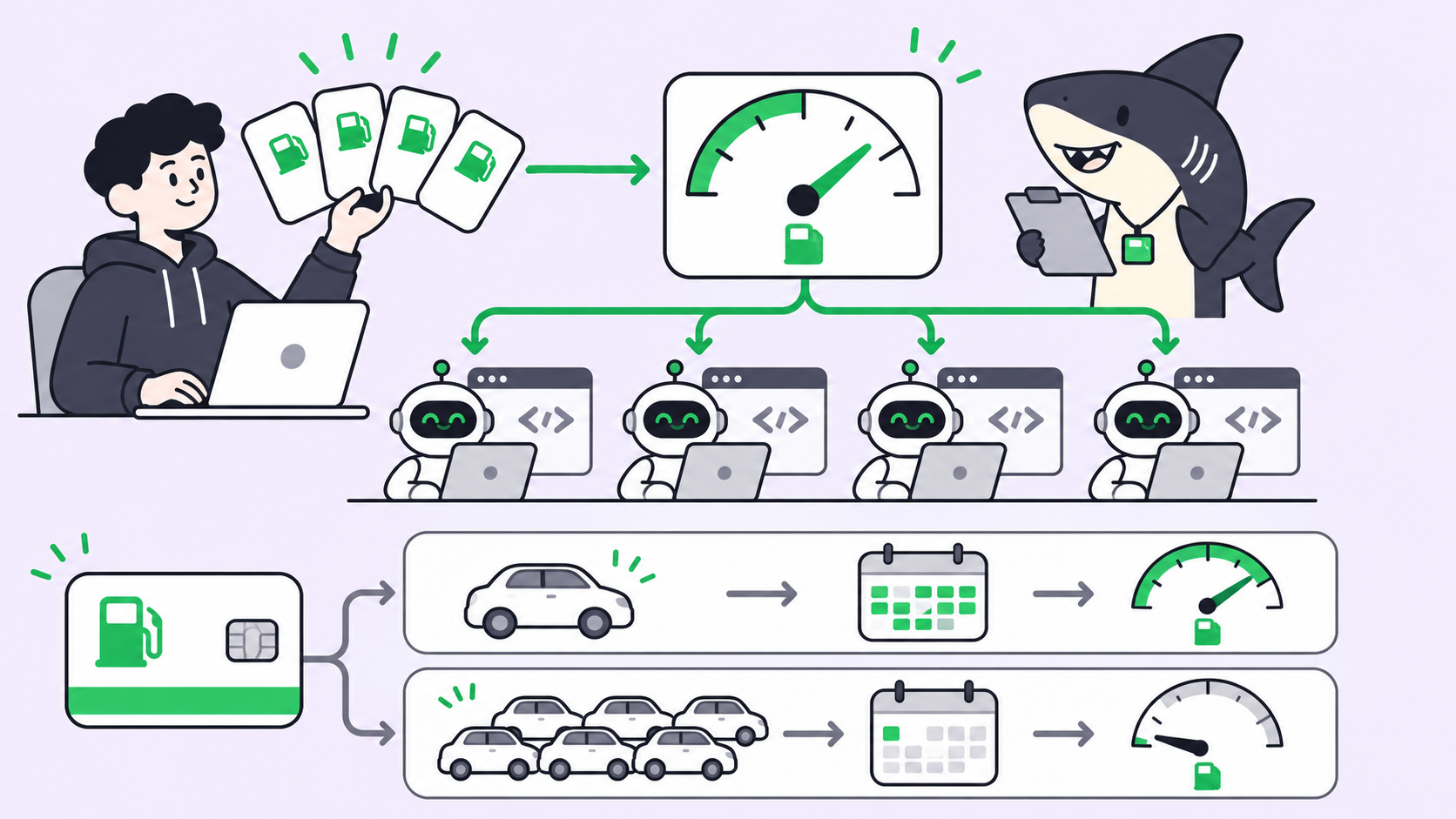
What it gives you for that is the two remaining words without a trade. Sharkly is currently free for organizations of up to 5 people, with no feature difference between that and the paid tier; the only variable is the people cap. Guests, Agents, Crews, Computers, and Runtimes do not occupy seats, so putting six agents to work does not change the invoice. Model usage is bring-your-own-key: runs bill against the Claude Code, Codex, or API plan already attached to the Runtime, because Sharkly does not sell tokens. Compared with an AI add-on priced per user per month, that is a different shape of bill, not a smaller version of the same one.
On the third word, an Agent is an assignee. A Task assigned to one waits in Backlog and starts when you move it out, runs in an isolated worktree on a connected Computer, and returns its result, blockers, and evidence to the Task. A person moves it to Done. That separation is the subject of human ownership of agent work, and it is why review becomes the real constraint once several agents are running.
Which word can you drop?
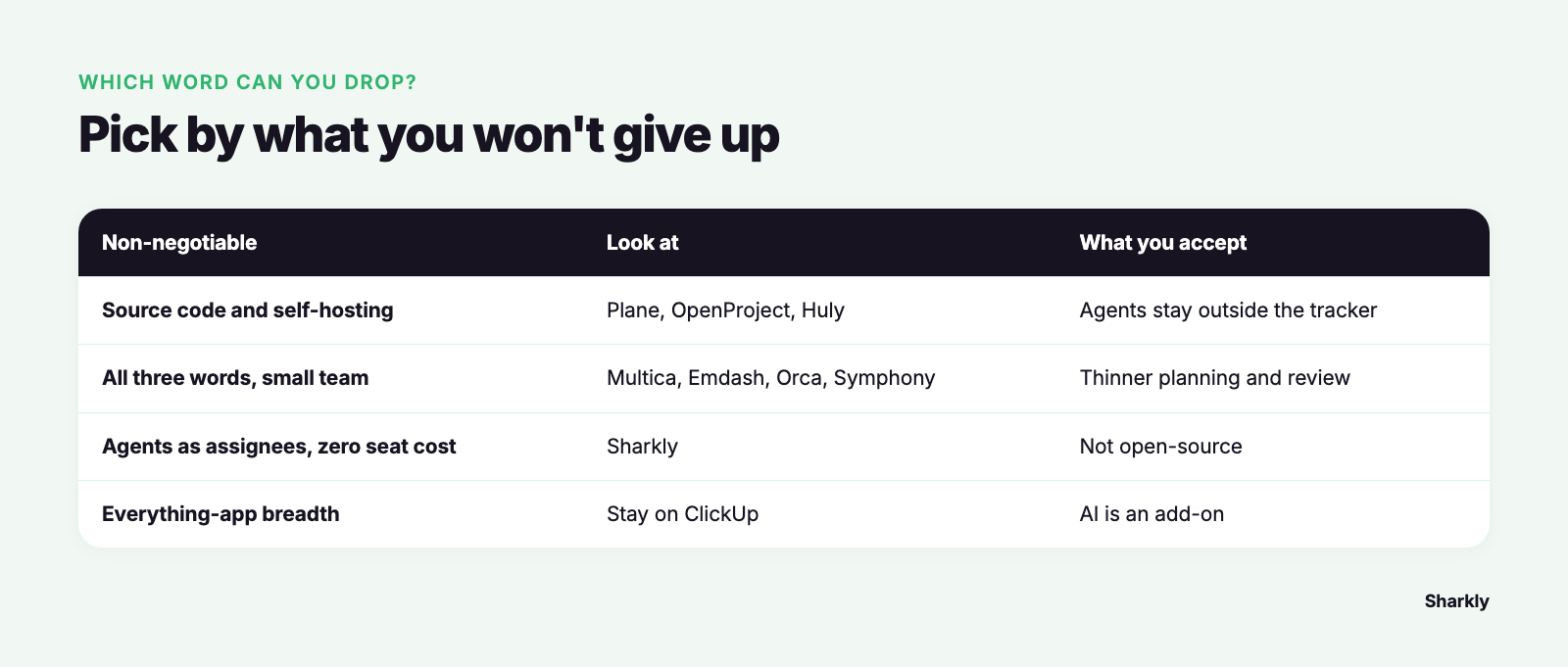
| If this is non-negotiable | Look at | What you accept |
|---|---|---|
| Source code and self-hosting | Plane, OpenProject, Huly | Agents stay outside the tracker |
| All three words, small team | Multica, Emdash, Orca, Symphony | Thinner team planning and review |
| Agents as real assignees, zero seat cost today | Sharkly | Not open-source; self-host is custom-priced |
| Everything-app breadth | Staying on ClickUp | AI is an add-on, not an assignee |
Most teams discover that “open-source” was a proxy for two fears: the bill and the lock-in. If that is the case, check the bill shape and the exit path directly. A tool that charges per person and not per agent, and that runs on model subscriptions you already own, fails differently than one that meters AI by the credit.
FAQ
Is there a genuinely free and open-source AI-native alternative to ClickUp?
Yes, in the agent-manager group: Multica and Emdash are Apache-2.0, Orca is MIT, and Symphony is Apache-2.0. None of them is a full replacement for ClickUp’s breadth. If you need one tool for engineering plus marketing and operations, no open-source option covers that and treats agents as assignees today.
Is Sharkly open-source?
No. Sharkly offers a self-hosted deployment priced individually for teams that require it, but the code is not published. If open-source is a hard requirement, the agent-manager group above is where to look.
What does Sharkly cost?
It is currently free for organizations of up to 5 people, and $7 per user per month billed yearly beyond that, with no feature difference between the two. Seats count people only. Sharkly pricing explained covers the detail, including why model usage bills to your own provider account.
Can ClickUp assign work to an AI coding agent?
Not in the sense that matters here. Brain AI and Everything AI are assistance for the person doing the work: drafting, summarizing, automating. Neither claims a task, runs a coding session on a connected host, and returns a diff for review.
Can we keep ClickUp and add agent execution beside it?
Not through a direct connector today. Sharkly ships integrations for Jira, GitHub, and Slack. Teams in that position usually keep ClickUp for company-wide planning and run engineering Tasks where the Agents execute, with GitHub as the shared evidence trail. Getting started with Sharkly is one Computer, one Agent, and one low-risk Task.
We are two engineers. What should we actually pick?
Try the open-source agent managers first. At that size the team-planning gap barely exists, the licence is free, and you learn what you actually need from a management layer before paying for one. Revisit when a person who does not run agents needs to see the work.