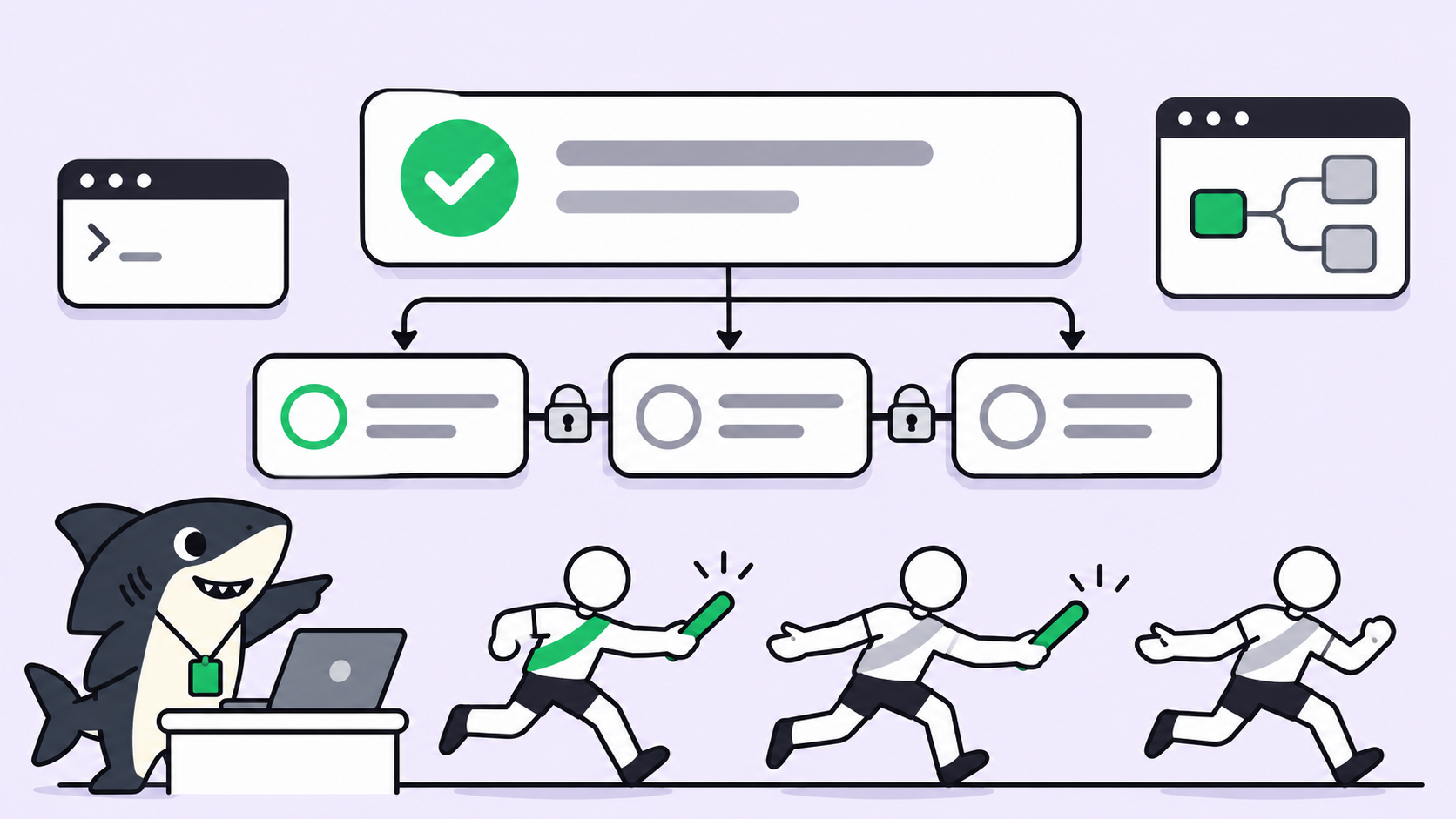

TL;DR: When AI agents produce more than a person can read, human in the loop review stops meaning “read every line.” The human job moves to four checkpoints: the statement of what was asked, the checker that judged the work, the escape hatches the agent may have used, and the residue no checker covers. Review those four, and you can sign off on work you didn’t read end to end.
On November 20, 2026, Anthropic researcher Levent Alpoge released a short note saying that, working with Claude, he had found a proof of the Generalized Riemann Hypothesis for Dirichlet L-functions. The proof is written in Lean, a language where software checks every logical step. BigGo reports that the Lean and Mathlib community certified it the next day. Mathematicians still say the argument will take weeks to digest.
So who reviewed it? A program did, line by line. Humans are now reviewing something else. That split is the most useful idea for any team running coding agents, and it’s what this article is about. If your agents already work on a Sharkly board, you’ll see where each checkpoint lives.
What human in the loop means when output outruns reading
Human in the loop for AI agents means a person owns the decision that work is acceptable, even when the person can’t inspect all of it. The human doesn’t redo the checking. The human confirms that the right question was checked, by a checker they trust, with no shortcuts taken.
That definition matters because the old one breaks at scale. Our review-capacity math shows agent output growing faster than any team’s reading hours. “Read every diff” turns into “skim every diff,” and skimming is where bad changes get through.
The Riemann story shows the alternative at its most extreme. No human will check the Lean proof step by step before trusting it. The Washington Post and Al Jazeera both describe a community that trusts the checker and is now arguing about other questions: what exactly was proved, and what the proof means.
The four things a human still reviews
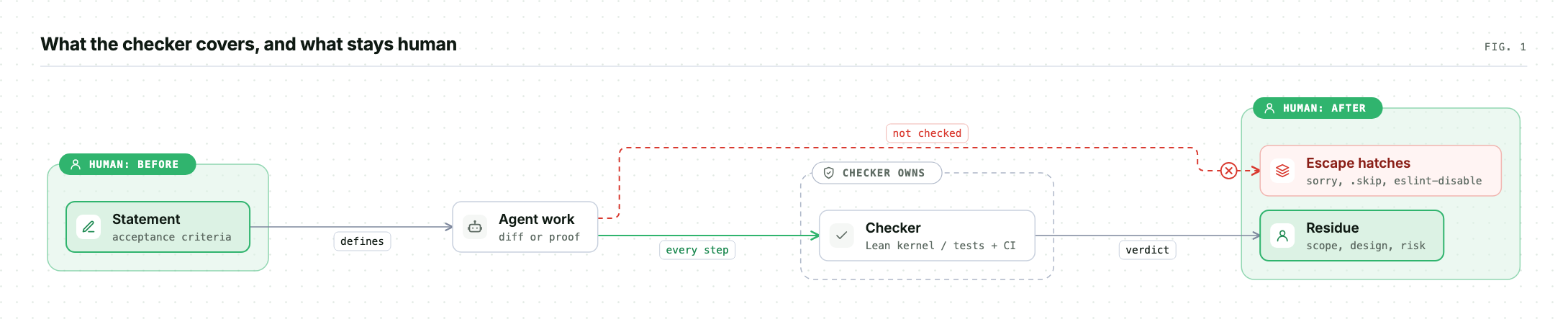
Here’s what moves to the human when a checker handles the line-by-line work:
- The statement. Does the checked claim match what you meant to ask?
- The checker. Does it test the claim, or something easier that looks similar?
- The escape hatches. Did the work skip, stub, or assume anything the checker can’t see?
- The residue. What matters that no checker measures: design, naming, cost, risk?
Each one has a direct parallel in Lean and in a pull request from a coding agent.
| Checkpoint | In a Lean proof | In agent code work |
|---|---|---|
| Statement | The theorem as written in Lean | The task’s acceptance criteria |
| Checker | The Lean kernel | Tests, type checks, CI |
| Escape hatches | sorry, added axioms |
Skipped tests, mocks, disabled lint rules |
| Residue | Is the proof illuminating? | Is the change maintainable and in scope? |
Why the statement is where errors hide
A checker proves exactly what it’s handed. In Lean, a theorem can be stated slightly wrong, and the kernel will happily verify the wrong theorem. That’s why reporters stressed that the proof targets the Generalized Riemann Hypothesis over Dirichlet L-functions, and why one report stresses that the proved theorem is the statement already in Mathlib, the shared library of formalized math. Agreeing on the statement is human work.
Your version is the acceptance criteria. An agent can pass every test for “the login endpoint returns 200” while the real request was “users with expired sessions get sent to the login page.” Read the criteria first, then read what the tests assert. If the two don’t match, nothing downstream saves you.
How do you know the checker checks the claim?
A green CI run tells you the checks passed, not that they were the right checks. Ask three questions of any checker before you trust its verdict:
- Did a test fail before the change and pass after it?
- Do the assertions touch the behavior in the criteria, or only nearby code?
- Did the agent write the tests it’s being graded by?
The last one deserves care. When the same agent writes the code and the test, both can encode the same misunderstanding. A separate reviewer agent, or tests written from the criteria before the run, breaks that loop. We cover the mechanics in what AI code review agents can and cannot verify.
Escape hatches: the shortcut the checker can’t see
Lean has a keyword, sorry, that tells the checker “assume this step.” A proof with one sorry compiles. It isn’t a proof. Anyone auditing a Lean proof looks for sorry and for extra axioms first, because those are the places the checker was told to look away.
Coding agents have the same moves:
# Escape hatches worth grepping for in an agent's diff
git diff main...agent-branch | grep -nE \
  "\.skip\(|xit\(|@pytest\.mark\.skip|eslint-disable|# type: ignore|--no-verify|TODO: real impl"
None of these is wrong on its own. Each one is a spot where a passing check means less than it appears to. Make your agents report them in their summary, so the human sees them without hunting.
The residue no checker covers
Some questions have no test. Is the change the right size? Does it fit how the codebase is meant to grow? Did the agent touch a file outside the task’s scope? Lean can’t tell you whether a proof teaches anything either, which is why mathematicians will spend weeks reading this one after the checker said yes.
This is the part of review only a person should do, and it’s small enough to do well once the first three checkpoints are covered.
Where review gates belong in an agent workflow
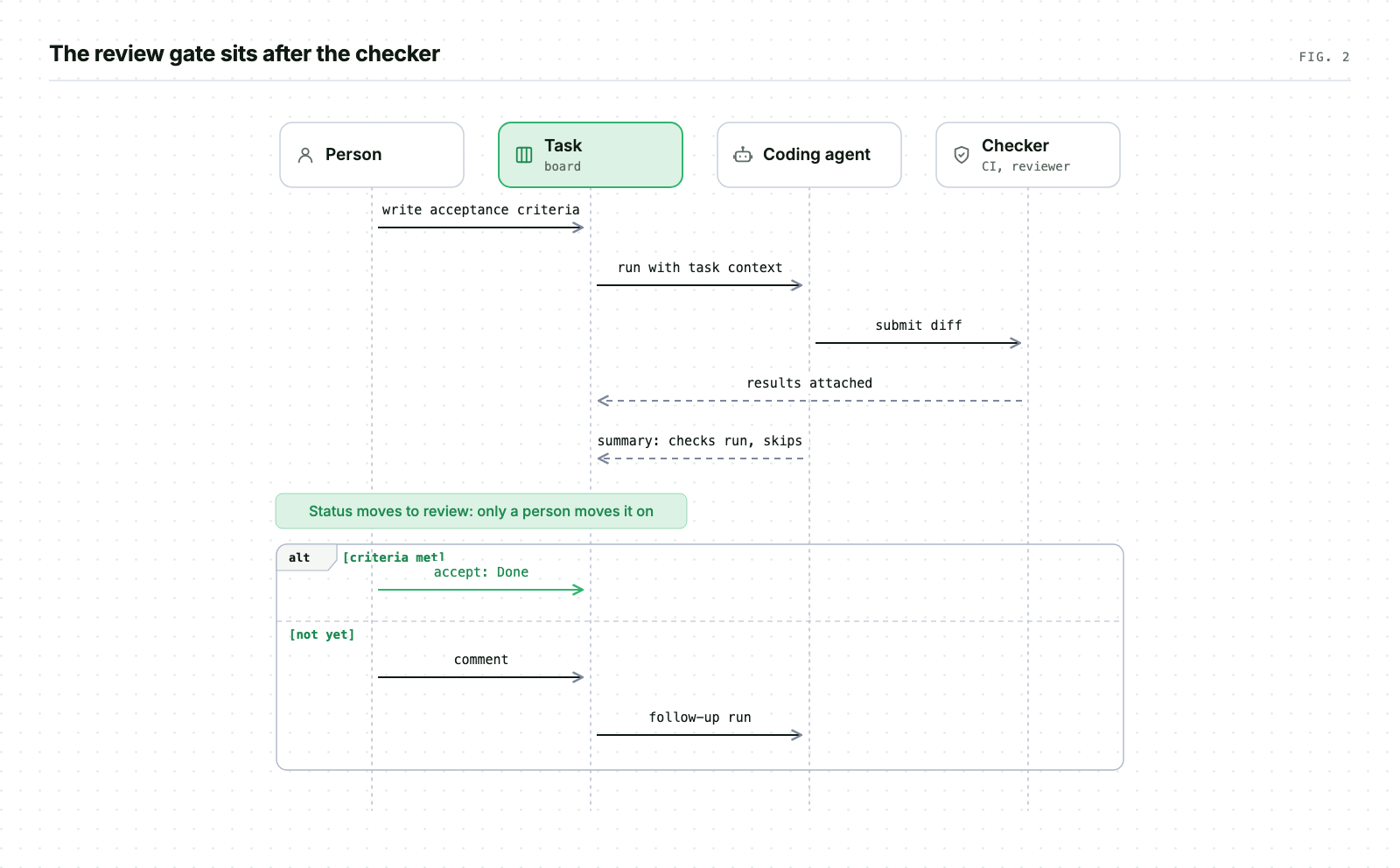
A review gate is a status that finished work must pass through before it counts as done. Put the gate after the checker runs and before the work merges or ships. The reviewer opens one place and finds the statement, the checker’s result, the escape-hatch list, and the diff.
Here’s the order that keeps the human’s time on the four checkpoints:
- Write acceptance criteria in the task before any agent starts.
- The agent runs and reports which checks it ran and what it skipped.
- Automated checks run: tests, types, a reviewer agent if you use one.
- The task moves to a review status and lands in a person’s queue.
- The person reviews statement, checker, escape hatches, residue.
- The person accepts, or comments, and the agent runs again.
For where to place gates across a longer pipeline, see approval gates for coding agents.
How Sharkly puts the human sign-off on the board
Sharkly is a work board where People, Agents, and Crews (a group of agents with a leader) take tasks side by side. It doesn’t replace Claude Code, Codex, or any other coding agent. It holds the four checkpoints in one record.
- The statement lives in the task. The Tasks docs tell you to put the goal, scope, and “how completion will be reviewed” in the description, so every run and every reviewer reads the same criteria.
- The review gate is a status you define. Each task type owns its workflow. On our own board, finished agent work moves to Ready for Release, a Started-category status, and only a person moves it to Done.
- Waiting for review is a signal. An Agent can leave a task waiting for human review, and that item appears in the reviewer’s Inbox instead of a chat they might miss.
- The checker’s evidence stays attached. The Executions tab keeps each run’s log: tool calls, trigger source, start and end time. See agent task execution.
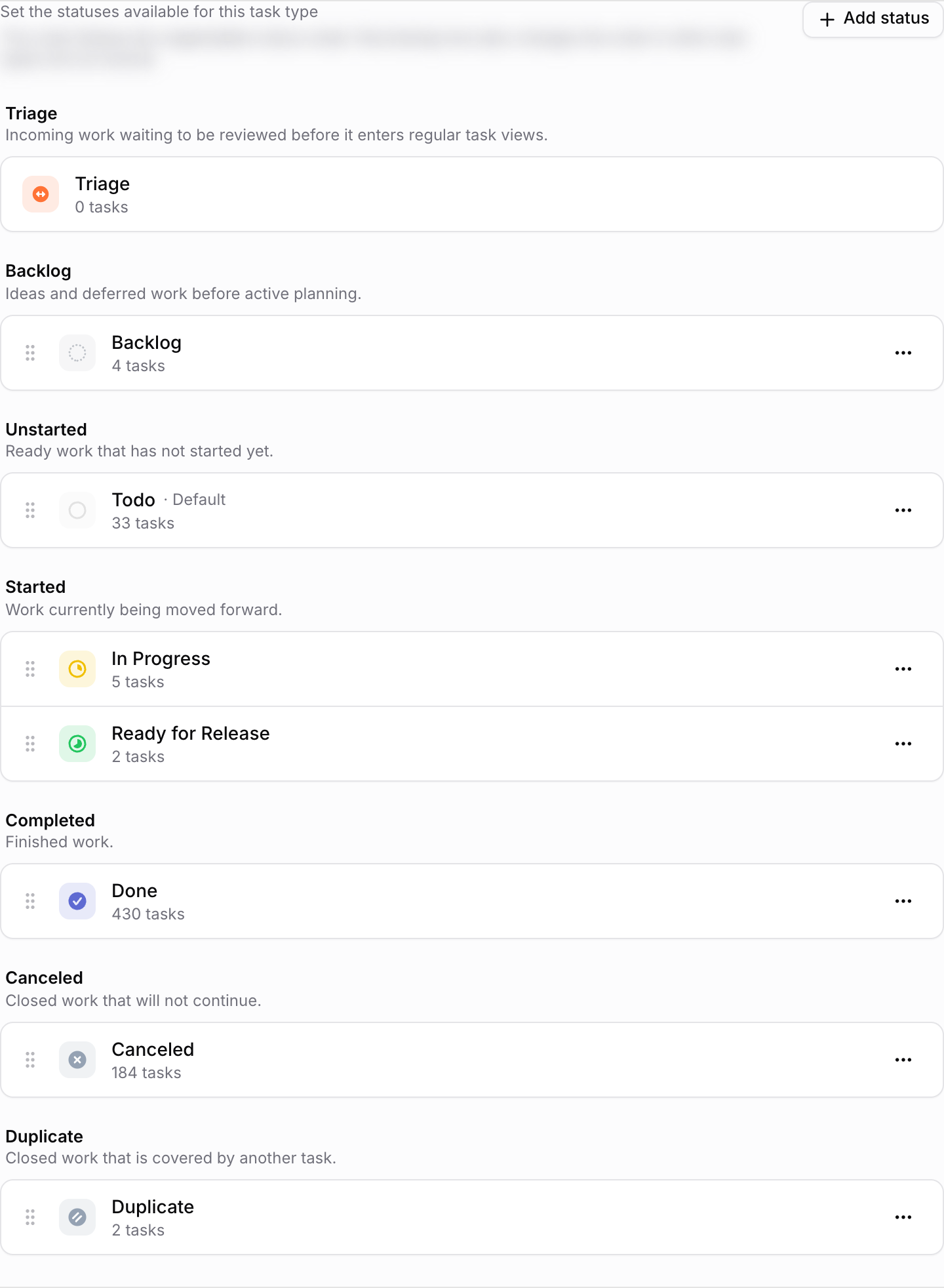
A comment from the reviewer can start a follow-up run on the same task, so a “no” turns straight into the next attempt with the context intact. If you want a reviewer agent ahead of the human, a Crew can hold the worker and the reviewer together.
Alternatives to full human review
You have three other options, and each has a cost:
- Spot-check a sample. Cheap, and it catches systemic failures. It misses the one bad change in fifty.
- Agent-only review. A reviewer agent reads everything. It helps, and our post on mixed-model Crews covers the setup, but it shares blind spots with the worker.
- Formal verification. The Lean route. It’s the strongest checker there is, and still rare for application code outside narrow components.
Most teams combine them: checkers for correctness, a reviewer agent for a first pass, and a human for the four checkpoints.
Conclusion
The Riemann claim didn’t remove humans from review. It moved them. Software checked the steps, and people are left with the questions that need judgment: was the right claim proved, and does it mean what we think? Your agent reviews work the same way at a smaller scale. Write the statement first, trust only checkers you’ve inspected, hunt for escape hatches, and keep your own attention for the residue.
Next step: pick one agent task this week, put the acceptance criteria in its description, and make your review status the only path to Done. Set it up on Sharkly, or read the docs first.
FAQ
What is human in the loop for AI agents?
It’s a workflow where a person approves agent work before it counts as finished. At scale, the person reviews the task statement, the checks that ran, any skipped steps, and design questions, rather than every line.
Can a person approve AI work they haven’t fully read?
Yes, if a trusted checker covered the line-by-line correctness and the person confirmed the checked claim matches the request. That’s how the Lean community treats a checked proof.
Was the Riemann Hypothesis solved?
Reports describe a claimed proof of the Generalized Riemann Hypothesis for Dirichlet L-functions, written in Lean and certified by the Lean and Mathlib community. Mathematicians say understanding it will take weeks.
What’s the most common agent review mistake?
Trusting a green test run without checking what the tests assert. Passing tests that check the wrong behavior look the same as passing tests that check the right one.
Should an AI agent review another agent’s code?
As a first pass, yes. Keep a human gate after it, because two agents can share the same misunderstanding of the task.
Where should the review gate sit?
After automated checks and before merge or release, as a workflow status that only a person can move forward.