Yes, Confluence is free: the Confluence Free plan covers up to 10 users with 2 GB of storage, and Atlassian calls it “free forever.” AI coding agents can use it on that plan too, through Atlassian’s official remote MCP server, which Atlassian says is open to “All Atlassian Cloud customers,” with a Free-plan limit of 500 calls per hour per site. Atlassian’s Jira pricing table, read on October 26, 2026, lists the Rovo MCP Server only under Standard, Premium and Enterprise, so connect it once on your own Free site before you plan around it. The part you may pay for is the agent, and there is a $0 route for that as well.
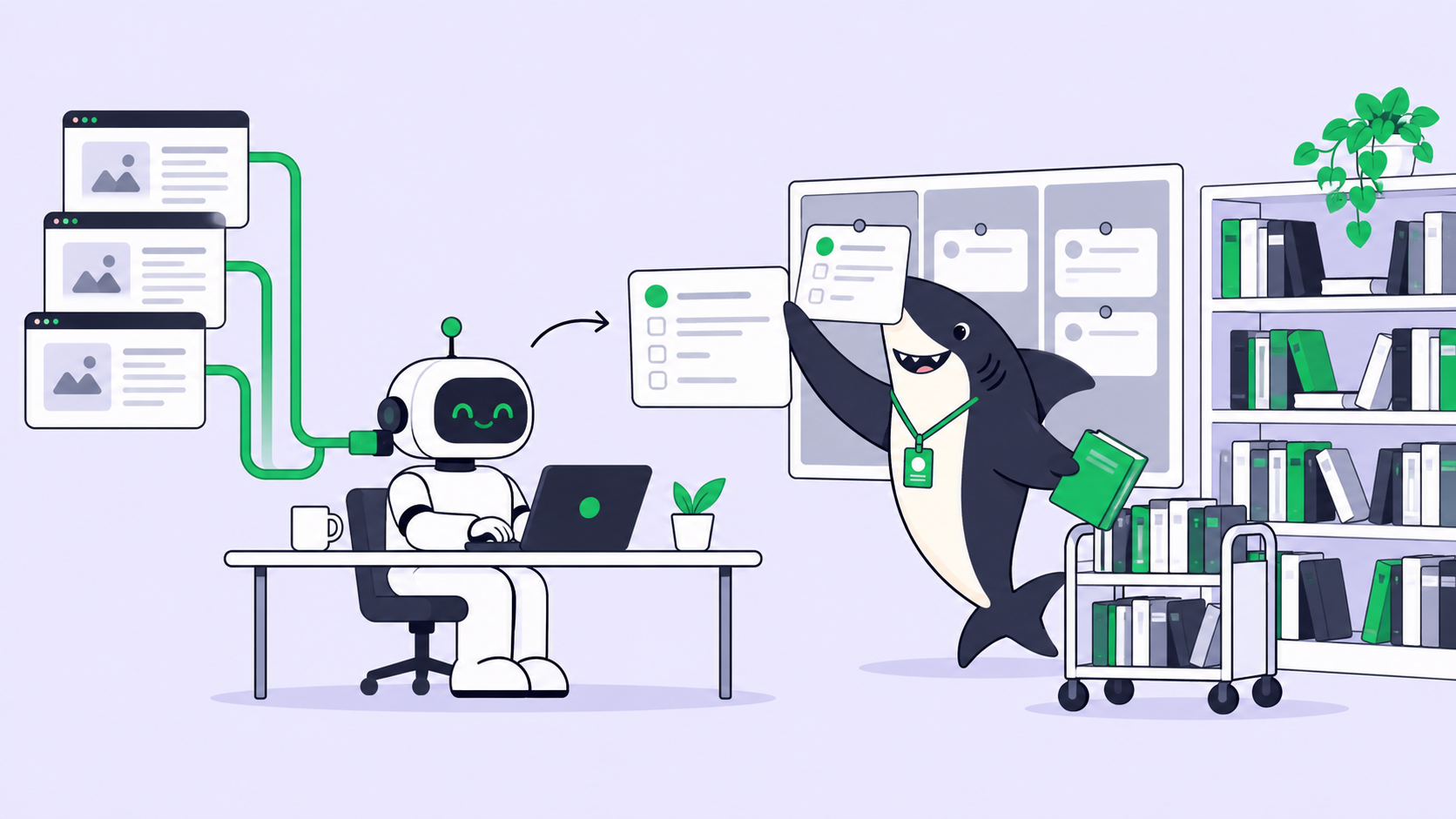
The Atlassian Rovo MCP Server is Atlassian’s hosted MCP endpoint for Jira and Confluence. It lets an MCP client such as Claude Code, Codex or OpenCode search, read, create and update Confluence pages with the signed-in user’s permissions. It is the same server Jira uses, so one connection covers both.
TL;DR
Keep Confluence on the Free plan, add the Rovo MCP server to your coding agent, sign in with OAuth, and the agent can pull specs and runbooks into its context and write pages back. Basic single-product calls are free; enriched cross-product search draws Rovo credits, which the Free plan doesn’t include. OpenCode on a free model makes the agent side $0. Sharkly has no Confluence connector: its part is the board where that agent becomes an assignable teammate.
What’s free and what you pay
| Layer | Free option | The cap | What you pay past it |
|---|---|---|---|
| Confluence | Free plan | 10 users, 2 GB, 50 automation steps per month, no space or page permissions | A paid Confluence plan, priced per user |
| Atlassian Rovo MCP Server | Included for all Cloud sites | 500 calls per hour per site on Free | Higher site limits on paid plans; Rovo credits for enriched calls |
| Coding agent | OpenCode with a free model | Free models are time-limited | Claude Code needs a paid Claude plan or API credits; Codex runs on a ChatGPT plan or an OpenAI API key |
| Sharkly | Currently free for organizations of up to 5 people | 5 people; Agents and Computers take no seats | $7 per person per month, billed yearly |
Confluence’s free plan: the limits that matter for agents
Ten users, and a hard edge. Atlassian’s pricing FAQ says the Free plan “lets you try Confluence for up to 10 users with 2GB of storage and Community Support.” Go over the user limit and Atlassian moves you onto a 7-day trial of Standard. An agent signed in through OAuth acts as an existing person’s account, so it doesn’t add a user.
No permissions. This is the limit that matters most for agents. The pricing page states: “The Free plan doesn’t allow permission settings for spaces or pages.” Atlassian says the MCP server operates “within the permissions of the signed-in user,” and on Free that user can typically see every space. Treat anything in a Free Confluence site as readable by every agent you connect.
Automation. The Free plan lists 50 automation steps per subscription per month. Pages your agent creates can trigger rules, and those rules use the same small budget.
Rovo credits. Per Atlassian’s Rovo credits page, installing the MCP server, write operations and single-product lookups are free, while enriched calls such as unified search with searchAtlassian cost 1 to 10 credits each. “Rovo credits are included in all paid Jira, Confluence, Service Collection and Teamwork Collection cloud subscriptions,” so a Free site has none. Plan around direct Confluence reads and writes.
The 500 calls per hour from the Rovo MCP FAQ apply to the whole site, shared by every person and agent.
Connect Confluence to Claude Code, Codex or OpenCode
Every client uses https://mcp.atlassian.com/v2/mcp, per Atlassian’s getting-started guide. You need a Confluence Cloud site.
1. Claude Code.
claude mcp add --transport http atlassian https://mcp.atlassian.com/v2/mcp
Start a session and run /mcp to sign in through your browser.
2. Codex.
codex mcp add atlassian --url https://mcp.atlassian.com/v2/mcp
3. OpenCode. Add a remote server under the mcp key of opencode.json. OpenCode’s MCP docs say it handles OAuth automatically:
{
  "$schema": "https://opencode.ai/config.json",
  "mcp": {
    "atlassian": {
      "type": "remote",
      "url": "https://mcp.atlassian.com/v2/mcp"
    }
  }
}
Then run opencode mcp auth atlassian once.
4. Test with a read. Ask for something you can check by eye: “Find the Confluence page titled Release checklist and summarize its steps.” Then try one write in a scratch space, such as creating a child page.
5. Unattended computers. OAuth needs a browser. Atlassian’s MCP server repository documents API tokens for headless setups, sent as Authorization: Basic <base64(email:api_token)>, once an organization admin turns on API token authentication for the Rovo MCP server.
What agents actually do with Confluence
A coding agent mostly needs Confluence for two jobs. It reads: the spec behind an issue, the runbook for a deploy, the architecture decision that explains a strange module. And it writes: a design note after a refactor, release notes, an updated how-to after an API changes.
Use the MCP server for the second job carefully. A page an agent writes is a page a person has to trust later, so keep agent-written pages in one space where someone reviews them. Requirements to code: a traceable agent workflow covers keeping the spec, the Task and the change linked, and maintaining context across AI sessions covers what belongs in a page versus in the repo.
The $0 route
Confluence Free, the Rovo MCP server, and OpenCode on a free model is the one stack where every line is $0. OpenCode runs its free models with no sign-in and no API key. In an earlier session on October 16, 2026, OpenCode 1.19.2 finished a write-and-run task in 32 seconds on opencode/deepseek-v4.1-flash-free. The OpenCode Zen docs list that model today with GLM-5.3-Flash Free, MiniMax M3.1 Flash Free and others.
The honest limits: the free tier works only inside the OpenCode program (a direct API call returns HTTP 403 FreeTierError), several free models are free “for a limited time,” and data terms differ by model. Zen says some providers follow “a zero-retention policy,” while for others “collected data may be used to improve the model.” Your Confluence pages go into the prompt, so choose with that in mind.
Claude Code needs a paid Claude plan or API credits. Codex signs in with a ChatGPT account or an API key; check OpenAI’s current limits before counting on a free tier.
From chat to assignment
Sharkly doesn’t connect to Confluence, and nothing here depends on it doing so. Sharkly is not a replacement for your coding agent either. It adds the shared Task, Computer and review layer around it.
Here is how the two fit. A Sharkly Agent runs your agent CLI, such as Claude Code or OpenCode, on your own Computer, inside the repository’s worktree. Sharkly’s docs don’t mention MCP, but because the Runtime is the CLI itself, MCP servers that CLI loads should be available to the run. The cleanest way to make the Confluence server travel with the work is to commit it to the repo: for Claude Code, add it with --scope project so it lands in a .mcp.json file; for OpenCode, put the mcp block in the project’s opencode.json. The OAuth sign-in still lives on each Computer, so sign in once there.
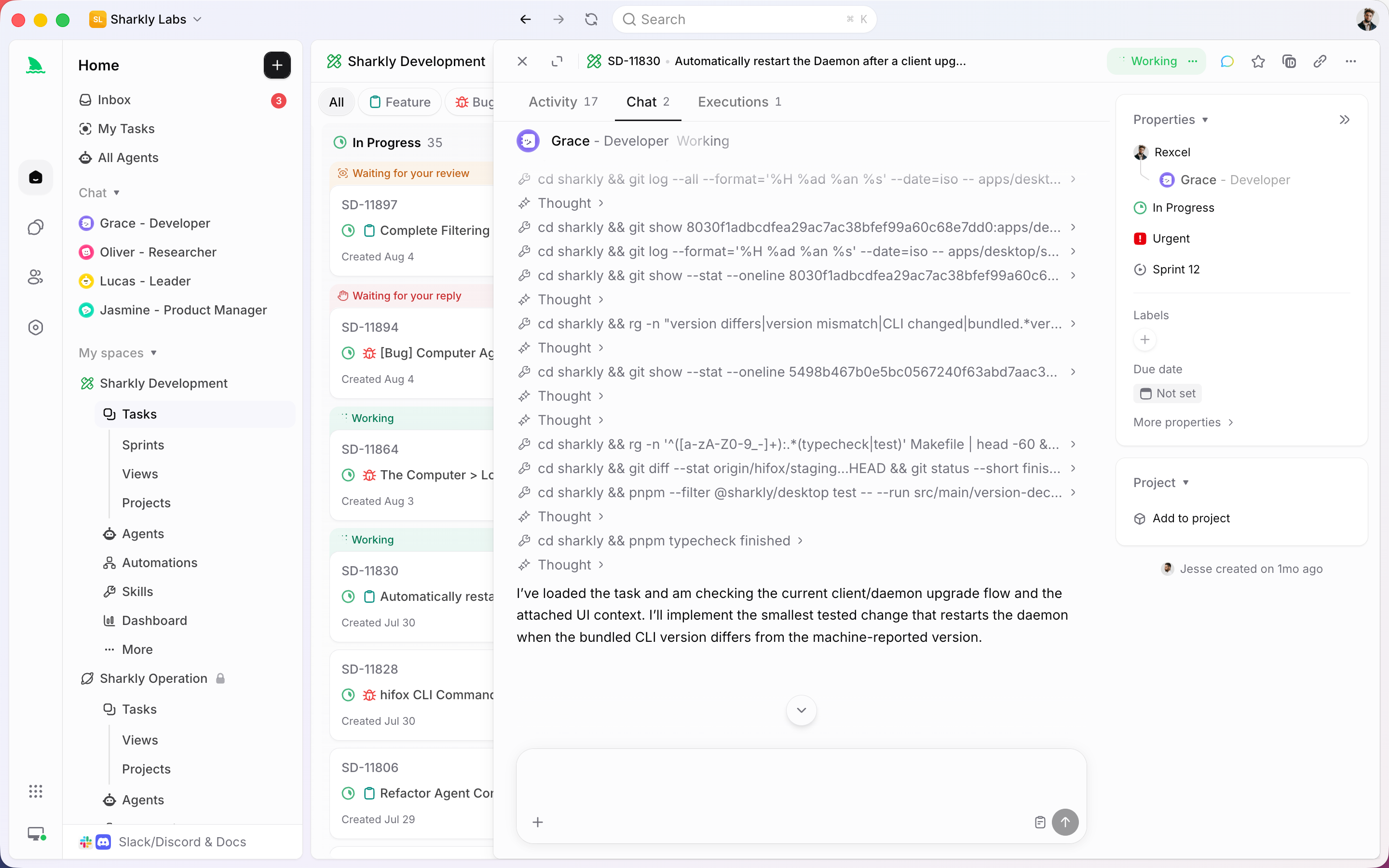
Then a Task like “Implement the export endpoint described in the Exports spec page” can go to an Agent the same way it goes to a person. The Agent reads the page, writes the code, and the diff, the summary and any blockers return to the Task for review. Agents research, execute, test, and report. People set direction, grant authority, and accept the result.
We haven’t run this inside a Sharkly Task, so smoke-test one small Task first: ask the Agent only to fetch and quote one Confluence page, and check the execution log. If your issues live in Jira, Sharkly’s Jira sync is a real integration; assigning a Jira ticket to an AI agent shows that side. Sharkly is currently free for up to 5 people, half the 10-user cap of Confluence Free; see Sharkly’s pricing, and running an agent Crew on free and cheap tiers for the model side.
Gotchas
- Free means flat visibility. With no space or page permissions, an agent sees what its user sees, which on Free is usually everything. Keep secrets out of Confluence Free.
- The call cap is site-wide. 500 calls per hour covers every person and agent on the site. Bulk page reads in parallel can hit it.
- Enriched search costs credits. Unified search across products uses Rovo credits; Free has none. Fetch pages directly where you can.
- Cloud only. The MCP server connects to Atlassian Cloud sites, not Confluence Data Center.
- v2 tool shape. The v2 endpoint exposes
discoveryandexecutetools; Atlassian suggests?tools=allfor gateways that need a flat list.
FAQ
Is Confluence free? Yes. Confluence Free costs $0 for up to 10 users with 2 GB of storage and Community support. It has no space or page permissions and a small automation budget.
Is there a free Confluence MCP server? Yes. Atlassian’s Rovo MCP Server covers Confluence and Jira, and every Atlassian Cloud customer has access. On Free the site limit is 500 calls per hour, and enriched calls need Rovo credits that only paid plans include.
Can Claude Code read Confluence pages for free? The Confluence and MCP side costs nothing. Claude Code needs a paid Claude plan or API credits; OpenCode with a free model is the $0 alternative.
Does Sharkly integrate with Confluence? No. Sharkly’s shipped integrations are Jira, GitHub, GitLab, Slack and Discord, plus Feishu as a chat bridge. Confluence reaches a Sharkly Agent through the MCP server your agent CLI loads.