You open one terminal for Claude Code, another for Codex, maybe a third for Gemini CLI. Each one writes code well. None of them can tell you which agent is on which task, what finished while you were in a meeting, what failed silently, or what is now sitting in a branch waiting for a human to read it. That gap is where coding agent management lives, and it is the problem this article walks through.
The gap shows up fast. The first agent in a second terminal feels like pure upside. By the fifth, you are switching windows to remember who was doing what, cleaning up worktrees by hand, and re-reading diffs you already reviewed. The execution tools are good at execution. They were never designed to coordinate each other.
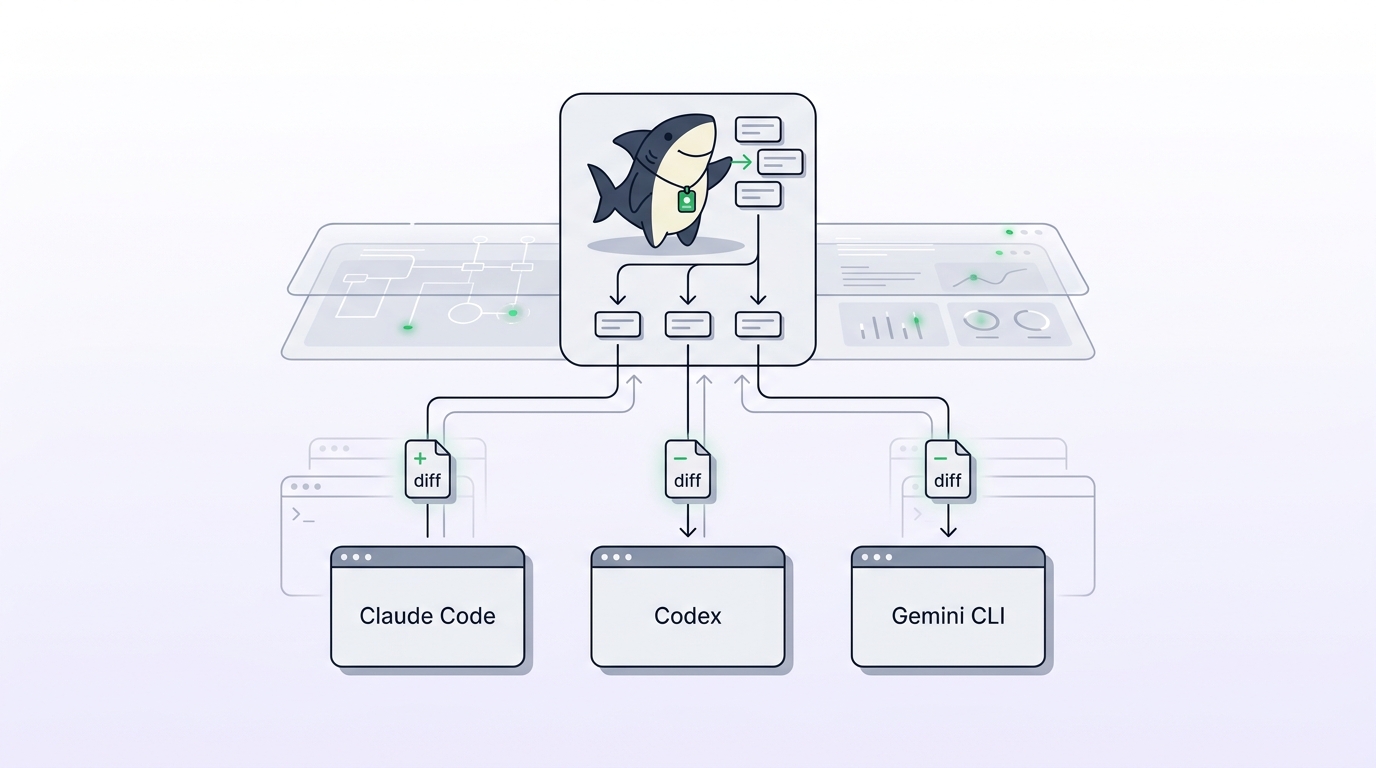
Sharkly is built for that coordination layer, and it is the workflow this article uses as the worked example. Sharkly does not write code and does not replace the agents you already run. It sits above them: you keep Claude Code and Codex, and Sharkly manages the tasks, context, progress, blockers, results, and human review around them. The rest of this piece explains what “management” means at this altitude and how to tell whether you need it yet.
What coding agent management means
Coding agent management is the practice of assigning, tracking, isolating, and reviewing the work of multiple AI coding agents from one shared place instead of one terminal per agent. It is a layer, not a tool that competes with the agents underneath it.
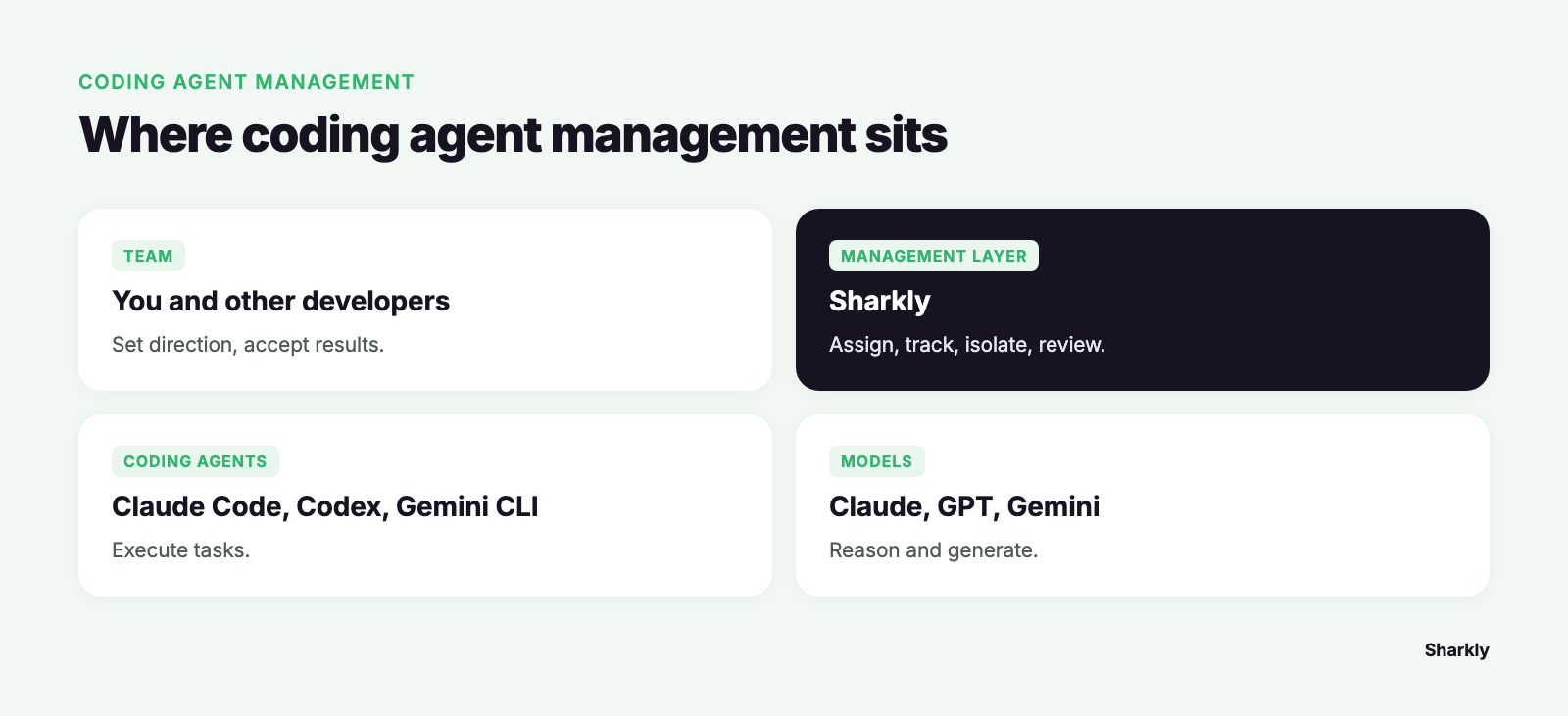
The stack is easier to reason about top to bottom:
Models            Claude / GPT / Gemini            (reason and generate)
Coding agents     Claude Code / Codex / Gemini CLI (execute tasks)
Management layer  Sharkly                          (assign, track, isolate, review)
Team              you and other developers          (set direction, accept results)
Each row has one job. The model reasons. The coding agent turns a request into edited files, run commands, and a diff. The management layer decides which agent gets which task, keeps their changes from colliding, and holds the record everyone reviews against. You set direction and accept the result. When people describe agents as workers rather than autocomplete, this is the org chart they are reaching for, and the management layer is the part that has been missing from most setups.
The reason the layer is separate matters. A coding agent is stateless about your other agents. Claude Code has no idea Codex is editing the same file two directories over. Managing that is not the agent’s job, and asking one agent to babysit the others only moves the chaos around.
The problem the tools below you don’t solve
Run the honest inventory of a busy afternoon with three or four agents going: which agent is working on what, which one should get the next task, what has finished, what failed, and what needs a human before it merges. Add the mechanics underneath: multiple terminals, multiple worktrees, multiple branches, multiple repositories, and multiple subscriptions billing in the background.
None of that is a failure of Claude Code or Codex. It is the cost of running several capable executors at once with nothing above them. The work is real, it is happening in parallel, and it is invisible. You find out an agent went down a wrong path when you finally switch to its window, not when it happened.
This is the enemy worth naming: not a rival product, but agent chaos. The moment your workflow starts to look like a wall of terminals you are afraid to close, you have outgrown running agents one at a time. Most developers hit this while trying to run multiple Claude Code agents or run Claude Code and Codex together on one codebase, and the management problem shows up before the productivity win does.
What the management layer is responsible for
Strip the layer down to its jobs and it has four: assignment, isolation, visibility, and review. Getting these right is most of what AI agent orchestration means in practice.
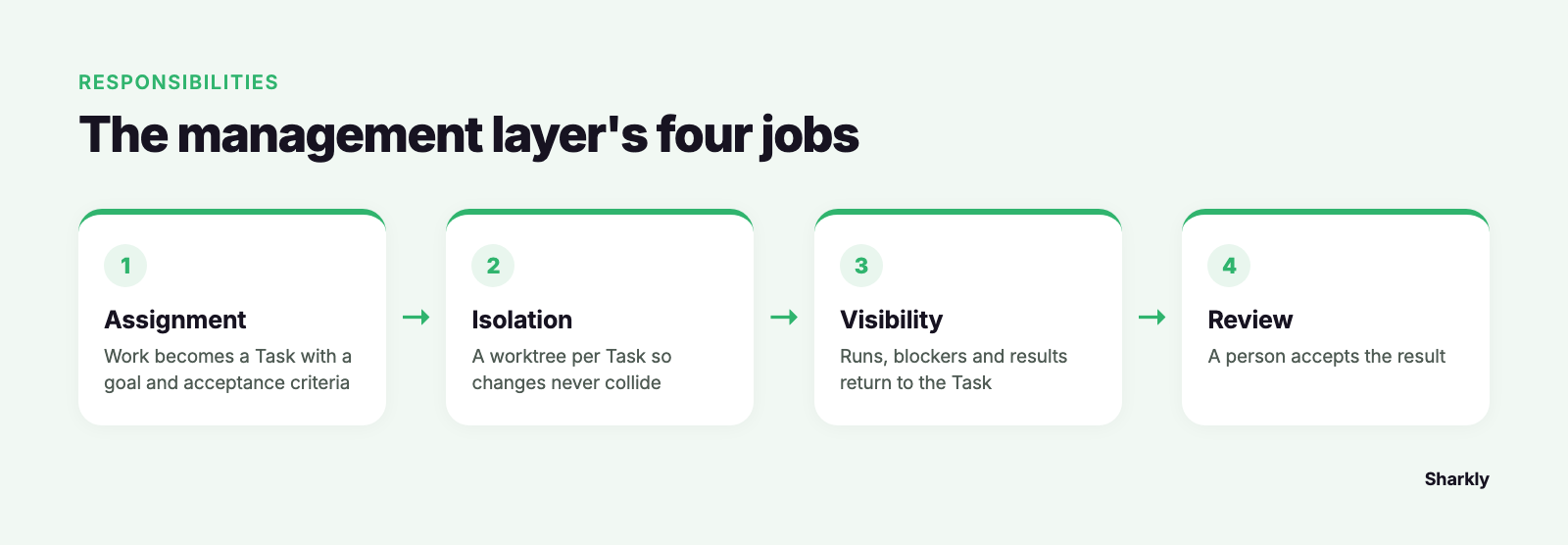
Assignment. Work becomes a Task, and the Task is the unit you hand to an agent, not a prompt you paste into whichever terminal is focused. A Task carries its own goal, context, and acceptance criteria, so the agent starts from the current state of the work instead of an empty chat.
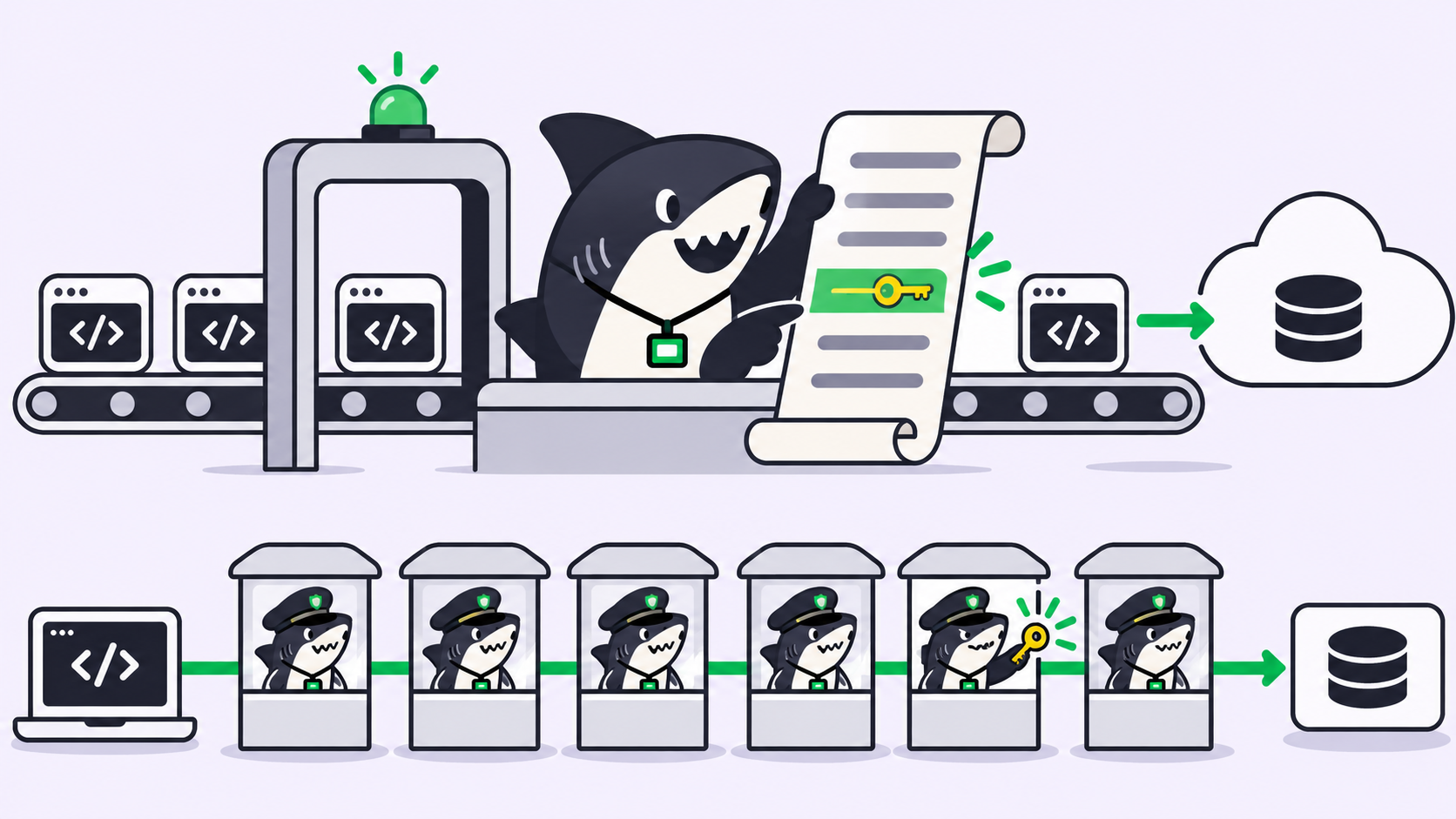
Isolation. Two agents editing one repository is fine until both touch the same files. The fix is a worktree per Task, so each agent gets its own checkout and their changes never collide mid-run. You can wire this up yourself with Git; the management layer’s job is to create, track, and clean up those isolated worktrees so you are not doing it by hand.
Visibility. Execution, blockers, results, and the follow-up discussion return to the Task timeline instead of scrolling past in a terminal you have since closed. One place answers “what is every agent doing right now,” which is exactly what an agent dashboard should show you.
Review. Agents research, execute, test, and report. People set direction, grant authority, and accept the result. The management layer’s most important boundary is that automation stops where team judgment is required: an agent can prepare a change, run the tests, and attach the evidence, but a person decides the merge. That human-in-the-loop checkpoint is a feature, not a slowdown.
Here is the honest decision pair. If you use one coding agent, work in one terminal, and finish a task before starting the next, you do not need a management layer, and adding one is overhead you will resent. The equation changes the moment you are running two or more agents across several tasks, worktrees, or repositories, or the moment a second person needs to see what the agents did. That is where the layer starts paying for itself.
Coding agent management with Sharkly
Sharkly is the management layer in this example, so here is the concrete shape of it.
You connect a Computer, which is any machine (your laptop, a server, or both) where an agent session can run. You define an Agent, which is a reusable configuration for how work should be handled, not a new model. You keep bringing your own subscriptions: model usage still runs through the Claude Code, Codex, or Gemini accounts you already pay for. Sharkly coordinates; it does not resell inference.
Then you assign a Task. Say SH-312 is “fix the flaky checkout test and add coverage.” You hand it to an Agent backed by Claude Code, or split a larger goal across a Crew where a leader Agent interprets the scope and brings other Agents’ results back into one Task. The Task runs in its own worktree on a connected Computer. While it runs, its progress, blockers, and diff return to the Task timeline. When it finishes, the Agent attaches the change summary, the test results, and the known limits, and the Task sits in review. You read it, request changes, or accept the merge.
Nothing about that flow asks you to give up Claude Code or Codex. You are routing the agents you already use through one workspace so the work is assignable and traceable instead of scattered across private terminals. If you want the full landscape of options here, we compared the tools for managing parallel coding agents rather than pretending one workflow fits everyone.
Why the layer matters more than which agent wins
Here is a prediction, labelled as a prediction: the “best coding agent” will keep changing, and betting your workflow on the current winner is the fragile move. Claude Code, Codex, Gemini, and whatever launches next will trade the lead task by task and quarter by quarter. Building your entire process around one of them means rebuilding it every time the ranking shifts.
The management layer is the part that survives that churn. If your tasks, context, isolation, and review live above the agents, you can swap which agent executes a given Task without touching how your team assigns and reviews work. Provider neutrality is not a feature checkbox; it is insurance against a market that reshuffles every few months.
None of this claims Sharkly writes better code than the agents it manages. It does not. The agents execute; the layer coordinates. The bet worth making this quarter is not on a single agent but on the workflow around all of them: pick the tasks you would run in parallel anyway, and put a real management layer above them before the terminal count gets away from you.
If you are already running several coding agents, Sharkly gives you one place to assign their tasks, isolate their work, and review their results. You can build most of this yourself with worktrees and discipline, or you can run your existing coding agents through Sharkly and let the layer handle the coordination.