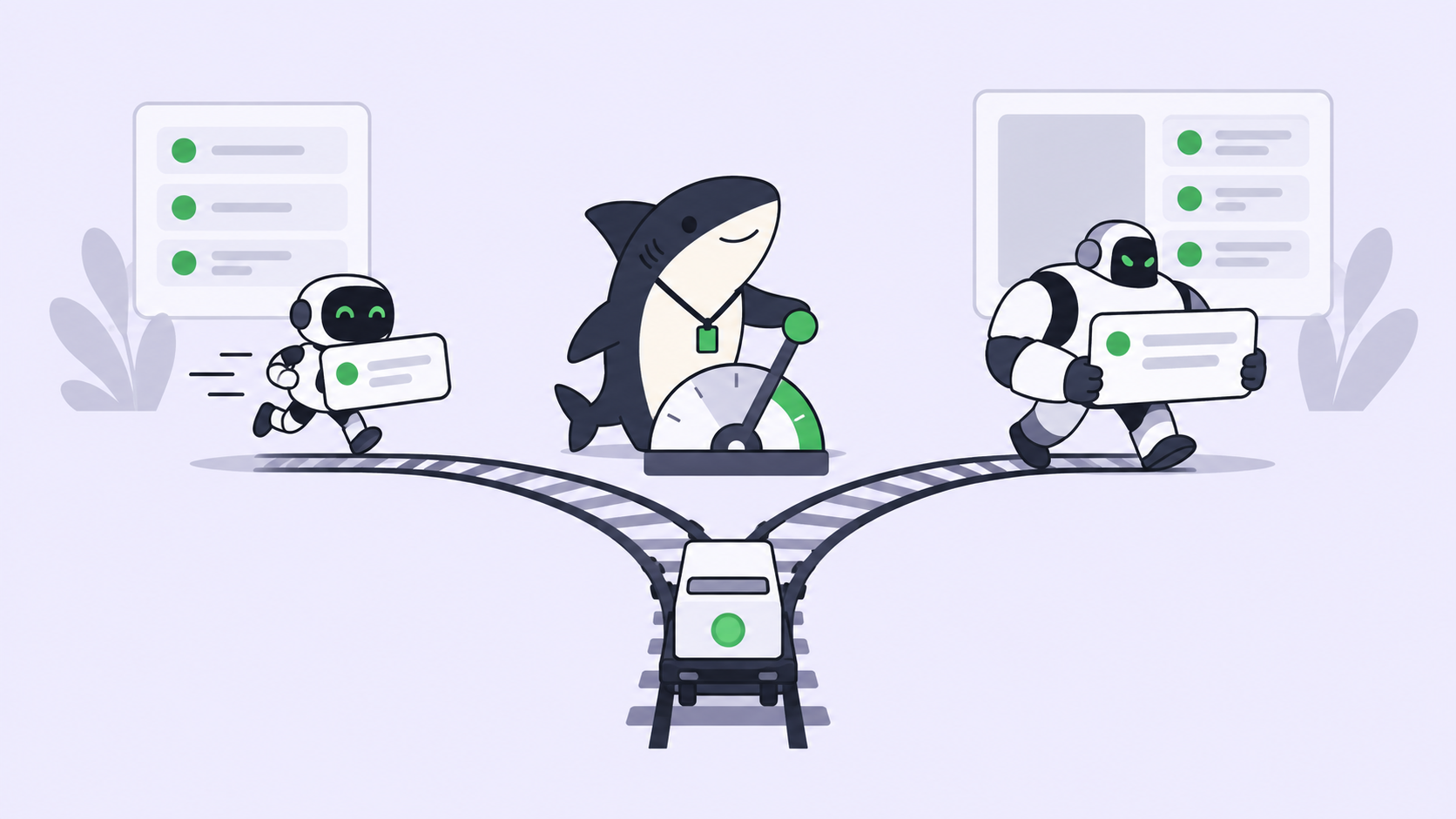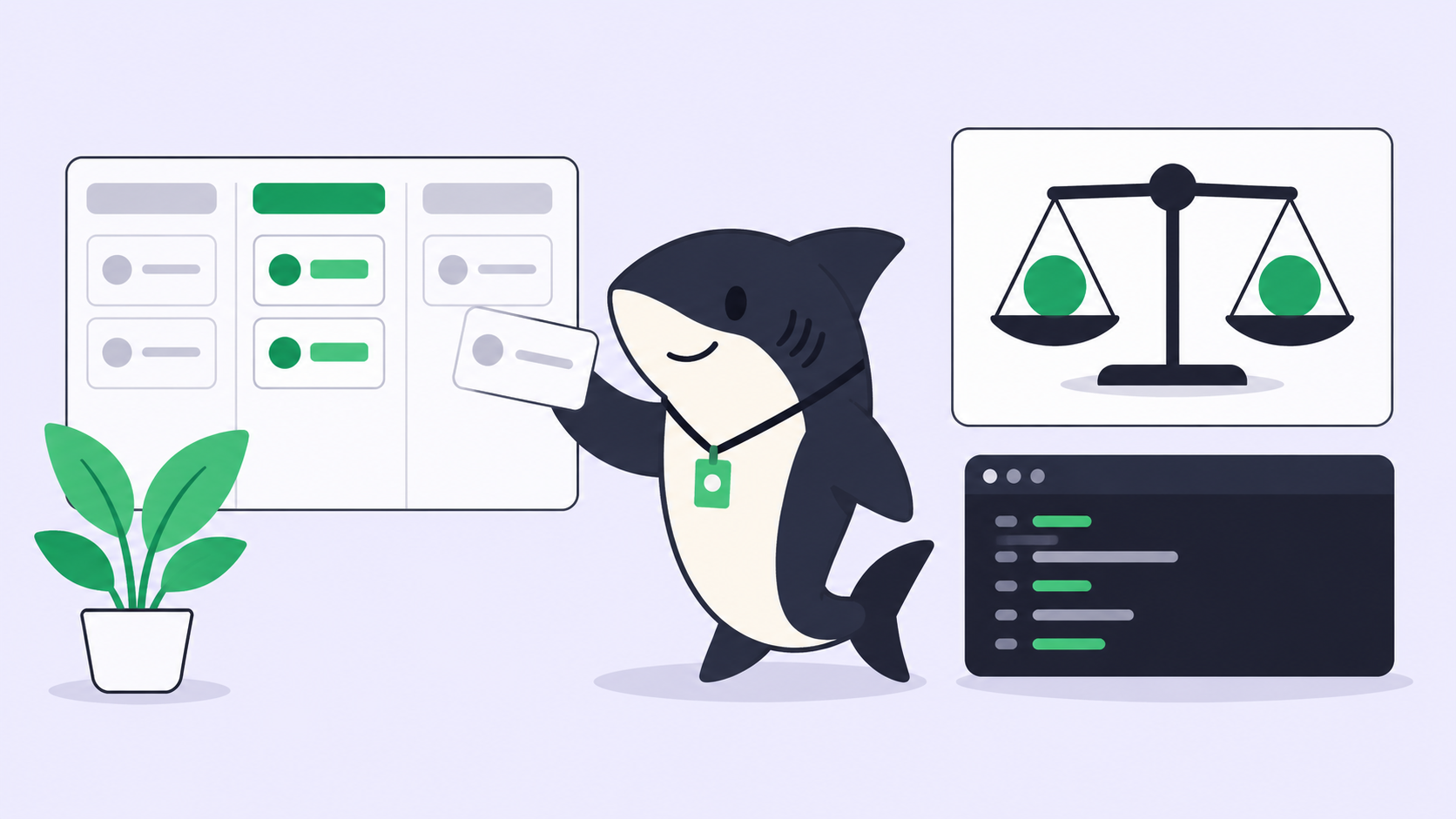
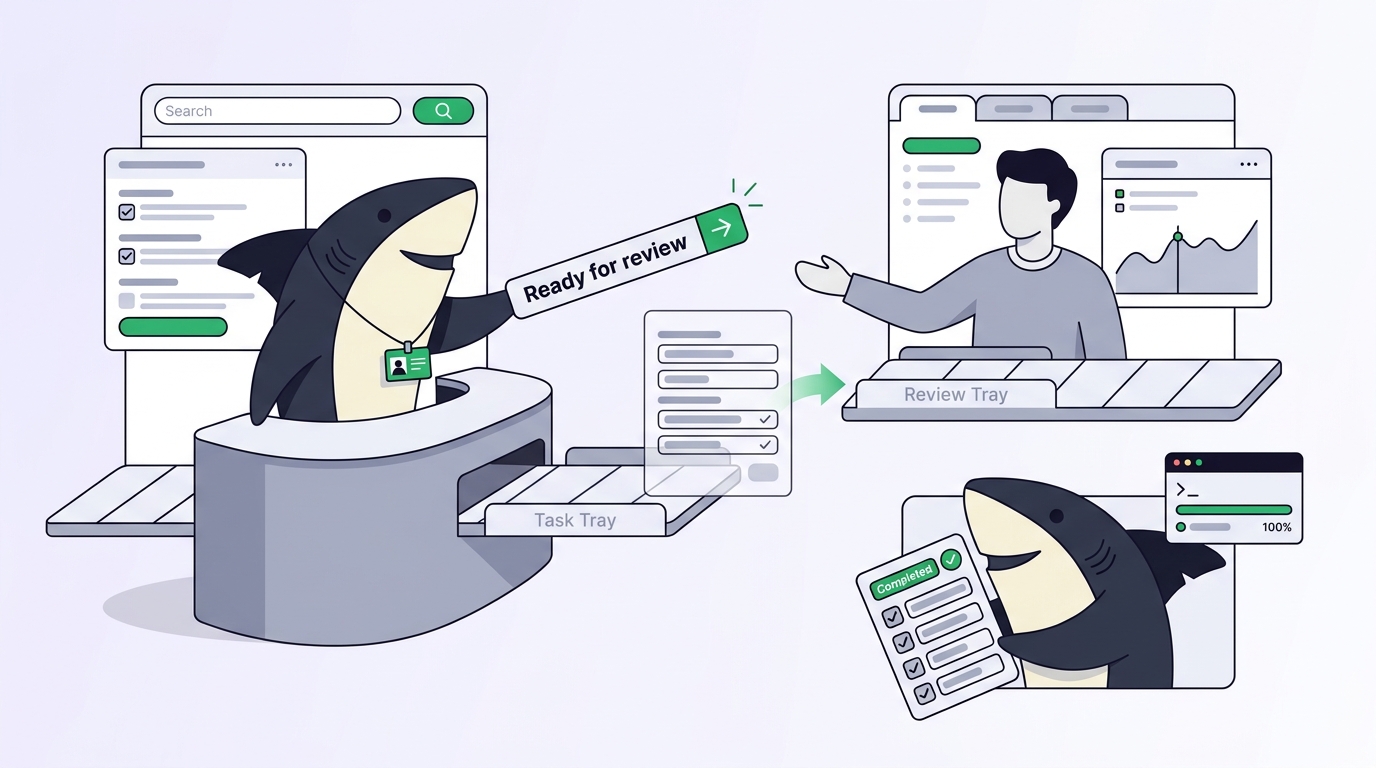
Every time a coding agent finishes a task, the same gap opens up. You get a diff and a cheerful “done,” but not what changed, what got skipped, what was tested, or what the agent is still unsure about. So you re-read the diff, re-run the tests yourself, and re-ask questions the agent could have answered when it handed the work back. Run two agents and that cost doubles. The work isn’t the problem. The handoff is: what moves between the person who asked and the agent that did it, and what comes back.
A coding-agent handoff template is a fixed structure for what a task carries when it changes hands: from a person to an agent at assignment, and from an agent back to a person at review. Instead of improvising the shape of every transfer, you fill the same fields every time. The agent knows what “done” means before it starts, and you get the same summary, evidence, and open questions when it stops.
This article walks through the two templates that hold up in practice, using Sharkly as the workflow: the layer above your coding agents that keeps context, progress, blockers, results, and human review visible from request to release. You already have coding agents. Sharkly turns them into a team, and the handoff template is what makes each transfer a record instead of a guess.
What a coding-agent handoff template is
A handoff template is a checklist made structural. It answers three questions a bare diff never does: what was asked, what happened, and whose turn it is now. When those three travel together, the next worker reads one record instead of reconstructing three.
There are two handoffs worth templating, because they run in opposite directions and carry opposite things:
- Assignment handoff (person or leader Agent, to an Agent): the goal, the boundaries, and the definition of done, handed down before work starts.
- Review handoff (Agent, back to a person): the change, the evidence it works, and the parts a human still has to judge, handed up when work stops.
Templating both is the point. Most teams write a rough ticket and template nothing on the way back, so every review starts as an interrogation. Fixing the return trip is where the time is.
The operating model the template encodes
A template is only as good as the operating model underneath it. Four verbs decide who owns each seam: who assigns, who runs, who reviews, who accepts. Agents research, execute, test, and report. People set direction, grant authority, and accept the result. Automation stops where team judgment is required.
That contract is why the two templates carry different fields. An Agent should never guess what acceptance looks like, so the assignment template forces the asker to write it down. A person should never guess whether green means safe, so the review template forces the Agent to show its work. Here is the assignment handoff as a copy-paste block:
## Assignment handoff
Task ID:        SH-###
Goal:           one sentence, in plain language
In scope:       the specific files, endpoints, or behaviors to touch
Out of scope:   what to leave alone (auth, billing, public contracts)
Definition of done:
  - [ ] observable acceptance criterion 1
  - [ ] observable acceptance criterion 2
Constraints:    frameworks, patterns, or limits to respect
Assignee:       the exact Agent that owns this
The “out of scope” and “definition of done” lines do the heavy lifting. Without them an agent optimizes for a passing diff, not for the outcome you meant. With them, the acceptance check is written before a single line of code exists.
The review handoff: what comes back
The return template is the one most workflows skip, and the one that saves your afternoon. When an Agent finishes, it should not ping you with “ready” and a link. It should hand back a filled structure:
## Review handoff
Task ID:        SH-###
Summary:        what changed, in 2-3 sentences
Acceptance:     each definition-of-done item, checked with how it was verified
Tests:          typecheck / unit / build results, pasted or linked
Diff:           the PR or worktree branch
Known limits:   what this does NOT cover, and any risky assumption
Open questions: decisions left for a human
The “known limits” and “open questions” fields are what separate a real handoff from a wall of green checkmarks. An honest limit (“the Redis counter assumes a single region”) turns a blind merge into an informed one. This is the same principle behind reviewing AI-generated code with task-level evidence: the reviewer reads a claim plus its proof, not a diff plus a hope.
A boundary worth stating plainly: the review handoff is not a request to merge. It is a request to review. The Agent presents; the person decides. Keeping those two acts separate is what stops unreviewed work from shipping.
Statuses and review gates: where the template lives
A template that lives in a scrollback buffer is a template nobody reads. The handoff has to be attached to something shared, and statuses are the natural home. Every Task moves through one lane, and each status change is a handoff with its template attached:
| Status | Owner | Template attached |
|---|---|---|
| Todo | Person or leader Agent | Assignment handoff |
| In progress | Agent | (working in an isolated worktree) |
| Ready for review | Agent | Review handoff |
| Done | Person | acceptance note + merge decision |
The rule that makes this legible: Agents move a Task to Ready for review; People move it to Done. An Agent never marks its own work Done, and a person never has to reconstruct what happened, because the review handoff is already on the Task. In Sharkly, execution, blockers, results, and follow-up discussion return to the Task timeline, so when ten agents are running you read the board, not ten terminals. That is the difference between tracking what agents completed and hoping a commit log explains it later. Where autonomous work must stop is itself a design choice, covered in where to place approval gates.
A worked example: from ticket to merged PR
Take a real-shaped Task, SH-441: “Add CSV export to the reports page.” Watch the templates fill in, not the code.
A person opens SH-441 and a leader Agent completes the assignment handoff: goal (“let users download the current report as CSV”), in scope (the reports controller and one new export module), out of scope (auth, the existing report queries), and a definition of done with three checkable items (a download button, correct escaping for commas and quotes, a test with a 10k-row fixture). The Assignee is a backend Agent. Nothing is ambiguous, because the template refused to let it be.
The backend Agent claims the Task, works in an isolated worktree so it never collides with other work, and runs the definition-of-done items as its own checklist. When typecheck, the unit tests, and the build are green, it moves SH-441 to Ready for review with the return template filled: a short summary, each acceptance item checked with how it was verified, the diff, and one known limit (“exports over 100k rows buffer in memory; streaming is not implemented”).
Now the handoff flips direction. A person reads one record, not a scrollback. They confirm the escaping test, weigh the memory limit against real report sizes, accept it for now, and move SH-441 to Done, which triggers the merge. Ticket to merged PR, with a filled template at both seams and a record of who owned each. This is the requirements-to-code path made traceable end to end.
When a template is overkill
Templates have a cost, so here is the honest decision pair. Skip the full template for small, well-defined work one Agent finishes in a single pass, where the goal and the acceptance are obvious from the Task title. Reach for it the moment work crosses a seam that matters: multiple agents on one goal, a change to a public contract, or anything touching auth, billing, or data you cannot easily un-ship. A template is insurance against dropped context, and you buy insurance where the loss would hurt.
You can run all of this by hand with a shared board and discipline. That works until the number of agents, tasks, and repositories climbs and the discipline is the first thing to go. If you’re already running several agents, Sharkly gives you one place to manage their tasks and results: shared Tasks that carry the assignment and review handoffs, per-Task Assignees, isolated worktrees, and a status lane where Agents reach Ready for review and People decide Done. Keep the coding agents you already use. Download Sharkly when the seams between them start costing more than the work.
FAQ
What is a coding-agent handoff template? It’s a fixed structure for what a task carries when it changes hands. There are two: an assignment handoff (goal, scope, and definition of done, from a person to an Agent) and a review handoff (summary, evidence, and known limits, from an Agent back to a person). Filling the same fields every time is what keeps context from evaporating between workers.
Why template the return trip and not only the ticket? Most teams write a ticket and template nothing on the way back, so every review starts as an interrogation. The review handoff, with its summary, checked acceptance items, and known limits, is where a template saves the most time. See human-in-the-loop coding agents.
Should an agent mark its own work as done? No. Let an Agent move a Task to Ready for review with the return template filled; leave the move to Done, and the merge decision, to a person. Separating “presented” from “accepted” is what stops unreviewed code from shipping.
Where should the template live? On a shared Task, attached to a status change, not in a terminal only one agent saw. When the handoff is a status with its template attached, the next worker sees exactly what’s waiting on them. This also keeps review from becoming the bottleneck when many agents finish at once.
Do I need a tool for this, or can I do it manually? You can run it with a shared board and discipline. A dedicated layer pays off once you coordinate multiple agents across multiple repositories and manual tracking becomes the work. Compare it against a general-purpose AI task manager for agent work.